

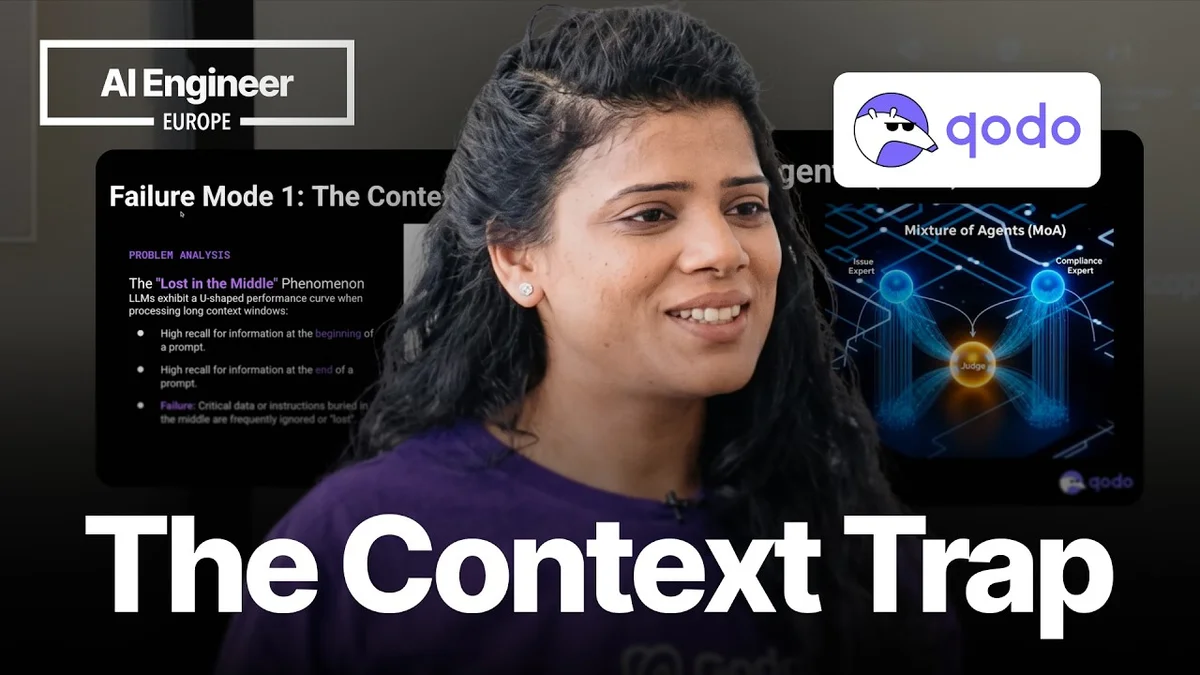
AI Agents Get Dumber With More Context, Expert Warns

Nupur Sharma of Qodo explains how too much context can hinder AI agents, leading to the 'lost in the middle' problem, and discusses solutions like context engines and hybrid orchestration.

9 min read
Nupur Sharma presenting on a stage with a slide showing 'Hidden Failure Modes for AI Agents'
Nupur Sharma, Solutions Architect at Qodo, presenting on the challenges of context in AI agent development.· AI Engineer

In the rapidly evolving world of AI, the quest for more capable and intelligent agents is constant. However, a recent presentation by Nupur Sharma, Solutions Architect at Qodo, highlighted a counterintuitive challenge: sometimes, more context can actually make an AI agent dumber. Sharma's talk, titled "Why More Context Makes Your Agent Dumber and What to Do About It," explored the pitfalls of simply overwhelming AI models with data and offered practical solutions for optimizing their performance.
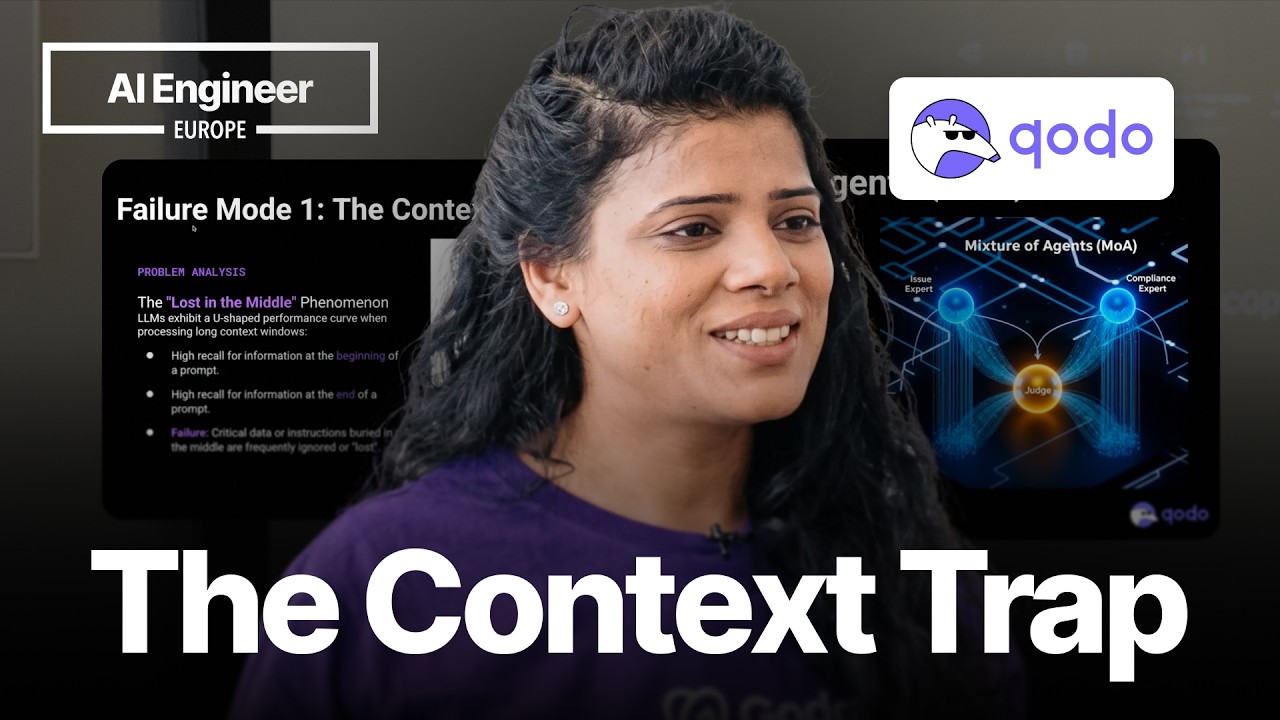
AI Agents Get Dumber With More Context, Expert Warns - AI Engineer
AI Agents Get Dumber With More Context, Expert Warns — from AI Engineer

Visual TL;DR. Too Much Context causes 'Lost in the Middle'. 'Lost in the Middle' leads to Dumber AI Agents. Context Optimization includes Context Engines. Context Engines enables Enhanced Performance. Hybrid Orchestration uses Multi-Agent Architectures. Multi-Agent Architectures improves Enhanced Performance.

  1. Too Much Context: overwhelming AI models with excessive data can be detrimental
  2. 'Lost in the Middle': LLMs struggle to recall info buried deep within long contexts
  3. Dumber AI Agents: performance degrades as context window size increases
  4. Context Optimization: strategies to manage and refine AI context effectively
  5. Context Engines: tools to intelligently select and present relevant context
  6. Hybrid Orchestration: combining different AI approaches for better performance
  7. Multi-Agent Architectures: systems with multiple specialized AI agents working together
  8. Enhanced Performance: achieving more intelligent and capable AI agents
Visual TL;DR
Visual TL;DR — startuphub.ai Too Much Context causes 'Lost in the Middle'. 'Lost in the Middle' leads to Dumber AI Agents. Context Engines enables Enhanced Performance. Multi-Agent Architectures improves Enhanced Performance causes leads to enables improves Too Much Context 'Lost in the Middle' Dumber AI Agents Context Engines Multi-Agent Architectures Enhanced Performance From startuphub.ai · The publishers behind this format
Visual TL;DR — startuphub.ai Too Much Context causes 'Lost in the Middle'. 'Lost in the Middle' leads to Dumber AI Agents. Context Engines enables Enhanced Performance. Multi-Agent Architectures improves Enhanced Performance causes leads to enables improves Too Much Context 'Lost in theMiddle' Dumber AI Agents Context Engines Multi-AgentArchitectures EnhancedPerformance From startuphub.ai · The publishers behind this format
Visual TL;DR — startuphub.ai Too Much Context causes 'Lost in the Middle'. 'Lost in the Middle' leads to Dumber AI Agents. Context Engines enables Enhanced Performance. Multi-Agent Architectures improves Enhanced Performance causes leads to enables improves Too Much Context overwhelming AI models with excessive datacan be detrimental 'Lost in the Middle' LLMs struggle to recall info buried deepwithin long contexts Dumber AI Agents performance degrades as context windowsize increases Context Engines tools to intelligently select and presentrelevant context Multi-Agent Architectures systems with multiple specialized AIagents working together Enhanced Performance achieving more intelligent and capable AIagents From startuphub.ai · The publishers behind this format
Visual TL;DR — startuphub.ai Too Much Context causes 'Lost in the Middle'. 'Lost in the Middle' leads to Dumber AI Agents. Context Engines enables Enhanced Performance. Multi-Agent Architectures improves Enhanced Performance causes leads to enables improves Too Much Context overwhelming AImodels withexcessive data can… 'Lost in theMiddle' LLMs struggle torecall info burieddeep within long… Dumber AI Agents performancedegrades as contextwindow size… Context Engines tools tointelligentlyselect and present… Multi-AgentArchitectures systems withmultiplespecialized AI… EnhancedPerformance achieving moreintelligent andcapable AI agents From startuphub.ai · The publishers behind this format
Visual TL;DR — startuphub.ai Too Much Context causes 'Lost in the Middle'. 'Lost in the Middle' leads to Dumber AI Agents. Context Optimization includes Context Engines. Context Engines enables Enhanced Performance. Hybrid Orchestration uses Multi-Agent Architectures. Multi-Agent Architectures improves Enhanced Performance causes leads to includes enables uses improves Too Much Context overwhelming AI models with excessive datacan be detrimental 'Lost in the Middle' LLMs struggle to recall info buried deepwithin long contexts Dumber AI Agents performance degrades as context windowsize increases Context Optimization strategies to manage and refine AI contexteffectively Context Engines tools to intelligently select and presentrelevant context Hybrid Orchestration combining different AI approaches forbetter performance Multi-Agent Architectures systems with multiple specialized AIagents working together Enhanced Performance achieving more intelligent and capable AIagents From startuphub.ai · The publishers behind this format
Visual TL;DR — startuphub.ai Too Much Context causes 'Lost in the Middle'. 'Lost in the Middle' leads to Dumber AI Agents. Context Optimization includes Context Engines. Context Engines enables Enhanced Performance. Hybrid Orchestration uses Multi-Agent Architectures. Multi-Agent Architectures improves Enhanced Performance causes leads to includes enables uses improves Too Much Context overwhelming AImodels withexcessive data can… 'Lost in theMiddle' LLMs struggle torecall info burieddeep within long… Dumber AI Agents performancedegrades as contextwindow size… ContextOptimization strategies tomanage and refineAI context… Context Engines tools tointelligentlyselect and present… HybridOrchestration combining differentAI approaches forbetter performance Multi-AgentArchitectures systems withmultiplespecialized AI… EnhancedPerformance achieving moreintelligent andcapable AI agents From startuphub.ai · The publishers behind this format

The Context Trap and the 'Lost in the Middle' Phenomenon

Sharma began by explaining a key failure mode she termed the 'context trap,' which is closely related to the 'lost in the middle' phenomenon observed in large language models (LLMs). This phenomenon describes how LLMs exhibit a U-shaped performance curve when processing long context windows. While they often recall information presented at the beginning and end of the context accurately, information buried in the middle is frequently ignored or 'lost.' This means that critical data or instructions, if placed in the middle of a lengthy context, are unlikely to be utilized by the agent, leading to suboptimal or incorrect outputs.

Related startups

Sharma illustrated this with a graph showing that as the number of retrieved documents (and thus context) increased, the accuracy of the LLM, even for models like Claude 1.3 and GPT-3.5, tended to dip for documents positioned in the middle of the context window. This poses a significant challenge for developers building AI agents that need to process and act upon extensive information, such as large codebases or complex datasets.

Strategies for Context Optimization

To combat this 'lost in the middle' problem, Sharma outlined several strategic solutions for context optimization:

  • Context Engine: This approach focuses on improving search and ranking logic to ensure the most relevant information is prioritized within the context window.
  • Hierarchical Summarization: By breaking down large amounts of text into summaries at different levels, this method aims to make crucial information more accessible.
  • Knowledge Graph: This involves structuring information in a graph format, which can help agents navigate complex logic and dependencies more effectively.
  • Iterative Retrieval: This strategy involves refining the retrieval process by allowing agents to re-query or re-fetch information based on intermediate results.
  • Self-Correction: Here, agents are designed to identify and correct their own errors, particularly in high-stakes tasks where accuracy is paramount.

Sharma noted that while these solutions vary in their effectiveness and implementation complexity, they all aim to make the context provided to AI agents more digestible and actionable.

The Orchestration Paradox and Hybrid Approaches

Moving on to another critical failure mode, Sharma discussed the 'orchestration paradox,' where the complexity of managing multiple agents can lead to 'reasoning drift' and 'dynamic loop degradation.' As agents become more sophisticated and capable of utilizing a wider array of tools, the risk of them entering infinite thinking loops or becoming overly reliant on tool execution, rather than solving the core task, increases. This can also lead to 'resource exhaustion,' where agents consume excessive API credits or computational power without delivering a meaningful outcome.

To address this, Sharma proposed an '80/20 Hybrid Orchestration' model. This approach suggests a division of labor: 80% of the agent's function should be dedicated to dynamic reasoning, allowing it to explore and use tools flexibly for non-critical subtasks and general logic. The remaining 20% should be reserved for 'hard-gated nodes,' which enforce deterministic logic for high-risk steps such as final validation, summarization, or critical security checks. This hybrid model aims to balance flexibility with the necessary rigor for critical operations.

Multi-Agent Architectures for Enhanced Performance

Sharma also touched upon the concept of 'multi-agent architectures' for specific tasks like code review. In such systems, multiple specialized sub-agents work in parallel, each focusing on narrow domains to avoid instruction dilution. For instance, one agent might focus on identifying bugs, another on style, and a third on security. A central 'judge agent' then curates the findings from these specialized agents, prioritizing them based on team needs and de-duplicating insights to produce a final, high-precision output. This approach, Sharma suggested, can significantly improve accuracy by leveraging specialized expertise within a coordinated system.

The presentation underscored the critical need for thoughtful engineering in building AI agents, emphasizing that simply increasing context or complexity does not always lead to better performance. Instead, a nuanced approach to context management, agent orchestration, and specialized task delegation is crucial for unlocking the true potential of AI in practical applications.

© 2026 StartupHub.ai. All rights reserved. Do not enter, scrape, copy, reproduce, or republish this article in whole or in part. Use as input to AI training, fine-tuning, retrieval-augmented generation, or any machine-learning system is prohibited without written license. Substantially-similar derivative works will be pursued to the fullest extent of applicable copyright, database, and computer-misuse laws. See our terms.