
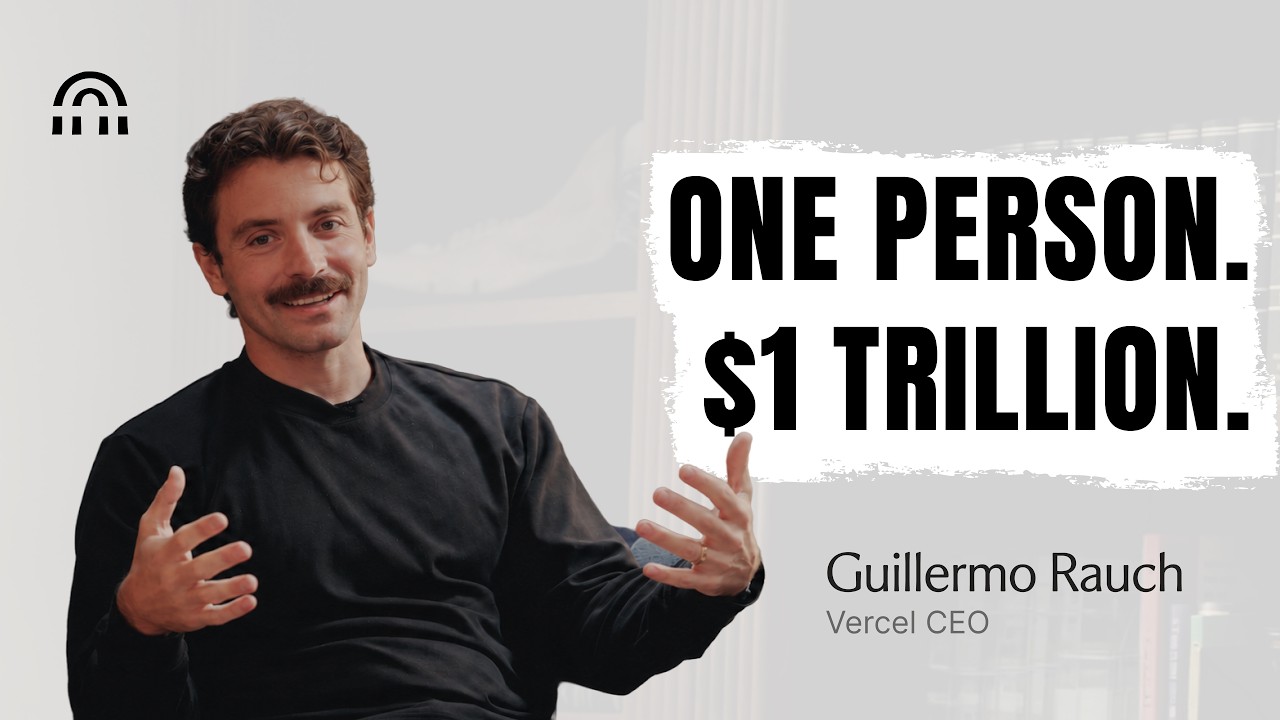
Delphi asked Guillermo Rauch how small a giant company can get. Rauch, chief executive of Vercel, answered that his platform could host the first single-person trillion-dollar company.
I think he is half right, and the more important half is not the headcount.
The bet is that one human plus agents does the work of hundreds or thousands, and that Vercel becomes the cloud layer that makes that staffing curve real. Rauch told Delphi, "My hope is that on Vercel we'll see maybe one day the single-person trillion-dollar company." It is a deployment pitch disguised as a labor forecast.
Rauch tied that future to trust. He told Delphi, "Trust is going to be one of the most valuable moats, you could call it, for a post-AGI business." Then he added the sharper line, "Trust is an output, not an input."
That framing matters because Vercel sells to builders who do not buy trust, they test it. Rauch used a gym metaphor to make the point, "your abs are made in the kitchen," meaning brand comes from foundational work, not surface campaigns. He said the best brand moves Vercel made were not labeled brand work at all, but sweat over customer experience and delightful details. The implication for any team shipping agent-built products is direct. If five or seven scattered interactions create trust, as Rauch put it, agents multiplying your touchpoints multiplies the places you can break it.
The daily brief
Get the free daily brief with the day's AI news, new AI startups and funding rounds every morning.
Join 11,990 subscribers.
Vercel wants that multiplication to happen on its rails. The company, founded around Next.js and frontend cloud infrastructure, now positions what Rauch called a "fluid computer" as core architecture. He described it to Delphi as scaling to zero, with no memory or CPU allocated when idle, and scaling to saturate 20 different regions when demand spikes. The pitch is old in one way. He called the cloud one of humanity's greatest achievements for its infinite compute. The new part is who consumes it.
That new customer is the agent. Rauch said agents are becoming a thousand-choice decision layer, and humans will delegate more decisions to them. In his ideal, agents choose the best products and create what he called the most liquid discovery system, the epitome of capitalism. Vercel's bet is that if agents pick tools on merit, a good product wins without persuasion. That is a clean theory. It also means every product team has to rebuild for an evaluator that is not human.
This is where workflow and budget change. Rauch said the best architecture now is an API that expresses data, captures intent, is easy to audit, and is secure. He argued coding agents have already persuaded the world to build in that direction, and he was blunt about tooling that does not. Tools that refuse to be agentic should be deleted, he said. He claimed the combination of a coding agent plus deployment on Vercel let the company delete four or five vendors. For engineering leaders, the message is that procurement is no longer just about human seats. It is about which services expose data and capability cleanly for agents to call.
The cost model changes with it. Rauch said humans' next big job will be capital allocation, deciding how to spend tokens and compute time across agentic tasks. Agents call APIs at a million times the rate a human would, he said, which increases the odds you hit scale. That is presented as validation, not a warning, but it is both. Infinite calls create infinite bills and infinite failure surfaces if rate limits, auth, and audit are not agent-ready on day one.
Rauch described the connective tissue as MCP, which he called almost like the new HTTP, a protocol for agents to speak. He also repeated a line he uses to collapse media and software, "Everything is code," arguing videos, images and math problems can be generated with code and that the coding agent is as miraculous for AGI as the browser was for the internet. The push is to normalize a stack where agents write the code, test it, and ship it to Vercel's fluid runtime without a human in the compile loop for every step.
There is a concession to make to Rauch's critics, and he made it himself. Fully autonomous businesses with CEO agents are possible for certain domains, he said, and he has invested in some building on Vercel. The qualifier matters. Agents have not solved open-ended management, taste, or trust recovery when they get something wrong. Rauch even noted agents will push back on chasing 100 percent optimization when they estimate 1,000 hours for the last point of gain, and will happily write two million garbage unit tests that check that 2 plus 2 equals 4 if not steered.
Vercel's go-to-market reflects that reality. Rauch said the company focuses on innovators and startups and then benefits from a trickle-up effect as ideas move to larger enterprises, sometimes via acquisition. He pointed to V0, the product that serves non-technical builders, and to Vercel.store, built with its Eve technology, as examples of lowering the bar while keeping the ceiling high. He wants technical and non-technical roles to merge into simply "builders." For buyers it means the pricing and packaging question is no longer abstract. V0 today is usage-based, with paid plans including a monthly credit balance and extra credits available for purchase, according to hosting listings. That credit model is how agent-driven creation gets metered when a high schooler and an enterprise team use the same canvas.
Rauch closed the loop with a personal note that explains his managerial stance. He called his six children "sub-agents" and said he wants them to find ikigai, the overlap of what the world needs, what they love, and what creates economic value, then harness agents to learn how to think. Five years ago he would have taught JavaScript first, he told Delphi. Now he preaches curiosity first, then amplification, using the personal computer and Google as precedent for what he calls power-ups of intellect and creativity. The throughline from that fire in San Francisco, which he called a true wake-up call while building his first startup, to his current doctrine is an insistence on foundations. The cloud may be infinite, but trust, auditability, and taste are not.
If you are deciding where to place next quarter's infra dollars, Rauch's argument asks you to fund agent-readable APIs before you fund more seats. I would tell a founder the same thing in plainer terms. Build for the customer who never sleeps and calls you a million times.



