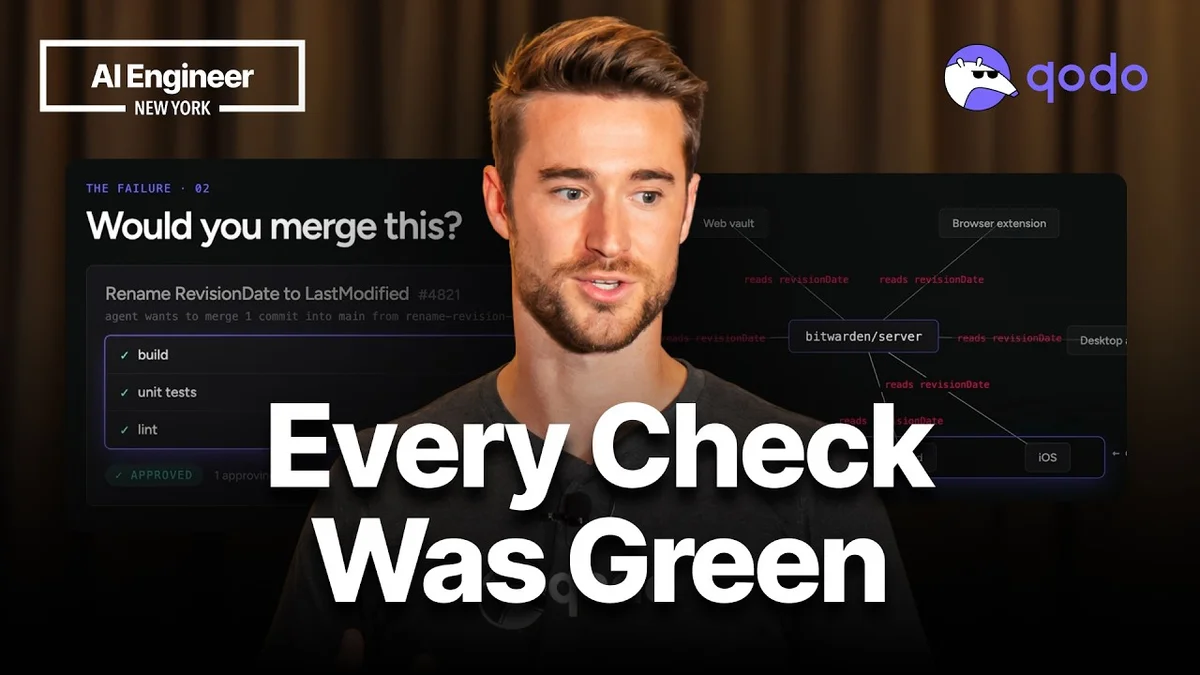
AI Engineer hosted Qodo solutions engineer Cole Gannaway as he demoed how a single-line data-model change can ripple across an entire product family. His example was Bitwarden, the open-source password manager, where one line touched the backend server and then the web client, mobile and iOS apps, MCP servers and CLI.
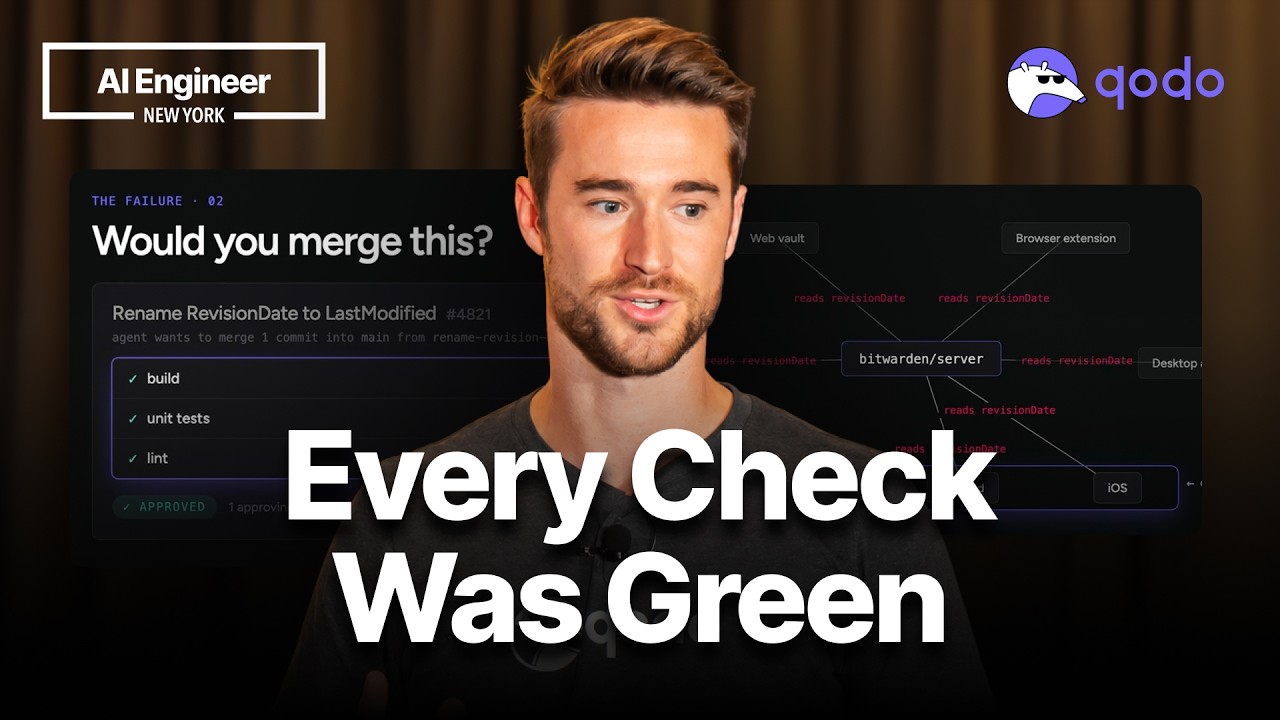
Green checks would have missed it.
Gannaway said that is the new bottleneck. Code generation is accelerating, he argued, but review is not keeping up, and teams that cannot read every changed line lean on builds, unit tests and linters that still pass when the blast radius is cross-repo. Qodo’s answer, as he presented it, is a review layer built on what he called context. That includes an automatically generated software graph and integration surface that maps which components actually connect, not just that repos are linked.
The pitch is to move that intelligence left of the pull request. Gannaway showed custom rules that flag public-API changes unless a deprecation is added, links to ticketing systems like Jira and Linear to check requirements coverage before code is generated, and periodic pre-PR reviews at roughly 25%, 50% and 75% of generation to keep an implementation agent from over-engineering or solving the wrong intent. He also argued for separating the writer from the grader, using an independent review agent with its own context window, model and harness, and even adversarial reviewers to compare findings.
What did not get a number is how well it works. Gannaway offered no defect-catch rate, no false-positive rate, no time-to-review comparison and no before-and-after data from customer software factories, and AI Engineer did not press for them in the segment. The demo leaned on an illustrative Bitwarden change, not a disclosed incident, and there was no CVE, patch or attacker model because this is not a vulnerability disclosure, it is a reliability failure that surfaces in production as crashes or broken clients.
The broader framing fits a pattern described outside the talk, where an AI software factory is a repeatable system that moves work from specification through testing and release and keeps control of each change once it reaches production, according to LaunchDarkly. Gannaway positioned Qodo as the trust and verification layer inside that factory, not the whole factory, with room to add ticket context, codebase wisdom and run-specific signals.
Until Qodo publishes controlled results on precision, recall and review latency, the claim that graph-aware review catches cross-repo breakage early remains plausible but unproven, and buyers will want to see it on their own repos, not a slide.