
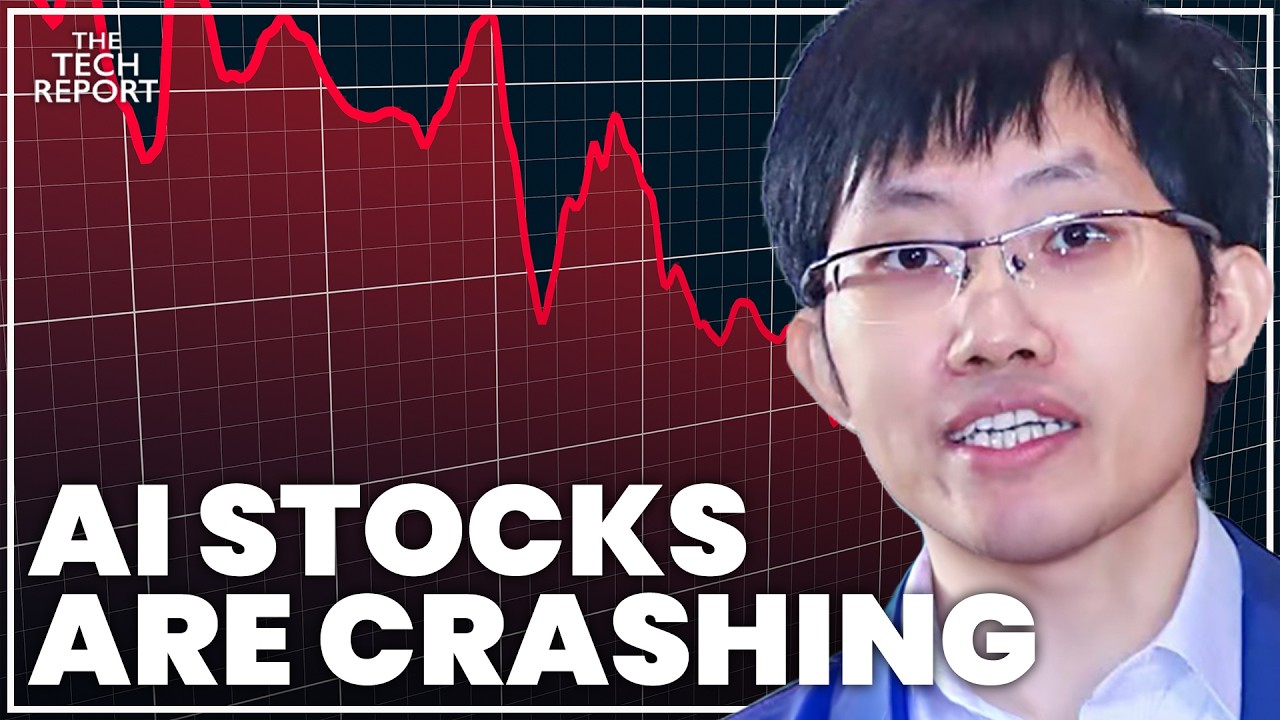
Dean Baker told The Tech Report that China's 12-week AI stock rout is a textbook bubble pop, and the math should worry the U.S.
The tell he kept coming back to was not the crash itself. It was that U.S. prices for computer technology are up 18% in the last year after decades of falling.
That matters because it shows AI investment is crowding out everything else, Baker said. When the private sector misprices a hot technology, he argued, resources get pulled in the wrong direction and the price signal itself becomes the warning.
The crash in China is stark on its own. The CSI 300, China's equivalent of the S&P 500, is down more than 20% since June, Baker said, with AI names that had swelled to about 42% of the entire market leading the fall. A Reuters estimate cited in the discussion put losses in the tech index at 40%, or about $480 billion, implying a total AI tech market cap around $1.2 trillion.
Baker's point was scale. He put the broad U.S. AI market, including adjacent giants like Amazon, at roughly $40 trillion. Anthropic alone expects to raise more than $1.2 trillion from its IPO, he noted, which would match the entire Chinese AI tech sector. On that math, China's AI capitalization is about one-thirtieth to one-fortieth the size of the U.S.
The daily brief
Get the free daily brief with the day's AI news, new AI startups and funding rounds every morning.
Join 64,000 other subscribers.
Smaller means contained. Host Isaac noted the fall hasn't hit like 2008 or the 2000-2002 dot-com bust, and Baker agreed. The Tech Report discussion framed the limited spillover as a function of segregation. U.S. investors are wary of irregularities and state control in China, so exposure stayed low despite the drawdown.
The mechanism that broke China looks familiar in the West. Baker pointed to a price war over tokens. Enterprise customers are balking at frontier model prices, he said, and Meta, OpenAI and Anthropic have cut prices to keep volume. Gary Marcus has predicted AI ends up like airlines, with razor-thin margins for everybody and zero loyalty, and Baker said he agrees. Companies are auditing AI spend like any other line item and hunting for cheaper substitutes.
You see it in the usage concentration. Baker cited data that about 1% of users drive 50% to 80% of AI spending, and that cohort is largely other AI companies. That left pocket, right pocket loop cannot sustain valuations, he said. Real revenue has to come from outside the AI cluster, from the other 493 names in the S&P 500.
This is where Torsten Slok's observation lands, Baker said. Outside the Magnificent Seven, Slok finds no revenue or productivity growth since AI arrived. Baker put it bluntly: "There's absolutely zero evidence it's the sort of sea change that the AI promoters are banking on. And unless it is, those stock prices don't make sense."
Infrastructure does not fix demand. China built computer corridors with dedicated energy very quickly, solving the bottleneck that now slows U.S. data center builds, Baker said. Yet its AI market still crashed. He read that as a demand problem, not a power problem. In the U.S., local opposition and higher build costs might actually help by slowing a rush into bad bets.
The U.S. risk is consumption. Third quarter GDP showed consumption growing at a 3.8% annual rate, Baker said, driven by wealth effects from stocks. A sharp pullback would hit spending fast. China is a mirror image and not a parallel, he added. Its economy is still dragging after a much larger housing bust, and Beijing has been reluctant to use social spending to lift demand.
Baker, Senior Distinguished Fellow at the Center for Economic Policy and Research in Washington, offered three takeaways. First, it was a bubble driven by irrational exuberance. Second, the dollar losses, while large in absolute terms, are small versus the U.S. Third, the technology does not die with the bubble. China's AI industry is still going strong, he said, the way the internet kept spreading after 2000.
He even called the Chinese bust potentially healthy, if it forces more measured development and proper pricing. Until AI proves real uses for firms outside tech, the pricing war and the concentration of spend among AI firms themselves will decide margins more than any new model release.



