

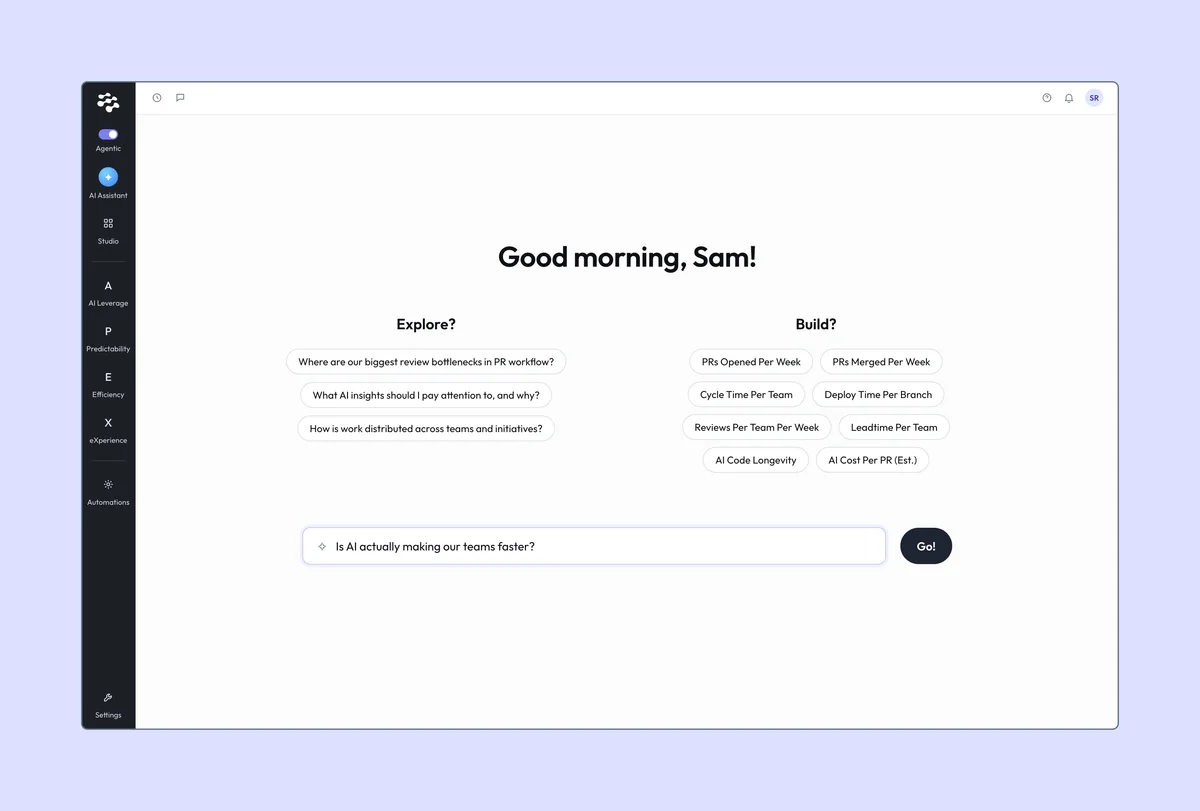
LinearB launched Agentic Studio to turn everything it already collects across the software delivery lifecycle into plain language answers for leaders and callable context for coding agents.
The obvious reading is that productivity platforms have graduated from dashboards to direction, and LinearB says context is now king. I am not convinced the product has graduated yet, because the part that actually acts is still gated. The Studio itself is available to all LinearB customers, but its agent skills are in early access, and the first skill that matters most is unproven outside LinearB’s own data.
LinearB’s claim is clear and fairly stated before you poke it. The company says it normalizes data from Git and project management tools into one model, links identities, traces every change from ticket to release, and layers AI attribution and benchmarks on top, then delivers that as an engineering context layer. Leaders can ask where delivery is stuck and get a next step, not a chart, and can pull the same context into tools like Claude through MCP. Agents get that context the same way, so they do not start each task blind.
The first agent skill is the test of that story. LinearB says its effort skill gauges a change’s business relevance, complexity and risk using code quality in the area, recent service incidents and ownership history, then routes low risk changes to lighter, cheaper edits and pushes complex or high priority work to more careful, tested edits. Leaders can see how often agents were routed to low, medium and high effort, and the skill works with any coding agent. LinearB has not disclosed pricing, token savings in production, or independent results for the skill, and more skills for review and merge are still on the way.
What LinearB can show is why acting matters at all. Its 2026 AI benchmarks covering 2.7 million pull requests across more than 250 organizations found heavy AI users nearly doubled merged pull requests year over year, according to the company. Its separate 2026 Software Engineering Benchmarks Report found AI assisted pull requests were 2.6 times larger than unassisted ones at the 75th percentile, and agent pull requests waited more than five times longer for review.
The daily brief
Get the free daily brief with the day's AI news, new AI startups and funding rounds every morning.
Join 64,000 other subscribers.
The deeper benchmark the company released with the launch makes the tradeoffs sharper. The typical developer using AI on at least 75% of coding days merged 96% more pull requests per week than a year earlier, while the typical developer using no AI merged 3.6% fewer, per LinearB. Even at elite organizations, AI assists only 54% of pull requests. At the 90th percentile, autonomous agents open 4.7% of pull requests, and at elite organizations 79% of agent pull requests merge within 30 days compared with 92% for human only pull requests. At fair organizations, agent yield drops to 37%. AI review is the one clear lift the company cites, raising merge yield by up to five percentage points, while token spend at the 90th percentile reached $35.20 per developer per coding day, up nearly 75% in three months, while the median barely moved.
That last number is the pressure behind this launch. Boards are asking about ROI on AI spend, as Emburse CTO Ken Ringdahl said he now uses LinearB data directly in board decks to answer those questions. Kraken is LinearB’s best proof point on the other side, where engineering operations lead Nik Sudan said the team used LinearB’s MCP server with AI to diagnose review delays and found time zones and reviewer availability mattered more than change size. Kraken cut review time at the 90th percentile by more than half in four months, according to the company.
To be fair, that Kraken result is the kind of evidence a context layer should produce, and it maps to how LinearB built its dataset over years. Its 2026 Software Engineering Benchmarks Report drew on more than 8.1 million pull requests from 4,800 engineering teams in 42 countries, per LinearB, and Gartner named the company a Leader in its first Magic Quadrant for Developer Productivity Insight Platforms in 2026. The company also says its AI assistant and MCP access show the highest user retention of any features it has released.
What would have to be true for the obvious reading to hold is that LinearB can reliably judge risk and complexity and get agents and reviewers to act on that judgment without adding governance drag. The announcement leaves the hard parts out. There is no detail on role based access beyond that it exists, no guardrail specifics for what agents can do, and no baseline for how often the effort router is right. Even the name is crowded. Google Cloud documents an Agent Studio within its Gemini Enterprise Agent Platform that offers advanced model access, which tells you how many vendors now want to own this label.
If you asked me whether to bet your delivery on this today, I would say buy the instrumentation you can audit, not the autonomy you cannot.




