

Human Code Review: AI's Next Frontier?

Qodo CEO Itamar Friedman discusses the critical role of contextual knowledge in AI code reviews, arguing for codifying tribal knowledge to achieve trustworthy automation.

7 min read
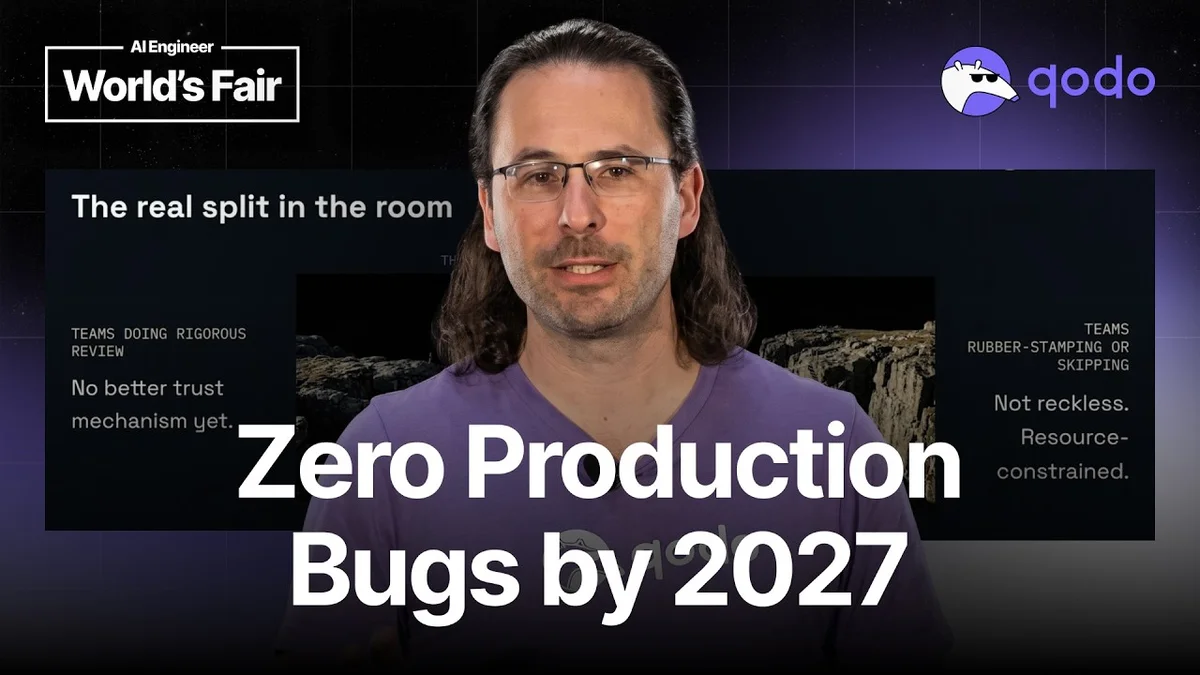
Itamar Friedman, CEO and Co-Founder of Qodo, presenting on stage.
AI Engineer

Visual TL;DR. Human Code Review vs AI Code Review. AI Code Review creates The Context Gap. The Context Gap requires Codify Tribal Knowledge. Codify Tribal Knowledge enables Trustworthy Automation. Trustworthy Automation leads to Artificial Wisdom. Artificial Wisdom shapes Future Governance.

  1. Human Code Review: ensures code quality, safety, maintainability, and team alignment/learning
  2. AI Code Review: current models lack specific organizational context and tribal knowledge
  3. The Context Gap: AI struggles with unique codebase, tribal knowledge, and architectural standards
  4. Codify Tribal Knowledge: explicitly define implicit organizational rules and architectural standards for AI
  5. Trustworthy Automation: AI can perform reliable code reviews with deep contextual understanding
  6. Artificial Wisdom: AI moves beyond basic checks to understand nuanced organizational context
  7. Future Governance: AI will transform how software development is managed and regulated
Visual TL;DR
Visual TL;DR, startuphub.ai Human Code Review vs AI Code Review. Codify Tribal Knowledge enables Trustworthy Automation vs enables Human Code Review AI Code Review Codify Tribal Knowledge Trustworthy Automation From startuphub.ai · The publishers behind this format
Visual TL;DR, startuphub.ai Human Code Review vs AI Code Review. Codify Tribal Knowledge enables Trustworthy Automation vs enables Human Code Review AI Code Review Codify TribalKnowledge TrustworthyAutomation From startuphub.ai · The publishers behind this format
Visual TL;DR, startuphub.ai Human Code Review vs AI Code Review. Codify Tribal Knowledge enables Trustworthy Automation vs enables Human Code Review ensures code quality, safety,maintainability, and teamalignment/learning AI Code Review current models lack specificorganizational context and tribalknowledge Codify Tribal Knowledge explicitly define implicit organizationalrules and architectural standards for AI Trustworthy Automation AI can perform reliable code reviews withdeep contextual understanding From startuphub.ai · The publishers behind this format
Visual TL;DR, startuphub.ai Human Code Review vs AI Code Review. Codify Tribal Knowledge enables Trustworthy Automation vs enables Human Code Review ensures codequality, safety,maintainability,… AI Code Review current models lackspecificorganizational… Codify TribalKnowledge explicitly defineimplicitorganizational… TrustworthyAutomation AI can performreliable codereviews with deep… From startuphub.ai · The publishers behind this format
Visual TL;DR, startuphub.ai Human Code Review vs AI Code Review. AI Code Review creates The Context Gap. The Context Gap requires Codify Tribal Knowledge. Codify Tribal Knowledge enables Trustworthy Automation. Trustworthy Automation leads to Artificial Wisdom. Artificial Wisdom shapes Future Governance vs creates requires enables leads to shapes Human Code Review ensures code quality, safety,maintainability, and teamalignment/learning AI Code Review current models lack specificorganizational context and tribalknowledge The Context Gap AI struggles with unique codebase, tribalknowledge, and architectural standards Codify Tribal Knowledge explicitly define implicit organizationalrules and architectural standards for AI Trustworthy Automation AI can perform reliable code reviews withdeep contextual understanding Artificial Wisdom AI moves beyond basic checks to understandnuanced organizational context Future Governance AI will transform how software developmentis managed and regulated From startuphub.ai · The publishers behind this format
Visual TL;DR, startuphub.ai Human Code Review vs AI Code Review. AI Code Review creates The Context Gap. The Context Gap requires Codify Tribal Knowledge. Codify Tribal Knowledge enables Trustworthy Automation. Trustworthy Automation leads to Artificial Wisdom. Artificial Wisdom shapes Future Governance vs creates requires enables leads to shapes Human Code Review ensures codequality, safety,maintainability,… AI Code Review current models lackspecificorganizational… The Context Gap AI struggles withunique codebase,tribal knowledge,… Codify TribalKnowledge explicitly defineimplicitorganizational… TrustworthyAutomation AI can performreliable codereviews with deep… Artificial Wisdom AI moves beyondbasic checks tounderstand nuanced… Future Governance AI will transformhow softwaredevelopment is… From startuphub.ai · The publishers behind this format

Itamar Friedman, CEO and co-founder of Qodo, delivered a keynote at the AI Engineer World's Fair 2026, titled "The Last Human Code Review: Building Trust in AI-Generated Code." Friedman addressed the critical need for contextual understanding in AI-powered code reviews, arguing that current models, while improving, often lack the specific context of an organization's codebase, tribal knowledge, and architectural standards.

Human Code Review: AI's Next Frontier? - AI Engineer
Human Code Review: AI's Next Frontier? — from AI Engineer

The Two Pillars of Code Review

Friedman began by outlining the fundamental purposes of code review: validation and alignment/learning. Validation ensures code quality, safety, maintainability, and adherence to architectural standards. Alignment and learning, on the other hand, focus on team coherence, skill development, and knowledge transfer. He posed the question of whether human code review remains essential for these two critical functions in the age of AI, and whether the pull request process is still the optimal place for them.

The Context Gap in AI Code Review

Friedman emphasized that the primary bottleneck in achieving trustworthy automated code review is not the AI model's capability but the absence of relevant context. He explained that while AI models can identify bugs, their effectiveness is severely limited without understanding the specific standards, best practices, and historical decisions that guide a particular codebase. "If you don't have the context, even the best model out there will give you different types of bugs and issues," Friedman stated. He highlighted that this context is often fragmented across various documents, communication channels, and, crucially, the uncodified knowledge residing within developers' heads.

Codifying Tribal Knowledge for AI

To bridge this gap, Friedman proposed the need to codify this 'tribal knowledge' and build a 'context lake' or 'context engine.' This system would serve as an interface for both humans and AI agents, allowing them to collaborate effectively. Qodo, as an example, aims to collect and organize team-specific rules and standards, providing this information during reviews. This includes not only explicit rules but also learning from past PRs, discussions, and even production incidents.

From AI to Artificial Wisdom

Friedman argued that the transition from Artificial Intelligence to Artificial Wisdom is crucial for trusting AI-generated code. This involves moving beyond mere detection of errors to a deeper understanding and judgment, mirroring the capabilities of experienced human developers. "If you want to get to a point where judgment is moving to your AI tools, that's AI wisdom where that experience needs to be codified on the right way, the right place for agents and humans," he explained.

The Future of Software Development Governance

The presentation concluded with a vision for the future of software development, characterized by a graph abstraction of the entire development lifecycle. This approach would provide a holistic view of interdependencies and potential conflicts between different code changes. Friedman stressed that to achieve this future, teams must focus on codifying their standards, embracing real-time, self-learning context, and building governance infrastructure that fosters trust and auditability. He predicted that by 2027, organizations that successfully implement these principles could aim for zero outages and zero critical bugs in production.
© 2026 StartupHub.ai. All rights reserved. Do not enter, scrape, copy, reproduce, or republish this article in whole or in part. Use as input to AI training, fine-tuning, retrieval-augmented generation, or any machine-learning system is prohibited without written license. Substantially-similar derivative works will be pursued to the fullest extent of applicable copyright, database, and computer-misuse laws. See our terms.