

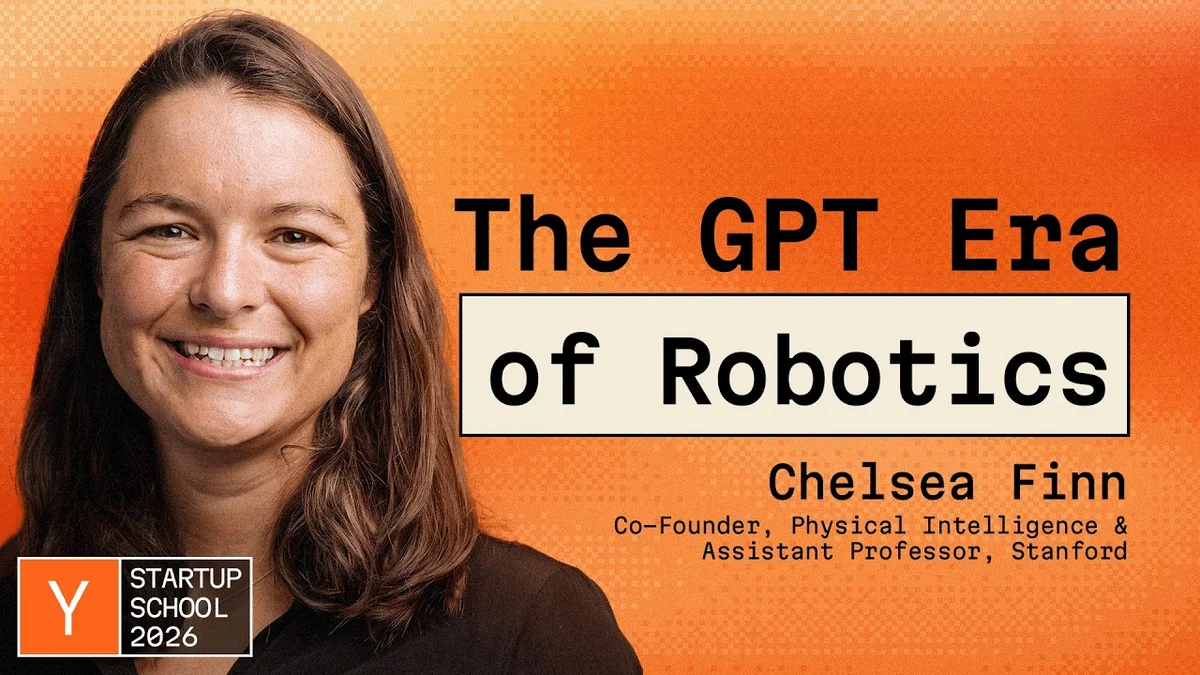
Chelsea Finn: The State of Physical Intelligence in Robotics

Chelsea Finn discusses the state of physical intelligence in robotics, focusing on achieving long-term autonomy and generality in robot models.

7 min read
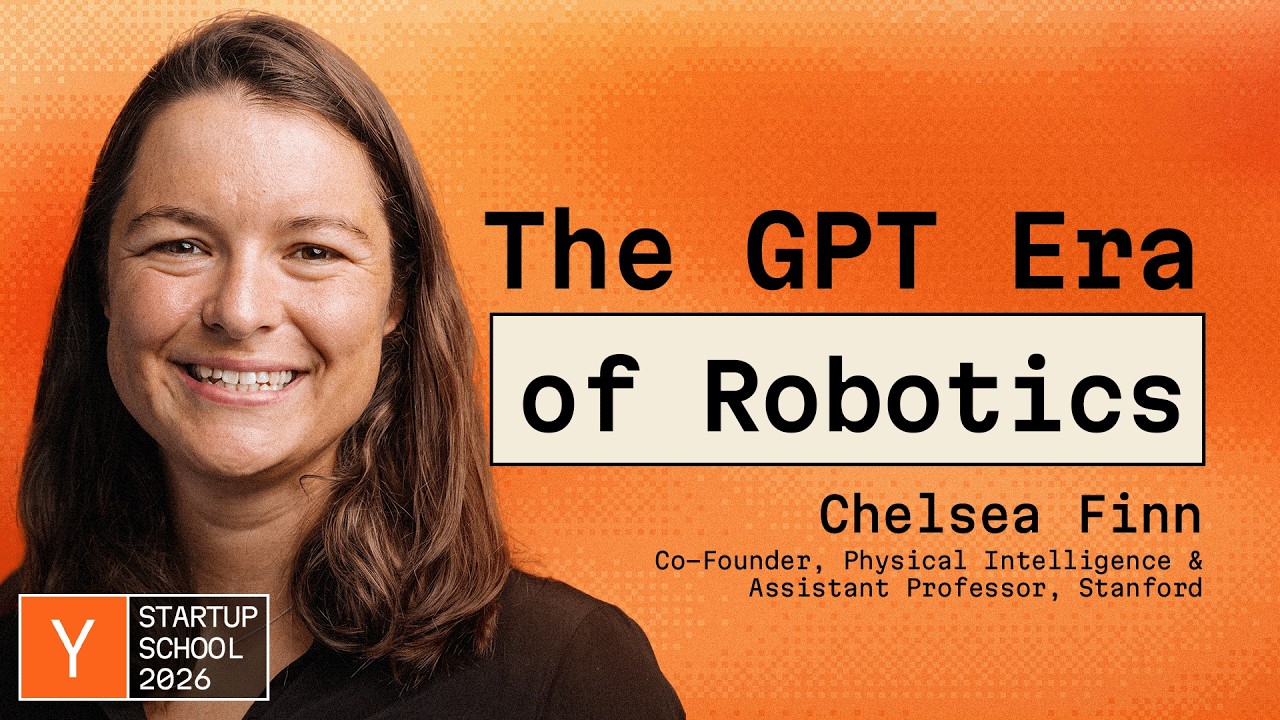
Chelsea Finn presenting on the state of physical intelligence in robotics
YC
Visual TL;DR
Chelsea FinnCore
From the article 9+ mentionsChelsea Finn, Assistant Professor at Stanford and co-founder of Physical Intelligence, recently outlined the current state and future trajectory of physical intelligence in robotics.
Real-World Robotics ChallengeDriver
moving beyond impressive demos to practical, useful, and impactful robot applications
From the article 2 mentionsRobotics, however, presents a different challenge.
Physical AI Demands ReliabilityContext
unlike language models, physical AI requires higher reliability for real-world tasks
From the articleAchieving over 90% reliability in such a complex task is crucial, and Finn explained that this requires more than just collecting data and training a model; it demands an iterative process where the AI system itself can identify areas needing improvement.
Iterative Learning & MemoryCore
critical factors needed for long-term autonomy and generality in robot models
Long-Term AutonomyEffect
enabling robots to perform any task in the real world over extended periods
From the articleThis necessitates a far higher level of reliability and autonomy, requiring systems to make significantly fewer mistakes than their software-based counterparts.
General-Purpose RoboticsOutcome
robots capable of performing diverse tasks, not just specific impressive feats
From the article 9 mentionsGeneral-purpose models are essential, but they must also be brought into the physical world effectively.
Future Physical IntelligenceOutcome
the ultimate goal of making robots truly useful and impactful in people's lives
From the article 2 mentionsChelsea Finn, Assistant Professor at Stanford and co-founder of Physical Intelligence, recently outlined the current state and future trajectory of physical intelligence in robotics.

Chelsea Finn, Assistant Professor at Stanford and co-founder of Physical Intelligence, recently outlined the current state and future trajectory of physical intelligence in robotics. Her talk focused on the critical factors needed to move beyond impressive demonstrations to practical, real-world applications of robots.

The Challenge of Real-World Robotics

Finn began by highlighting the company's goal: to enable any robot to perform any task in the real world. She contrasted the progress seen in language models, like ChatGPT reaching a million users in five days, with the slower, more complex path of physical AI. While impressive feats like folding laundry or washing greasy pans were showcased from the previous year, Finn emphasized that the core challenge is not just performing cool tricks, but understanding what it truly takes to make robots useful and impactful in people's lives.

The full discussion can be found on YC's YouTube channel.

Chelsea Finn: This is the State of the Art in Robotics - YC
Chelsea Finn: This is the State of the Art in Robotics, from YC

This usefulness, she argued, breaks down into two key aspects: generality and real-world deployment. General-purpose models are essential, but they must also be brought into the physical world effectively. Finn drew a parallel to the evolution of AI in the real world, noting the progression from early machine learning applications like product recommendations and ad ranking to the deep learning revolution and the pivotal launch of ChatGPT. These advancements, she pointed out, have largely involved customers making decisions based on AI recommendations, where the system's imperfections are often acceptable.

Physical AI Demands Higher Reliability

Robotics, however, presents a different challenge. Physical AI systems must directly make decisions that affect the physical world. This necessitates a far higher level of reliability and autonomy, requiring systems to make significantly fewer mistakes than their software-based counterparts. Finn cited Waymo's achievement of a quarter-million weekly autonomous rides as evidence that machine learning-based systems can operate reliably and autonomously in the physical world, offering optimism for the broader field of physical AI.

To achieve this, Finn stressed the need for robots to operate autonomously for extended periods, moving beyond human-in-the-loop decision-making. She used the example of a robot making espresso, a task requiring precise control, smooth handling of liquids, and accurate timing. Achieving over 90% reliability in such a complex task is crucial, and Finn explained that this requires more than just collecting data and training a model; it demands an iterative process where the AI system itself can identify areas needing improvement.

The Power of Iterative Learning and Memory

Finn advocated for AI systems that can autonomously seek out data and supervision, iterating on their own performance to achieve higher reliability. This approach, she noted, resembles reinforcement learning algorithms that learn from failures and continuously improve. However, she highlighted the scalability challenges of applying these algorithms to robotics, where millions of attempts could translate to hundreds of robot days for a single task.

To address these inefficiencies, Finn proposed two key improvements. First, preventing robots from wasting time on "dead-end trajectories" by having humans intervene or terminating episodes early when a task goes wrong. Second, she suggested amortizing the cost of multiple attempts per prompt by training a general-purpose value function that can learn what constitutes good versus bad performance across diverse scenarios. This general-purpose value model, she explained, can significantly reduce the number of attempts needed to learn and improve.

The Path to General-Purpose Robotics

Finn then discussed the development of a single, general-purpose model that can perform a wide range of tasks, drawing a parallel to the evolution from BERT to GPT in language models. She emphasized the need for models that work "out of the box" without extensive fine-tuning for each specific task. Finn also highlighted the importance of compositional generalization, the ability of models to combine learned concepts in novel ways, as seen in DALL-E's ability to merge concepts like 'avocado' and 'chair'.

The recipe for achieving these goals, she stated, involves training a foundation model on a massive and diverse dataset, including low-quality demonstrations and data from various sources. Crucially, this data needs to be prompted with detailed context, including subtask instructions and subgoal images, to enable the model to make effective predictions. This approach, she concluded, allows for the development of single models that match or even exceed the performance of specialized, fine-tuned systems.

The Future of Physical Intelligence

Finn concluded by stating that physical intelligence is now firmly in a "GPT-like era" for robotics. She pointed to real-world deployments of these advanced models in companies like Ultra and Weave, demonstrating their application in tasks such as folding laundry and packaging in warehouses. These models are adaptable to various robotic embodiments, including drones, surgical robots, and tractors, signifying a significant step towards making robots truly impactful in the physical world.

© 2026 StartupHub.ai. All rights reserved. Do not enter, scrape, copy, reproduce, or republish this article in whole or in part. Use as input to AI training, fine-tuning, retrieval-augmented generation, or any machine-learning system is prohibited without written license. Substantially-similar derivative works will be pursued to the fullest extent of applicable copyright, database, and computer-misuse laws. See our terms.