
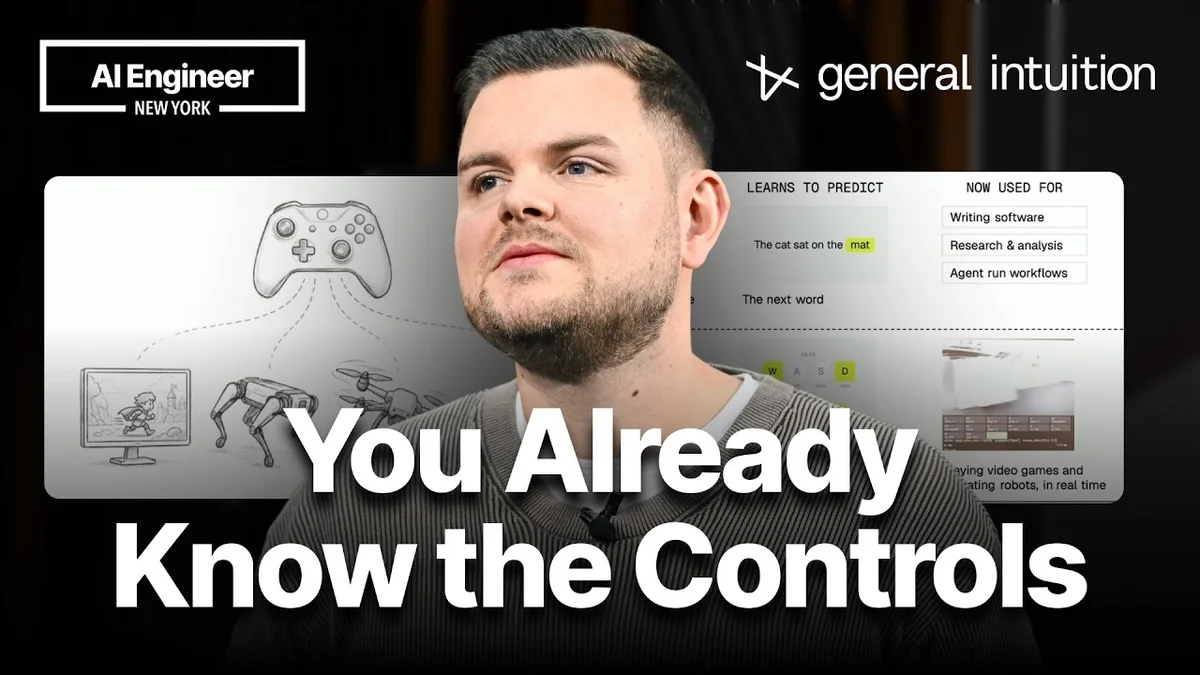
I think the cheapest path to capable robots runs through gamer controllers, not lab teleoperation.
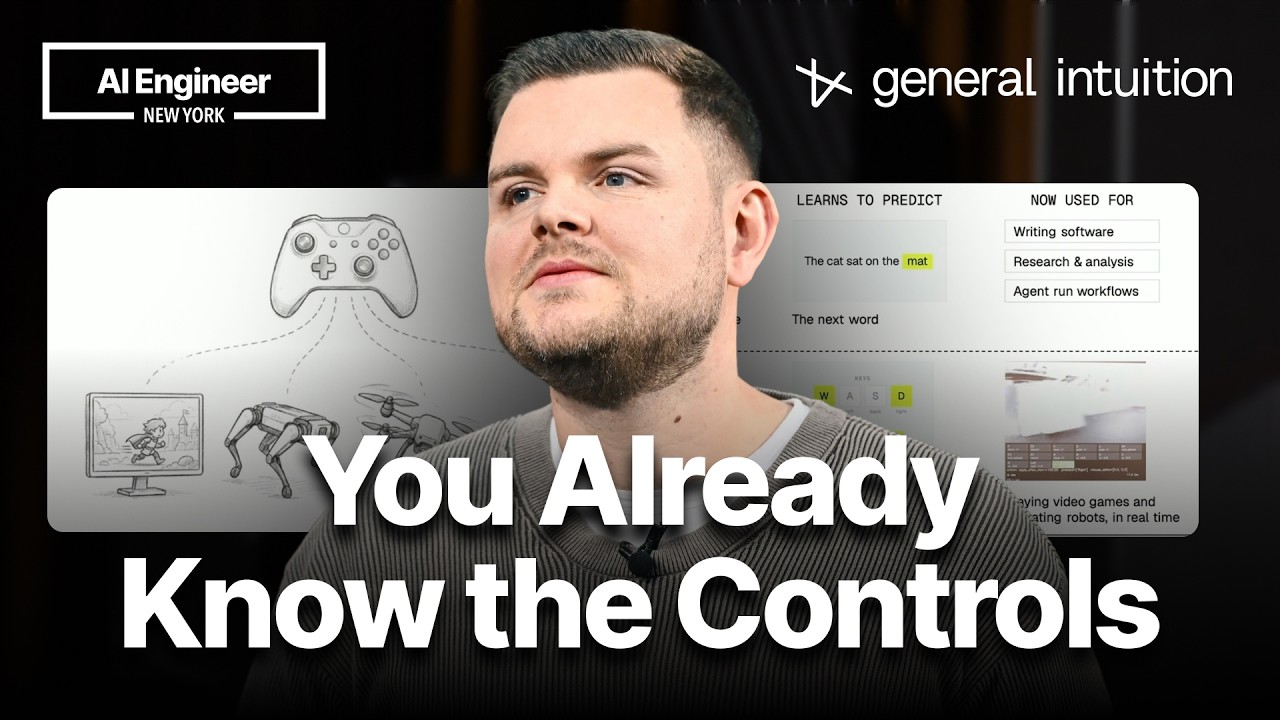
Pim de Witte told AI Engineer that General Intuition will release a single pixels-in, actions-out model that plays games at the highest level and controls more than 10 robot types with the same primitives.
He said Medal already sees a billion videos per year and is tracking to three billion this year, yielding over one and a half trillion action tokens per month, which he claimed equals half a day to match the total data frontier labs have used to train robotics models.
He argued that game data is action-dense and lets the model predict high APM in real time from frames, so a drone needing constant micro-adjustments learns better from gamers than from sparse teleoperation.
That bet is already attracting capital, with KraneShares AI ETF AGIX disclosing an investment in General Intuition as a frontier lab training physical AI on game footage, a signal that investors are pricing game-data scale against simulation-heavy approaches favored by other frontier labs, according to Markets Insider.
The daily brief
Get the free daily brief with the day's AI news, new AI startups and funding rounds every morning.
Join 64,000 other subscribers.
The fair counter is that Pim de Witte conceded that JEPA-style world models without action labels may be more correct in the limit, and predicting controller tokens is not the same as closing a physical loop with force, slip and safety constraints.
It survives for now because scale and native pixel-to-action learning beat elegant simulation when you need speed, interpretability and a shared input space with humans, and if you are building you should get on the November hackathon waitlist in New York and London to test whether this controller abstraction holds for your embodiment before you bet your stack on torque prediction.






