

#Computer Vision
50 articles with this tag
Unified Framework for Decision-Informed Future Prediction
DA-WAM unifies predictive representation learning and action-conditioned future modeling for safer autonomous driving, outperforming existing methods on key benchmarks.
Claude's Corner: AxionOrbital Space - Seeing Through the Clouds
AxionOrbital Space translates raw SAR satellite data into photorealistic optical imagery in 0.06 seconds, making Earth observation useful regardless of clouds or darkness. Their one-step diffusion model outperforms every published benchmark on MSAW, and they occupy a competitive category with no other commercial entrant.

Reactor's Ahmed Ahres on Real-Time Interactive Video
Ahmed Ahres of Reactor discusses the transformative potential of real-time interactive video, moving beyond static generative models to dynamic, programmable content.
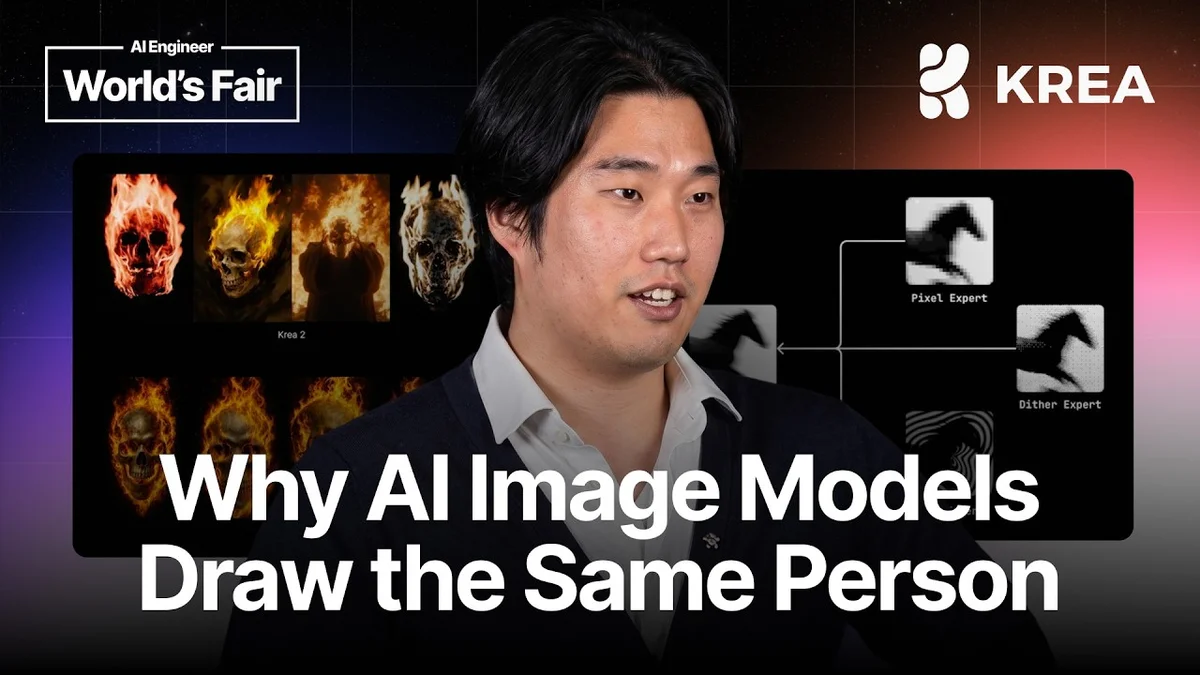
Krea.ai Details Krea 2 Image Model Training
Sangwha Lee of Krea.ai details the rigorous data curation and training process behind the Krea 2 image generation model, emphasizing stylistic diversity and efficiency.

Runway Research Unveils Autoregressive-to-Diffusion VLMs for Faster Visual AI

Runway General World Models Advance AI Simulation
Runway Research has launched a new research initiative called General World Models (GWM), aiming to create AI systems that can understand and simulate real-world visual dynamics and interactions.
Marionette: Decoupling Appearance from State
The Marionette world model decouples visual synthesis from geometric state, enabling controllable, long-horizon interactive simulations with explicit state repair.
MMDiff: Auditing and Steering MLLMs
MMDiff, a new multimodal model-diffing framework, enables granular control and understanding of MLLMs by isolating and manipulating specific behavioral features.

Nvidia's Chris Alexiuk on Compression at the Edge
Nvidia's Chris Alexiuk discusses the critical role of data compression in enabling powerful AI processing on resource-constrained edge devices.

Uber Eats Uses AI Agents to Enhance Food Photos at Scale
Uber Eats' computer vision team details their AI agent system for enhancing food photos, focusing on closed-loop feedback and continuous learning.
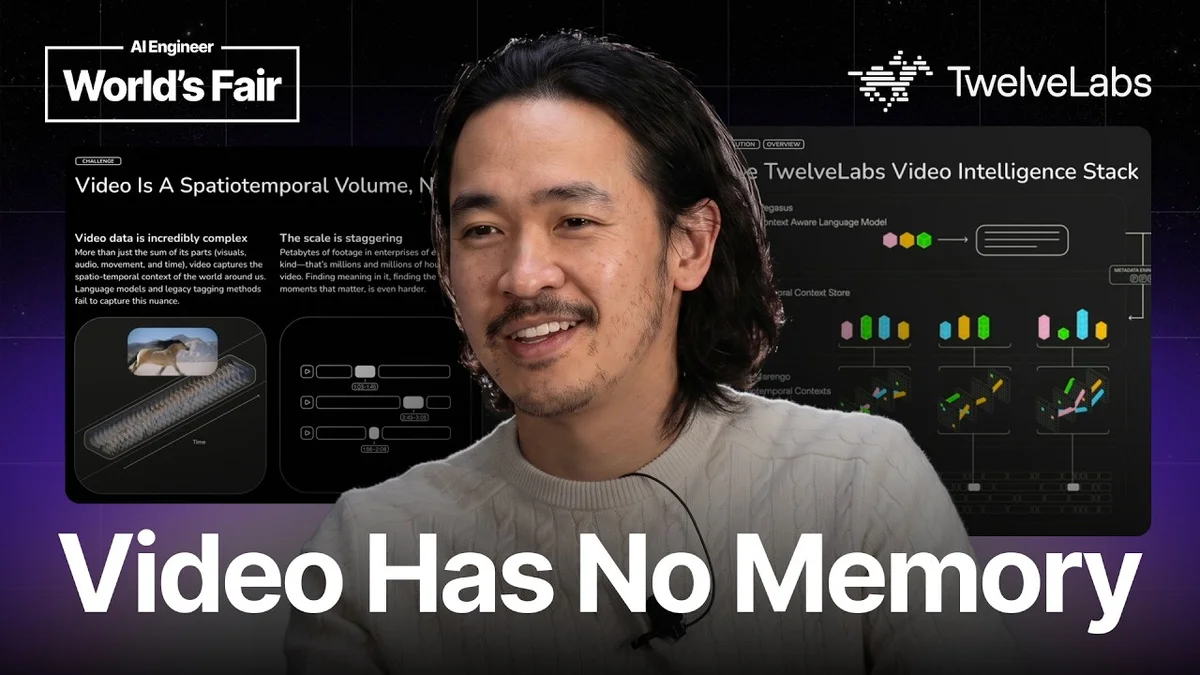
TwelveLabs Builds Video Memory Layer
James Le of TwelveLabs discusses the critical need for memory in video AI, detailing the limitations of current systems and introducing their 'Jockey' platform as a solution.
ABot-World-0: Real-time Video World Models
ABot-World-0 introduces a real-time video world model for long-horizon agent interaction, achieving 16 FPS at 720P with an optimized inference stack.
DiTs Unlock Precise Regional Image Control
New 'appearance pointers' enable Diffusion Transformers to precisely control image generation regionally, matching SOTA performance without retraining.
Claude's Corner: Overshoot, Real-Time AI Vision That Moves as Fast as the World
Overshoot is building real-time AI vision infrastructure that connects any video stream to any VLM in under 200ms. Three lines of code. The API is simple. The performance is not. Here's how they do it, and what it takes to replicate it.
AI Vision Test Reveals Model Hallucinations
A new benchmark, PerceptionBench, reveals that even advanced multimodal AI models struggle with basic visual perception, often guessing answers instead of truly seeing.
WCog-VLA: Bridging Foresight for Proactive Autonomy
WCog-VLA pioneers a dual-level framework, unifying semantic forecasting with generative world evolution to enable proactive autonomous driving, achieving SOTA on NAVSIM.

State of the Union: Local AI Focus
Nvidia, Osmantic, Roboflow, and EXO Labs discuss the critical shift towards local AI solutions and its implications.
CARLA-GS: Unified Corner-Case Synthesis
CARLA-GS offers a unified, modular pipeline for synthesizing photorealistic and physically consistent corner cases in autonomous driving simulation.
ELSA3D: Structured Text-3D Reasoning
ELSA3D revolutionizes unified 3D models with elastic semantic anchoring, achieving SOTA performance in 3D generation and captioning while halving computational costs.

AI Learns to Smell: The Science of Olfactory AI
AI is learning to smell thanks to companies like Osmo, which are building models to understand, predict, and design scents by mapping molecular structures to olfactory perception.
CamVLA: Unshackling Robot Control from Camera Calibration
CamVLA revolutionizes robot control by enabling policies to infer camera geometry, achieving robust, calibration-free manipulation from single RGB images.
VisionAId: On-Device Vision for the Visually Impaired
VisionAId transforms smartphones into real-time visual assistants for the visually impaired, leveraging on-device AI and few-shot learning for personalized object recognition and multimodal guidance.
Netflix Tackles AI Video Editing Challenges
Netflix is developing advanced AI tools, Vera and VOID, to enhance video editing precision and realism for creators.

Claude's Corner: Bidflow, The AI That Reads Electrical Drawings While Estimators Drink Coffee
Bidflow uses custom-trained vision models to automate electrical takeoffs, counting symbols in CAD drawings with 99% accuracy in under 10 minutes. Here's how it works, what's hard to replicate, and how to build a clone.
How Adult Websites Use AI: Inside Pornhub's Tech Stack and the Porn AI Boom
How do adult websites use AI? A technical deep dive into the Pornhub AI stack: computer vision tagging, recommendation pipelines, content moderation, and neural upscaling that power modern adult tech.
OneCanvas: Unified 3D Scene Representation
OneCanvas revolutionizes 3D scene understanding in VLMs by projecting multi-view features onto a unified equirectangular canvas, enabling efficient situated reasoning and SOTA performance.

Phase Dominance in AI Image Recognition
AI image classifiers exhibit a striking phase dominance for identity encoding, mirroring human vision principles, with architectural differences shaping its expression.
ActiveSAM: Efficient Open-Vocabulary Segmentation
ActiveSAM revolutionizes open-vocabulary semantic segmentation with a training-free framework that dynamically identifies relevant classes, boosting speed and accuracy while enhancing robustness for real-world AI.
HYDRA-X: Unifying Image & Video Tokenization
HYDRA-X, a novel Vision Transformer-based UMM, unifies image and video tokenization, enhancing editing consistency and performance through causal attention and latent-level manipulation.
Humanoids Learn Self-Other Distinction
Humanoid robots now learn self-other distinction and build predictive self-models from sensory data, enabling better collaboration and task performance in human-robot environments.
Claude's Corner: Lexius, Your Dumb Cameras Just Got Smart
770 million square feet of US retail space is under surveillance and almost none of it is actually watched. Lexius fixes that with a software-only AI layer on existing cameras, real-time theft detection, cross-visit person tracking, and automated case files. Replicability score: 52/100.
Rethinking VLM Token Reduction
Reroute transforms VLM token reduction from irreversible pruning to recoverable routing, improving grounding performance without sacrificing efficiency.
Images as the New Reasoning Medium
This paper introduces optical reasoning, enabling images to serve as the primary medium for LLM and MLLM reasoning, achieving higher token efficiency and competitive performance.
Beyond Observable Data: Imaginative Perception for VLMs
Researchers introduce Imaginative Perception Tokens (IPTs) to enable VLMs to reason about unobserved spatial configurations, outperforming textual chain-of-thought.

Fei-Fei Li Clarifies 'World Models'
Fei-Fei Li offers a framework to define AI 'world models', distinguishing them from language models and tracing their roots to agent-environment interaction.
AdaCodec: Efficient Video MLLM Encoding
AdaCodec revolutionizes video MLLMs by using predictive visual coding to drastically cut tokenization costs and latency, achieving superior performance at a fraction of the budget.

Claude's Corner: Asimov, The Robot Teacher Running a Side Hustle as a Cleaning Company
Asimov (YC W26) is building the internet-scale training data marketplace for humanoid robots, and they run a cleaning company on the side to collect organic household data while paying workers a real salary. A deep dive into the pipeline, the moat, and whether you can clone it.
GPIC: Fueling Next-Gen Generative Models
The GPIC dataset, a 28 trillion pixel permissive image corpus, democratizes large-scale visual generative model research and commercialization.

LocateAnything: Parallel Decoding for Vision
LocateAnything revolutionizes vision-language models with Parallel Box Decoding, boosting speed and accuracy in visual grounding and detection.
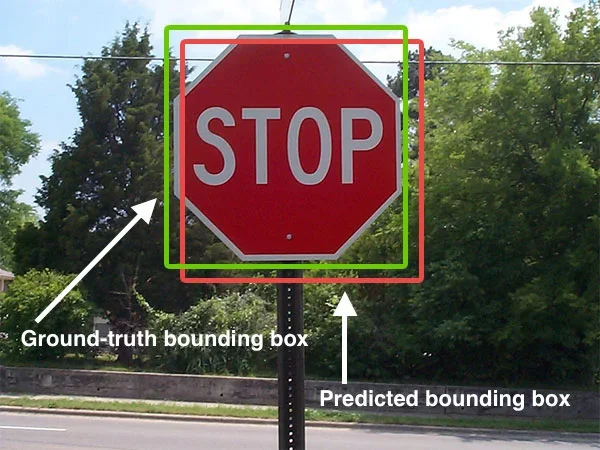
Uber Fights Bounding Box Errors
Uber Engineering uses machine learning to automatically detect and correct bounding box annotation errors in video data, boosting ML model training quality.
AI Image Generation Reimagined: Channel-Wise Quantization
Channel-wise Vector Quantization (CVQ) redefines image tokenization, enabling autoregressive models like CAR to generate richer, more detailed images with state-of-the-art performance.
SpatioRoute VLM: Dynamic Prompting for Video QA
SpatioRoute VLM revolutionizes zero-shot spatial video question answering with dynamic prompt routing, achieving SOTA without fine-tuning or 3D sensors.
TaskGround: Bridging Scene Context and Action
TaskGround revolutionizes household AI by enabling compact models to interpret complex scenes, infer task structures, and act effectively, drastically improving performance and reducing costs.

AI Learns to See, Hear, and Understand
Multimodal AI analytics is enabling businesses to decode video, audio, and images, unlocking deeper insights from previously unstructured data.
LMPath: Semantics Supercharge UAV Search
LMPath integrates language and vision models to create semantically-aware exploration priors for UAVs, dramatically improving search mission efficiency over traditional geometric methods.
Beyond RGB: Grounding Vision-Language on Raw Sensor Data
PRISM-VL advances vision-language models by grounding them in raw camera measurements, not just RGB, significantly improving performance on challenging visual tasks.

Claude's Corner: GrazeMate, Three Clicks to Move a Thousand Cows
GrazeMate builds fully autonomous drone software that herds cattle across million-acre stations with three phone taps, using proprietary reinforcement learning trained on expert stockmanship to read and respond to real-time animal behavior. Founded by a 19-year-old Australian farmer, the company has $1.2M raised, 1.7 million acres under contract, and is expanding into California and Texas.
Codex AI Automates Complex Computer Tasks
Codex AI demonstrates advanced capabilities, automating complex tasks across applications by interacting with computer interfaces.

Claude's Corner: Librar Labs, The AI Librarian That's Really a Data-Catalog Trojan Horse
Librar Labs looks like another YC W2026 SaaS, AI-powered school library management, until you look at the team and the technical claim under the hood. OpenAI / Scale / Palantir alums plus quantum physicists plus a 'self-healing database for unstructured data' don't build a school librarian assistant unless the school librarian is the wedge.
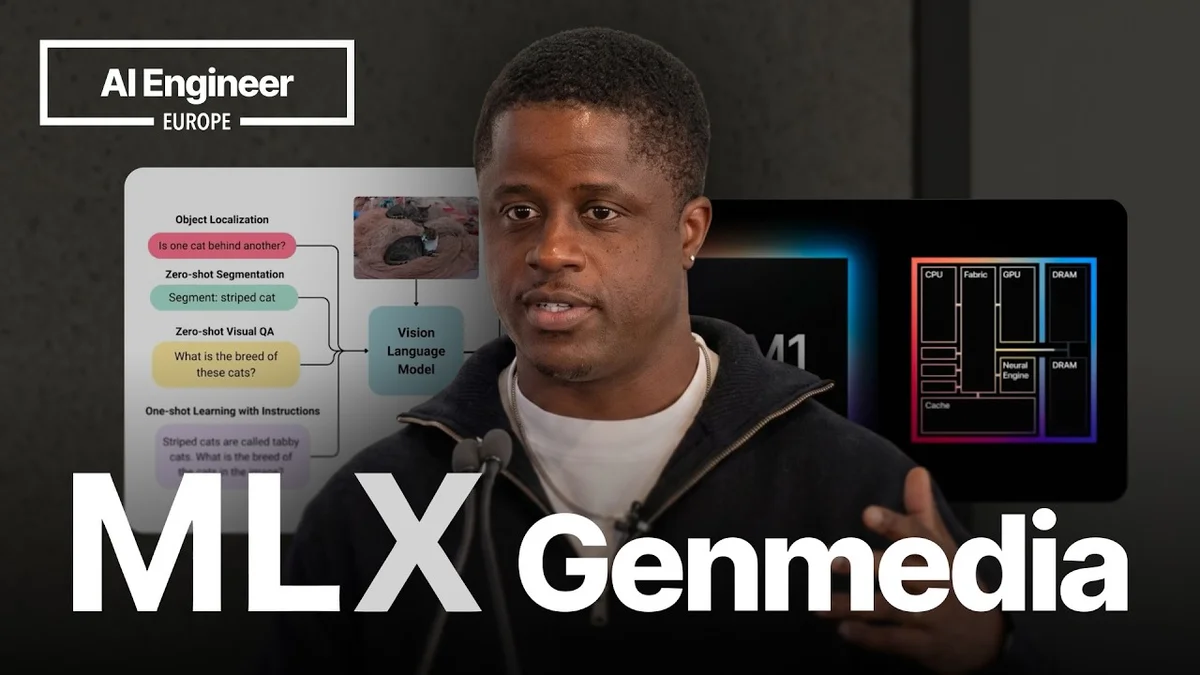
MLX Genmedia: Prince Canuma on On-Device AI
Prince Canuma of MLX Genmedia discusses the power of on-device AI, showcasing how MLX enables efficient deployment of AI models on Apple Silicon devices for vision and audio tasks.