

Transformers Conquer Computer Vision

Isaac Robinson from Roboflow explains how Transformers, once confined to NLP, have revolutionized computer vision, surpassing CNNs through massive pre-training and architectural innovation.

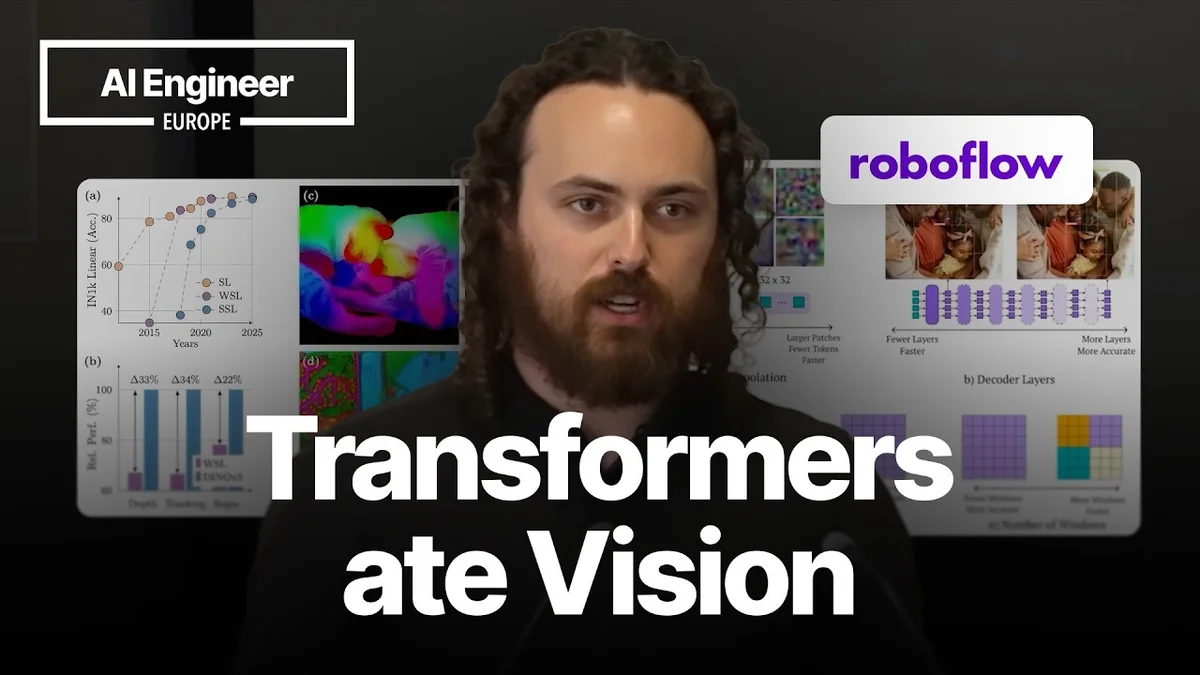
Presentation slide showing the evolution of vision models from ViT to Swin, ConvNeXt, Hiera, and back to ViT.
Image credit: Roboflow· AI Engineer

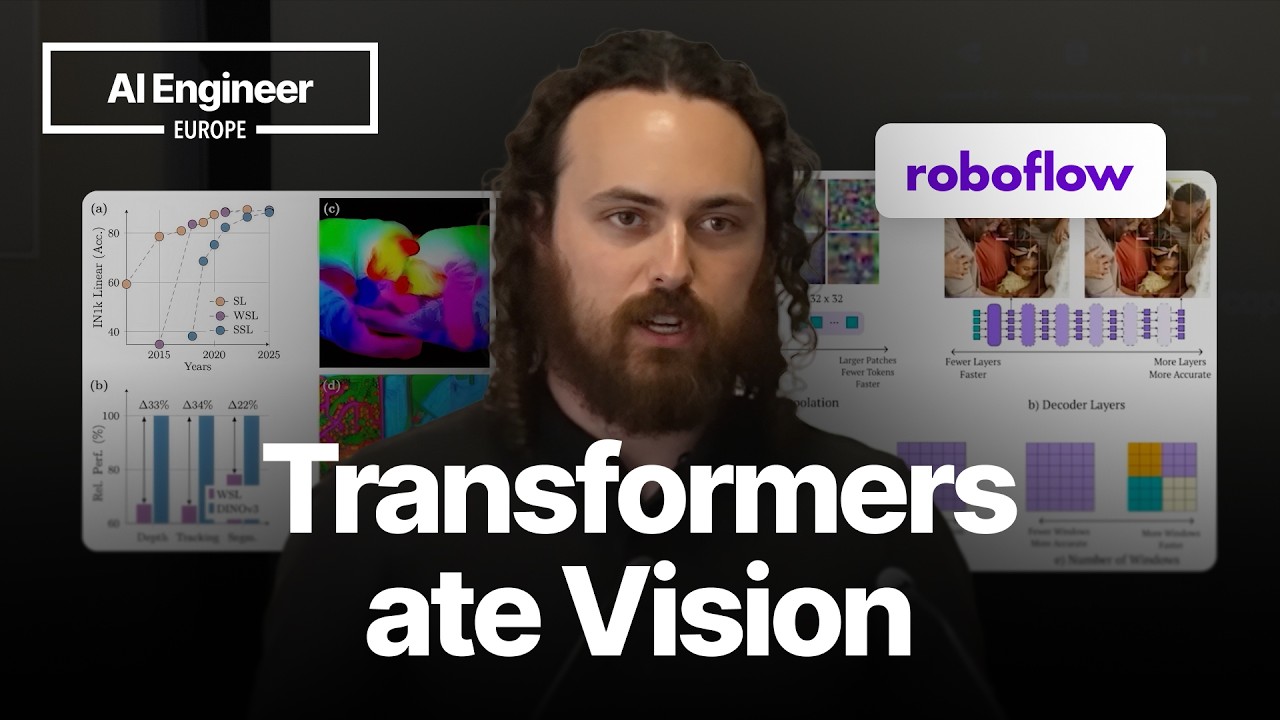
In the rapidly evolving world of artificial intelligence, a significant architectural shift has occurred, with Transformers, initially a powerhouse in natural language processing, now making substantial inroads into computer vision. Isaac Robinson, Research Lead at Roboflow, recently delivered a presentation titled "How Transformers Finally Ate Vision," detailing this transition and its implications for the field.
Transformers Conquer Computer Vision - AI Engineer
Transformers Conquer Computer Vision — from AI Engineer

The Rise of Transformers in Vision

Robinson began by contrasting the established dominance of Convolutional Neural Networks (CNNs) in vision tasks with the emergence of Transformers. CNNs, with their inherent inductive biases like locality and translation equivariance, have long been the go-to architecture for image recognition and related tasks. These biases are crucial for understanding spatial relationships within images. However, Transformers, with their self-attention mechanisms, offer a different approach, allowing them to model long-range dependencies within data, a capability that has proven exceptionally powerful in language but is now being effectively applied to visual data.

The presentation highlighted that while CNNs are inherently biased towards local features, Transformers, by design, are more flexible and can learn these spatial relationships from data through extensive pre-training. This ability to learn from vast datasets has allowed Transformers to achieve state-of-the-art results in various vision benchmarks, effectively challenging the long-held supremacy of CNNs.

Related startups

Evolutionary Steps: From ViT to ConvNeXt

Robinson traced the evolution of these vision transformers, starting with the foundational Vision Transformer (ViT). This model demonstrated the viability of a pure transformer architecture for vision tasks by treating images as sequences of patches. However, ViTs initially lacked the strong inductive biases of CNNs, requiring massive datasets and computational resources for pre-training to compensate.

The presentation then moved to subsequent advancements that sought to bridge this gap. Swin Transformers, for instance, introduced shifted windows to incorporate a degree of locality, improving efficiency and performance. ConvNeXt further refined this by re-examining and modernizing the CNN architecture, incorporating design choices inspired by transformers, such as larger kernel sizes and layer normalization, to achieve competitive performance with transformer-based models.

The narrative illustrated a clear trend: a convergence of ideas between the transformer and CNN architectures. This evolution shows a path towards models that can capture both local details and global context effectively, leading to more robust and efficient vision systems.

The Trade-offs: Inductive Bias vs. Flexibility

A key theme explored was the trade-off between high inductive bias (as seen in CNNs) and the flexibility offered by transformers. Robinson posed the question, "Which wins?" He explained that while CNNs with their built-in biases are often more efficient for specific tasks, especially with limited data, transformers, with their ability to learn from massive datasets, can achieve superior performance by learning these biases from scratch.

The presentation suggested that the success of transformers in vision is largely due to this ability to leverage massive pre-training to learn the necessary inductive biases. This is further augmented by techniques that borrow computational efficiencies from large language models (LLMs), such as FlashAttention, which optimizes the attention mechanism for faster computation.

Future Directions: Pre-training and NAS

Looking ahead, Robinson emphasized the importance of pre-training-compatible Neural Architecture Search (NAS) as a critical factor. The ability to efficiently search for optimal architectures that can be effectively pre-trained is key to unlocking the full potential of transformers in vision.

The presentation concluded by highlighting how models like Hiera and subsequent iterations further refine these concepts, demonstrating that by carefully combining pre-training strategies with architectural innovations, researchers can achieve significant speedups and performance gains. This ongoing development underscores the dynamic nature of AI research, where cross-pollination of ideas between different domains is driving rapid progress.

© 2026 StartupHub.ai. All rights reserved. Do not enter, scrape, copy, reproduce, or republish this article in whole or in part. Use as input to AI training, fine-tuning, retrieval-augmented generation, or any machine-learning system is prohibited without written license. Substantially-similar derivative works will be pursued to the fullest extent of applicable copyright, database, and computer-misuse laws. See our terms.