



State of the Union: Local AI Focus

Nvidia, Osmantic, Roboflow, and EXO Labs discuss the critical shift towards local AI solutions and its implications.

6 min read
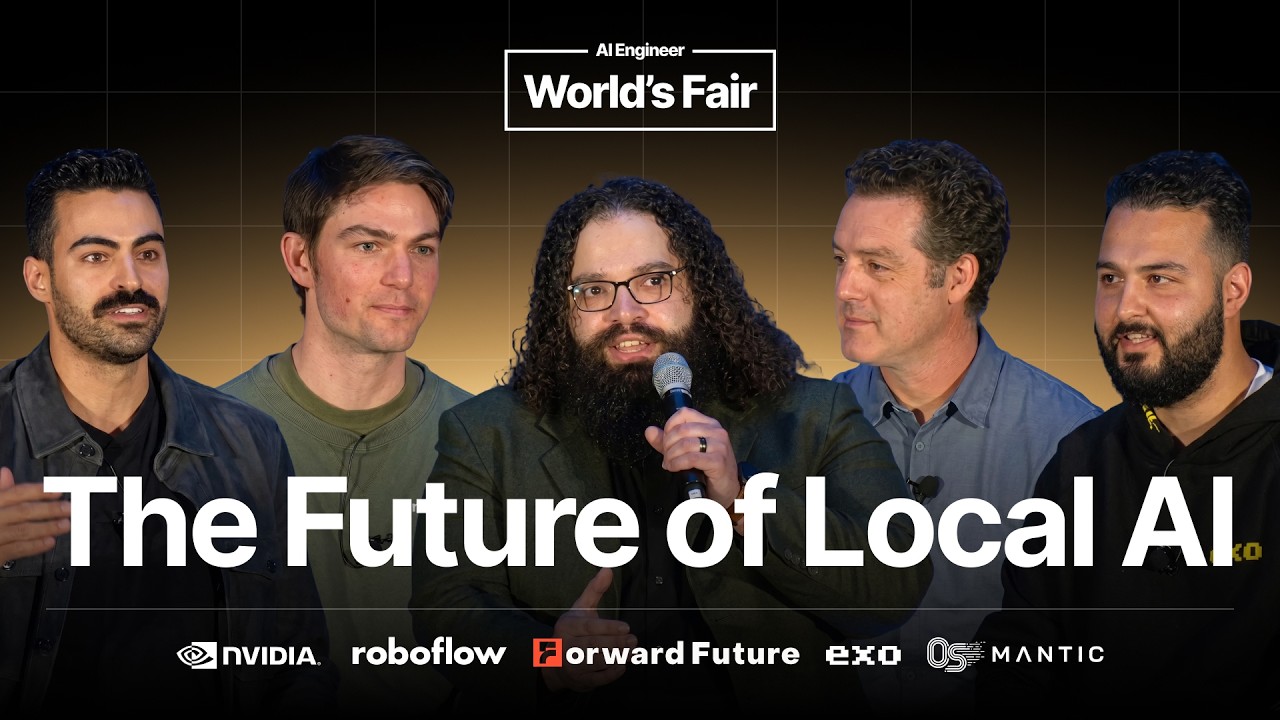
Panelists discussing AI solutions at a conference.
AI Engineer
Visual TL;DR
Cloud AI LimitationsDriver
data sovereignty, latency, security, connectivity issues
From the article 7 mentionsThe discussion highlights that the traditional cloud-centric approach to AI, while powerful, presents limitations.
Shift to Local AIContext
deploying AI models and data processing closer to source
From the article 9+ mentionsThe recent "State of the Union: Why Local, Why Now" discussion brings together prominent voices from the AI and computer vision sectors to explore a critical shift: the increasing relevance and necessity of local AI solutions.
Key PlayersCore
Nvidia, Osmantic, Roboflow, EXO Labs, Alphabet
Data Processing CloserContext
enabling local AI solutions for practical applications
From the article 5 mentions(NASDAQ:GOOGL) contributor Matthew Berman, delves into the strategic advantages and emerging opportunities in deploying AI models and data processing closer to the source.
Strategic AdvantagesEffect
reduced latency, enhanced security, real-time decisions
From the article 3 mentions(NASDAQ:GOOGL) contributor Matthew Berman, delves into the strategic advantages and emerging opportunities in deploying AI models and data processing closer to the source.
Imperative for BusinessesOutcome
critical shift for businesses and developers today
From the article 2 mentionsThe core thesis revolves around the compelling reasons why focusing on local AI is not just a trend, but a strategic imperative for businesses and developers today.
Contents(3)

The recent "State of the Union: Why Local, Why Now" discussion brings together prominent voices from the AI and computer vision sectors to explore a critical shift: the increasing relevance and necessity of local AI solutions. Featuring insights from Nvidia (NASDAQ:NVDA), Osmantic, Roboflow, and EXO Labs, the conversation, also including Alphabet Inc. (NASDAQ:GOOGL) contributor Matthew Berman, delves into the strategic advantages and emerging opportunities in deploying AI models and data processing closer to the source.

State of the Union: Local AI Focus - AI Engineer
State of the Union: Local AI Focus, from AI Engineer

The core thesis revolves around the compelling reasons why focusing on local AI is not just a trend, but a strategic imperative for businesses and developers today. This includes addressing data sovereignty, reducing latency, enhancing security, and enabling real-time decision-making in environments where constant connectivity or cloud reliance is impractical or undesirable.

The Imperative for Local AI

The discussion highlights that the traditional cloud-centric approach to AI, while powerful, presents limitations. As AI applications become more pervasive, particularly at the edge, the need for processing data locally becomes paramount. This allows for faster inference, immediate action based on sensory input, and a significant reduction in the volume of data that needs to be transmitted to the cloud. For industries such as manufacturing, retail, and autonomous systems, this localized intelligence can translate directly into increased efficiency, improved safety, and novel user experiences.

Matthew Berman, known for his work and insights into the AI field, likely frames the broader context of this shift. His contribution would typically provide the connective tissue, explaining how various technological advancements are converging to make local AI more feasible and attractive. This includes improvements in edge hardware, specialized AI chips, and more efficient model architectures designed for constrained environments.

Key Players and Their Contributions

The participation of companies like Nvidia, Osmantic, Roboflow, and EXO Labs signifies the diverse range of expertise and solutions being brought to bear on the local AI challenge.

Nvidia, a titan in AI hardware, provides the foundational processing power necessary for sophisticated AI models to run efficiently on edge devices. Their development of specialized GPUs and AI platforms tailored for edge computing is crucial for enabling the computational demands of local AI.

Osmantic, Roboflow, and EXO Labs represent companies building the software, platforms, and application layers that make local AI accessible and practical. Roboflow, for instance, is known for its platform that streamlines the process of building, deploying, and managing computer vision models. Their focus on making AI accessible to a broader range of developers and businesses aligns directly with the goal of enabling widespread local AI adoption.

EXO Labs likely contributes expertise in developing AI solutions for specific use cases or hardware, perhaps focusing on real-time video analytics or embedded AI systems. Osmantic's specific role would add another dimension, potentially focusing on data management, privacy-preserving AI, or specialized AI algorithms for local deployment.

Why Now? The Convergence of Factors

The emphasis on "Why Now" suggests a critical juncture where several factors align to accelerate the adoption of local AI. These include:

  • Data Privacy and Security: Increasing global regulations and public concern over data privacy make processing sensitive information locally a more attractive proposition than sending it to the cloud.
  • Latency Requirements: Many emerging AI applications, such as autonomous vehicles, industrial robotics, and augmented reality, require near-instantaneous response times that cloud processing cannot consistently guarantee.
  • Connectivity Limitations: In remote areas or during network outages, local AI ensures continuous operation and functionality without relying on stable internet access.
  • Cost Efficiency: While initial hardware investment is required, processing data locally can, in many scenarios, reduce ongoing cloud computing costs associated with data transfer and storage.
  • Advancements in Edge AI: The continuous improvement in the performance and power efficiency of edge processors and specialized AI accelerators makes running complex models on smaller, less power-intensive devices a reality.

The discussion likely explores how these companies are collaborating or competing to define the future of local AI. This could involve partnerships to integrate hardware and software, the development of new standards, or the creation of specialized AI solutions tailored for specific local deployment scenarios. The conversation serves as a vital pulse check on the state of AI development, highlighting a significant strategic pivot towards intelligence that operates closer to where data is generated and decisions are made.

© 2026 StartupHub.ai. All rights reserved. Do not enter, scrape, copy, reproduce, or republish this article in whole or in part. Use as input to AI training, fine-tuning, retrieval-augmented generation, or any machine-learning system is prohibited without written license. Substantially-similar derivative works will be pursued to the fullest extent of applicable copyright, database, and computer-misuse laws. See our terms.