

AI Agents in Healthcare: X12 as the Harness

Vasant Kearney of Onlay AI discusses how X12 and a robust 'execution layer' are crucial for safe and reliable AI agents in healthcare.

8 min read
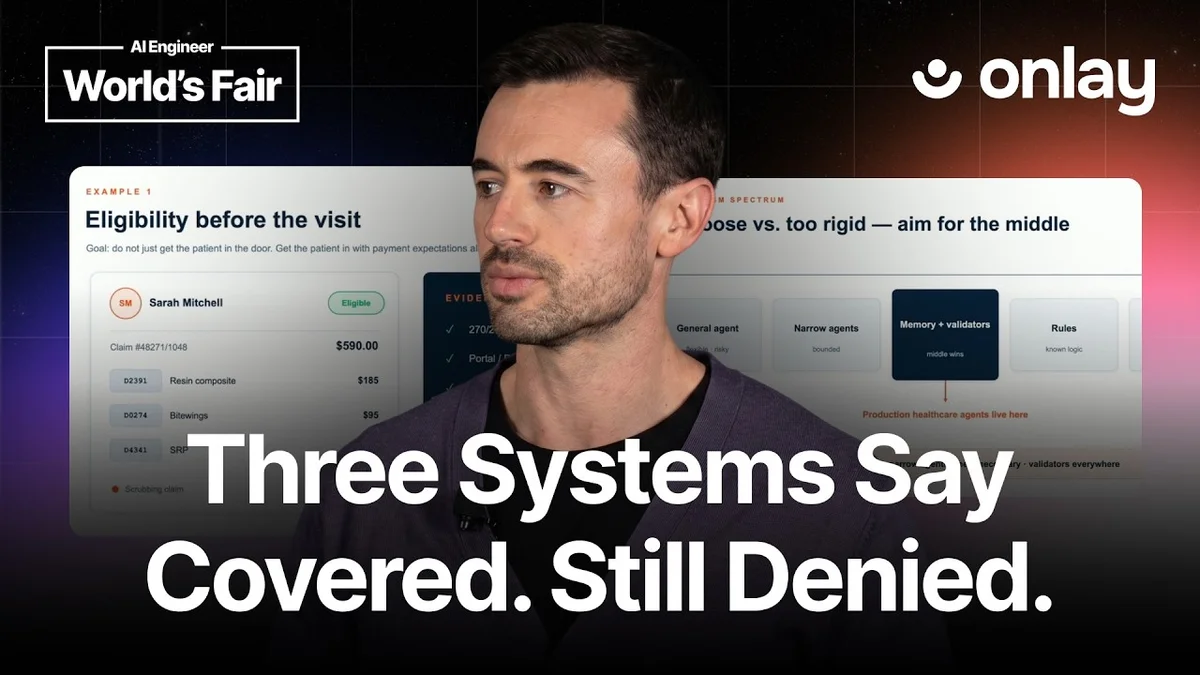
Vasant Kearney speaking at a podium with 'AI Engineer World's Fair' logo.
AI Engineer

Visual TL;DR. Healthcare AI Goals drives Advanced AI Models. Advanced AI Models requires Need Execution Layer. Need Execution Layer uses X12 Data Format. X12 Data Format functions as X12 as Harness. X12 as Harness enables Safe AI Agents. Safe AI Agents leads to Improved Healthcare. Need Execution Layer supported by X12 as Harness.

  1. Healthcare AI Goals: driving down costs and improving patient experience are primary objectives
  2. Advanced AI Models: powerful but need safe, effective deployment in complex healthcare workflows
  3. Need Execution Layer: critical for reliable and safe operation of AI agents in healthcare
  4. X12 Data Format: structured data format crucial for leveraging AI agents effectively
  5. X12 as Harness: provides bounded reasoning and validation for AI agent actions
  6. Safe AI Agents: ensures reliable, validated, and bias-reduced AI operations
  7. Improved Healthcare: achieving cost reduction and enhanced patient experience through AI
Visual TL;DR
Visual TL;DR, startuphub.ai Need Execution Layer uses X12 Data Format. X12 Data Format functions as X12 as Harness. Need Execution Layer supported by X12 as Harness uses functions as supported by Healthcare AI Goals Need Execution Layer X12 Data Format X12 as Harness Improved Healthcare From startuphub.ai · The publishers behind this format
Visual TL;DR, startuphub.ai Need Execution Layer uses X12 Data Format. X12 Data Format functions as X12 as Harness. Need Execution Layer supported by X12 as Harness uses functions as supported by Healthcare AIGoals Need ExecutionLayer X12 Data Format X12 as Harness ImprovedHealthcare From startuphub.ai · The publishers behind this format
Visual TL;DR, startuphub.ai Need Execution Layer uses X12 Data Format. X12 Data Format functions as X12 as Harness. Need Execution Layer supported by X12 as Harness uses functions as supported by Healthcare AI Goals driving down costs and improving patientexperience are primary objectives Need Execution Layer critical for reliable and safe operationof AI agents in healthcare X12 Data Format structured data format crucial forleveraging AI agents effectively X12 as Harness provides bounded reasoning and validationfor AI agent actions Improved Healthcare achieving cost reduction and enhancedpatient experience through AI From startuphub.ai · The publishers behind this format
Visual TL;DR, startuphub.ai Need Execution Layer uses X12 Data Format. X12 Data Format functions as X12 as Harness. Need Execution Layer supported by X12 as Harness uses functions as supported by Healthcare AIGoals driving down costsand improvingpatient experience… Need ExecutionLayer critical forreliable and safeoperation of AI… X12 Data Format structured dataformat crucial forleveraging AI… X12 as Harness provides boundedreasoning andvalidation for AI… ImprovedHealthcare achieving costreduction andenhanced patient… From startuphub.ai · The publishers behind this format
Visual TL;DR, startuphub.ai Healthcare AI Goals drives Advanced AI Models. Advanced AI Models requires Need Execution Layer. Need Execution Layer uses X12 Data Format. X12 Data Format functions as X12 as Harness. X12 as Harness enables Safe AI Agents. Safe AI Agents leads to Improved Healthcare. Need Execution Layer supported by X12 as Harness drives requires uses functions as enables leads to supported by Healthcare AI Goals driving down costs and improving patientexperience are primary objectives Advanced AI Models powerful but need safe, effectivedeployment in complex healthcare workflows Need Execution Layer critical for reliable and safe operationof AI agents in healthcare X12 Data Format structured data format crucial forleveraging AI agents effectively X12 as Harness provides bounded reasoning and validationfor AI agent actions Safe AI Agents ensures reliable, validated, andbias-reduced AI operations Improved Healthcare achieving cost reduction and enhancedpatient experience through AI From startuphub.ai · The publishers behind this format
Visual TL;DR, startuphub.ai Healthcare AI Goals drives Advanced AI Models. Advanced AI Models requires Need Execution Layer. Need Execution Layer uses X12 Data Format. X12 Data Format functions as X12 as Harness. X12 as Harness enables Safe AI Agents. Safe AI Agents leads to Improved Healthcare. Need Execution Layer supported by X12 as Harness drives requires uses functions as enables leads to supported by Healthcare AIGoals driving down costsand improvingpatient experience… Advanced AIModels powerful but needsafe, effectivedeployment in… Need ExecutionLayer critical forreliable and safeoperation of AI… X12 Data Format structured dataformat crucial forleveraging AI… X12 as Harness provides boundedreasoning andvalidation for AI… Safe AI Agents ensures reliable,validated, andbias-reduced AI… ImprovedHealthcare achieving costreduction andenhanced patient… From startuphub.ai · The publishers behind this format

Vasant Kearney, Co-founder & CEO of Onlay AI, delivered a compelling talk at the AI Engineer World's Fair on the critical role of AI agents in revolutionizing healthcare workflows. Kearney emphasized that while advanced AI models are powerful, their effective and safe deployment in healthcare hinges on building a robust 'execution layer' and leveraging structured data formats like X12.

AI Agents in Healthcare: X12 as the Harness - AI Engineer
AI Agents in Healthcare: X12 as the Harness — from AI Engineer

Understanding the Goals in Healthcare AI

Kearney began by grounding the discussion in the primary objectives of AI in healthcare: driving down costs and improving the patient experience. He noted that while technical teams often get excited about the technology itself, its application must always be tied to these fundamental goals. This perspective is crucial when considering the complex and often fragmented nature of healthcare processes.

The Evolution of AI and the Need for an Execution Layer

The presentation traced the evolution of AI from early neural networks to the current era of large language models (LLMs) and agentic execution layers. Kearney highlighted that moving from recognizing digits on a check to processing complex insurance claims involves navigating a web of interconnected systems and numerous small, critical steps. He introduced the concept of an 'execution layer' as the mechanism to manage these steps safely and reliably, particularly in a highly regulated field like healthcare.

Navigating Multimodal Context and Data Challenges

A significant challenge discussed was the handling of multimodal context in healthcare, where images, text, and other data types must be processed together. Kearney explained that simply extracting text from an image might lead to a loss of crucial contextual information. He stressed the importance of multimodal processing to capture nuances that could be missed by discrete, text-only models.

The Role of X12 as a Harness for AI Agents

Kearney identified X12, a standard for electronic data interchange in healthcare, as a key component for building reliable AI agents. He described X12 as providing an underlying structure and contract between entities, similar to strict programming languages. By grounding AI reasoning in X12 formats, agents can operate more predictably and safely within the complex ecosystem of healthcare transactions, from eligibility checks to claim submissions and payments.

The "Harness" and the Importance of Bounded Reasoning

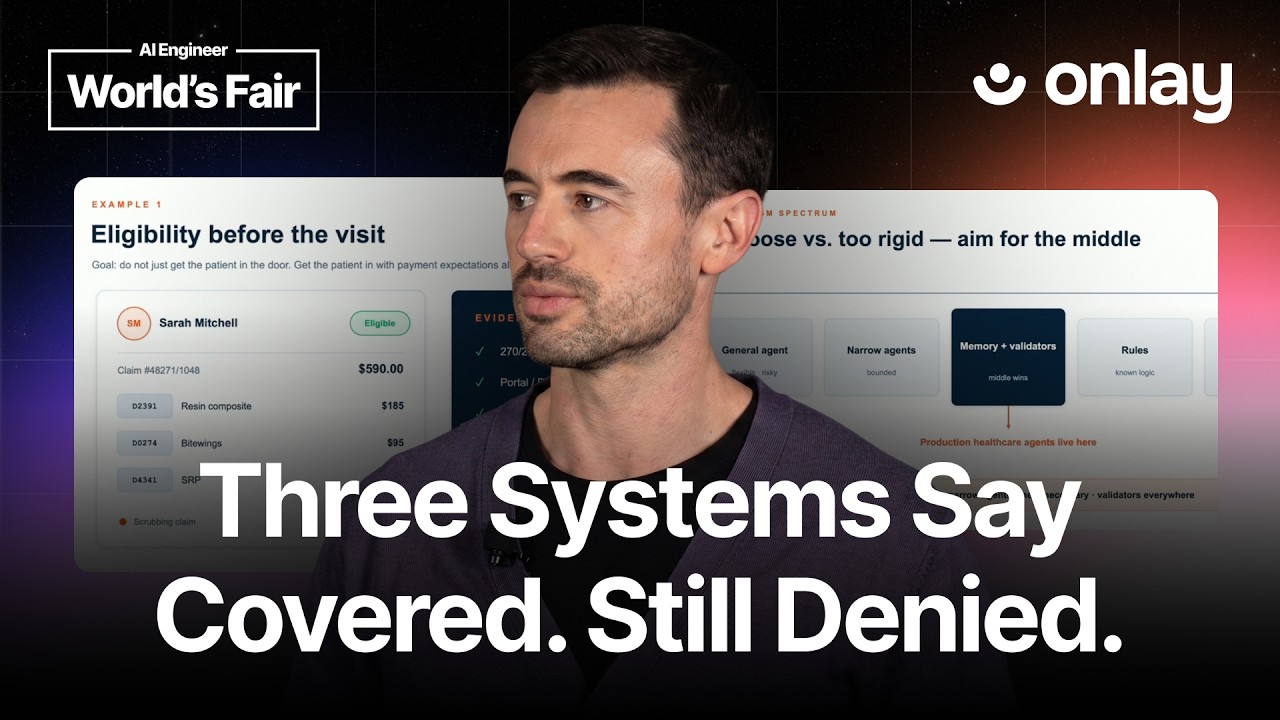
The concept of a "harness" was central to Kearney's talk, encompassing tools, contracts, memory, checks, permissions, and handoffs. This harness ensures that AI agents operate within defined boundaries, preventing the kind of unmanageable code explosions that can occur with completely open-ended systems. He stressed the need for a balance between agentic flexibility and rigid, hard-coded processes, advocating for a middle ground that incorporates memory and validators.

Memory, Bias, and the Need for Validation

Kearney delved into the critical role of memory in AI agents, differentiating between local memory (like that used by Codex or Claude Code) and enterprise-level memory stored in databases for logical separation. He also cautioned about the potential for bias when implementing persistent memory across user interactions, emphasizing the need for users to be able to break out of pre-determined patterns. Crucially, he highlighted the necessity of rigorous evaluation and validation when introducing new models, as improved metrics in one area don't guarantee overall system improvement.
The Messy Reality of Healthcare Data

The presentation also touched upon the inherent messiness of real-world healthcare data. Unlike a 'perfect world' where every transaction is clean and complete, the reality involves portals, PDFs, screenshots, missing status files, and EOBs that don't match. Kearney advised treating every source as evidence, not gospel, and using X12 as an anchor while agents navigate these inconsistencies.

Key Takeaways for Reliable Healthcare AI

Kearney summarized the key takeaways for building reliable healthcare AI agents: LLMs reason over ambiguity, but X12 provides defined targets; the ledger (memory) is a durable object; every source is evidence, but sources can disagree; trust comes from rejection, not just acceptance; and it's essential to use the cheapest reliable layer, employing narrow agents and validators where necessary. He concluded by stating that production AI wins when stochastic reasoning is harnessed by deterministic proof.

© 2026 StartupHub.ai. All rights reserved. Do not enter, scrape, copy, reproduce, or republish this article in whole or in part. Use as input to AI training, fine-tuning, retrieval-augmented generation, or any machine-learning system is prohibited without written license. Substantially-similar derivative works will be pursued to the fullest extent of applicable copyright, database, and computer-misuse laws. See our terms.