

Microsoft's CARE-X tackles radiology AI

Microsoft Research's CARE-X advances radiology AI with a unified VLM for chest X-ray interpretation, combining generation, structured prediction, and tool-augmented measurement.

8 min read
Diagram illustrating the CARE-X model architecture and training pipeline.
Microsoft Reesarch

Visual TL;DR. Radiology AI Challenges addresses Microsoft CARE-X. Microsoft CARE-X uses Unified VLM Approach. Unified VLM Approach enhanced by Auxiliary Supervision. Unified VLM Approach includes Tool-Augmented Measurement. Microsoft CARE-X enables Improved Interpretation. Improved Interpretation leads to Clinical Impact.

  1. Radiology AI Challenges: existing models specialize, lack calibrated confidence, or struggle with diverse tasks
  2. Microsoft CARE-X: novel VLM for chest X-ray interpretation, unifying diverse radiology tasks
  3. Unified VLM Approach: combines generation, structured prediction, and tool-augmented measurement in one model
  4. Auxiliary Supervision: uses reward alignment and additional data to improve model performance and calibration
  5. Tool-Augmented Measurement: goes beyond visual approximation, using tools for precise diagnostic assessments
  6. Improved Interpretation: generates detailed findings, provides calibrated diagnostic scores, localizes abnormalities
  7. Clinical Impact: offers fluent reports and precise diagnostic assessments with calibrated confidence scores
Visual TL;DR
Visual TL;DR, startuphub.ai Radiology AI Challenges addresses Microsoft CARE-X. Microsoft CARE-X enables Improved Interpretation. Improved Interpretation leads to Clinical Impact addresses enables leads to Radiology AI Challenges Microsoft CARE-X Improved Interpretation Clinical Impact From startuphub.ai · The publishers behind this format
Visual TL;DR, startuphub.ai Radiology AI Challenges addresses Microsoft CARE-X. Microsoft CARE-X enables Improved Interpretation. Improved Interpretation leads to Clinical Impact addresses enables leads to Radiology AIChallenges Microsoft CARE-X ImprovedInterpretation Clinical Impact From startuphub.ai · The publishers behind this format
Visual TL;DR, startuphub.ai Radiology AI Challenges addresses Microsoft CARE-X. Microsoft CARE-X enables Improved Interpretation. Improved Interpretation leads to Clinical Impact addresses enables leads to Radiology AI Challenges existing models specialize, lackcalibrated confidence, or struggle withdiverse tasks Microsoft CARE-X novel VLM for chest X-ray interpretation,unifying diverse radiology tasks Improved Interpretation generates detailed findings, providescalibrated diagnostic scores, localizesabnormalities Clinical Impact offers fluent reports and precisediagnostic assessments with calibratedconfidence scores From startuphub.ai · The publishers behind this format
Visual TL;DR, startuphub.ai Radiology AI Challenges addresses Microsoft CARE-X. Microsoft CARE-X enables Improved Interpretation. Improved Interpretation leads to Clinical Impact addresses enables leads to Radiology AIChallenges existing modelsspecialize, lackcalibrated… Microsoft CARE-X novel VLM for chestX-rayinterpretation,… ImprovedInterpretation generates detailedfindings, providescalibrated… Clinical Impact offers fluentreports and precisediagnostic… From startuphub.ai · The publishers behind this format
Visual TL;DR, startuphub.ai Radiology AI Challenges addresses Microsoft CARE-X. Microsoft CARE-X uses Unified VLM Approach. Unified VLM Approach enhanced by Auxiliary Supervision. Unified VLM Approach includes Tool-Augmented Measurement. Microsoft CARE-X enables Improved Interpretation. Improved Interpretation leads to Clinical Impact addresses uses enhanced by includes enables leads to Radiology AI Challenges existing models specialize, lackcalibrated confidence, or struggle withdiverse tasks Microsoft CARE-X novel VLM for chest X-ray interpretation,unifying diverse radiology tasks Unified VLM Approach combines generation, structuredprediction, and tool-augmented measurementin one model Auxiliary Supervision uses reward alignment and additional datato improve model performance andcalibration Tool-Augmented Measurement goes beyond visual approximation, usingtools for precise diagnostic assessments Improved Interpretation generates detailed findings, providescalibrated diagnostic scores, localizesabnormalities Clinical Impact offers fluent reports and precisediagnostic assessments with calibratedconfidence scores From startuphub.ai · The publishers behind this format
Visual TL;DR, startuphub.ai Radiology AI Challenges addresses Microsoft CARE-X. Microsoft CARE-X uses Unified VLM Approach. Unified VLM Approach enhanced by Auxiliary Supervision. Unified VLM Approach includes Tool-Augmented Measurement. Microsoft CARE-X enables Improved Interpretation. Improved Interpretation leads to Clinical Impact addresses uses enhanced by includes enables leads to Radiology AIChallenges existing modelsspecialize, lackcalibrated… Microsoft CARE-X novel VLM for chestX-rayinterpretation,… Unified VLMApproach combinesgeneration,structured… AuxiliarySupervision uses rewardalignment andadditional data to… Tool-AugmentedMeasurement goes beyond visualapproximation,using tools for… ImprovedInterpretation generates detailedfindings, providescalibrated… Clinical Impact offers fluentreports and precisediagnostic… From startuphub.ai · The publishers behind this format

Microsoft Research has unveiled CARE-X, a novel vision-language model (VLM) designed to tackle the multifaceted demands of clinical radiology, specifically focusing on chest X-ray interpretation. Unlike existing models that often specialize in either free-text report generation or structured diagnostic predictions, CARE-X aims for a unified approach that bridges this gap. The research, detailed on Microsoft Research, highlights the system's ability to perform diverse tasks, from generating detailed findings to providing calibrated diagnostic scores and even localizing abnormalities.

The challenge in radiology AI is significant. Radiologists need systems that are not only fluent in generating reports but also precise in their diagnostic assessments. Current VLMs often fall short by lacking calibrated confidence scores for their predictions, a critical feature for clinicians who need to understand the certainty of a diagnosis. Furthermore, standard training methods, like cross-entropy loss, treat all errors equally, failing to prioritize clinically significant mistakes, such as missing a life-threatening condition over a minor wording change. This is where CARE-X introduces key innovations.

Unified Approach for Diverse Tasks

CARE-X integrates generative and discriminative capabilities, allowing for flexible outputs depending on the task. For report generation, it can produce detailed findings or concise impressions. For tasks requiring deterministic outputs and calibrated confidence, it employs a dual inference mode that combines generative responses with auxiliary prediction heads. This allows for tasks like presence/negation assessment and abnormal placement detection of medical devices to yield both narrative explanations and reliable scores.

The model is built upon a SigLIP2-so400M vision encoder and a Phi-4-mini-instruct language model, enhanced with task-specific auxiliary heads for classification and visual grounding. These heads are co-trained with the language modeling objective, a process that enriches shared representations and demonstrably improves generative performance. The training pipeline involves a three-stage supervised fine-tuning followed by reinforcement learning using DAPO (Distributional Actor-Critic with Policy Optimization), which optimizes for clinical correctness across various tasks.

Auxiliary Supervision and Reward Alignment

A core finding from the CARE-X research is that auxiliary discriminative heads significantly bolster the generative VLM. Auxiliary grounding heads, for instance, improved localization accuracy on benchmarks like Chest ImaGenome and PadChest by substantial margins. Moreover, reinforcement learning via DAPO enabled the generative output to match or exceed the performance of dedicated detection heads, suggesting that reward-aligned learning can bring autoregressive spatial decoding to parity with structured prediction. This means clinicians might eventually get the benefits of structured outputs without needing separate auxiliary models at inference time.

The classification head offers another crucial advantage: calibrated probability scores. This feature allows clinicians to adjust operating points, shifting between high-sensitivity screening and high-specificity confirmation, a flexibility that purely generative models cannot provide. On the Chest ImaGenome dataset for abnormality classification, CARE-X demonstrated tunable operating points, outperforming generative models like CheXOne and MedGemma.

Beyond Visual Approximation: Tool-Augmented Measurement

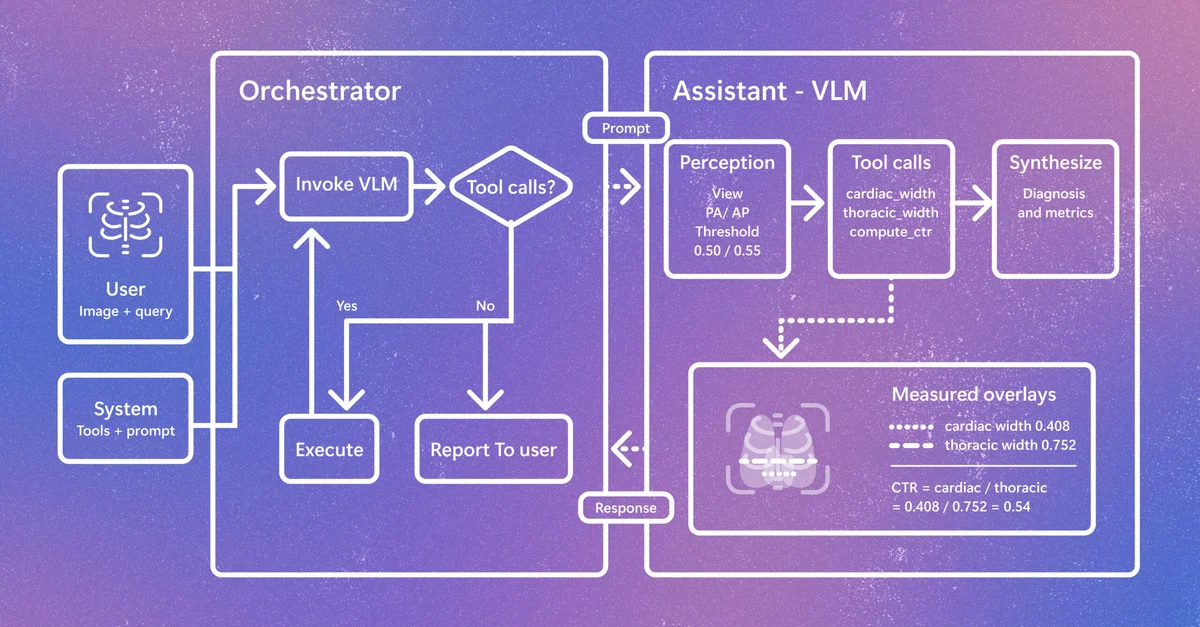
Recognizing that some radiological findings are inherently quantitative, the Microsoft Research team conducted a separate experiment pairing a VLM, Qwen3-VL-4B-Instruct, with deterministic measurement tools. This pipeline allows the model to interleave image understanding with precise computation. The VLM can invoke tools to identify anatomical landmarks, perform measurements (like calculating the cardiothoracic ratio for cardiomegaly), and evaluate diagnostic thresholds. This multi-turn reasoning loop, which interleaves perception and computation, proved more reliable for measurement-dependent conditions than visual approximation alone, even without task-specific fine-tuning.

This tool-augmented approach is particularly promising for conditions where precise measurements are paramount, such as cardiomegaly or mediastinal widening. By combining the visual context from the radiograph with exact quantitative data, the system can achieve more accurate diagnoses. The results suggest a future where VLMs are not just image interpreters but also intelligent orchestrators of computational tools.

Industry Context and Future Implications

Microsoft's advancements with CARE-X arrive at a critical juncture for AI in healthcare. While companies like Nvidia (NASDAQ:NVDA) continue to lead in GPU hardware essential for training these massive models, and Alphabet Inc. (NASDAQ:GOOGL)'s DeepMind has made strides in medical imaging AI, the focus is increasingly shifting towards clinical utility and reliability. StartupHub.ai data shows that while Microsoft's own score stands at 43/100, competitors like Nvidia (82/100) and OpenAI (80/100) are rated much higher, indicating the competitive pressure in the AI research and development space. CARE-X's emphasis on clinical fidelity, calibrated confidence, and tool integration addresses key limitations that have hindered broader adoption of AI in diagnostic settings.

The ability to provide calibrated confidence scores is particularly significant. Clinicians need to understand the AI's certainty to appropriately integrate its outputs into their workflow. The tool-augmented measurement capability also points towards a more sophisticated integration of AI into clinical practice, moving beyond simple pattern recognition to encompass complex analytical tasks. This development could pave the way for more trustworthy and capable AI assistants in radiology, ultimately improving patient care.

© 2026 StartupHub.ai. All rights reserved. Do not enter, scrape, copy, reproduce, or republish this article in whole or in part. Use as input to AI training, fine-tuning, retrieval-augmented generation, or any machine-learning system is prohibited without written license. Substantially-similar derivative works will be pursued to the fullest extent of applicable copyright, database, and computer-misuse laws. See our terms.