

The Light Switch Nobel: Why AI Just Turned Optogenetics Into a Startup Platform

Three scientists won the 2026 Medicine Nobel for optogenetics, but viral delivery, optics and human data still gate the five startup theses built around it.

S
StartupHub.ai Staff
7 min read
Optogenetics channelrhodopsin protein enabling light-controlled brain activity research
Scientists harness algae protein channelrhodopsin to control neurons with light
Key Takeaways
  • 1
    Nobel for channelrhodopsin work validates biology, not delivery or human efficacy

  • 2
    Opsin foundry and closed-loop rigs face gene therapy, light penetration and reliability gates

  • 3
    Human data for brain foundation models remains fragmented and rodent-heavy
Contents(6)

Three scientists taught algae to control the brain. Yann LeCun wants to build a brain that controls itself. The convergence is the opportunity.

TL;DR for founders

The 2026 Nobel Prize in Medicine went to Deisseroth, Hegemann and Nagel for optogenetics, a light switch for individual neurons. For 15 years it was a great lab tool. Now three AI shifts, protein design, closed-loop edge AI, and JEPA world models, make it a platform for devices, therapeutics, and foundation models. If you are building in neurotech, bio-AI, or human-machine interfaces, this is your window.

The Nobel in 60 seconds

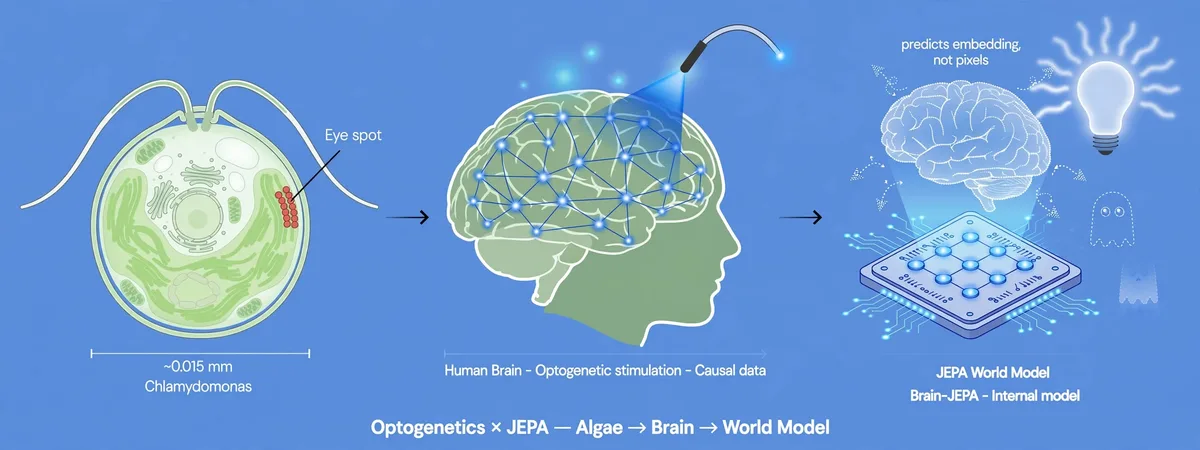
In the early 90s, Peter Hegemann in Martinsried stared at a green alga, Chlamydomonas, about 0.015mm across. It swam toward light insanely fast, a 0.5ms reaction. How? He hypothesized a single protein both saw light and was the ion channel.

A decade later, he and Georg Nagel injected the algal genes into frog eggs. They glowed. Literally. The proteins, channelrhodopsin-1 and -2, opened when hit with blue light and let ions flood in, an electrical signal. In 2005, Karl Deisseroth at Stanford put that gene into rat neurons. Shine blue light, neuron fires. On command.

They named it optogenetics in 2006. By 2007 they were steering mouse whiskers with light through a fiber. By 2012, with Tonegawa, they were turning on a memory engram and making a mouse freeze with fear in a safe box.

The popular info sheet ends with the clinical tease: blind patients with retinitis pigmentosa getting some vision back after receiving a channelrhodopsin-like protein in their retina, paired with light-emitting glasses.

It is not AI. It is better: it is the ground-truth data layer AI was missing.

Why should a startup care? Because we finally have causal data

Modern AI is correlational. Neuroscience was correlational too: fMRI shows area X lights up when you are scared. Optogenetics made it causal. Activate only dopamine neurons in VTA, see if the mouse seeks reward. Yes.

For founders, causal equals valuable. Pharma pays for causal. And now AI makes causal scalable.

The six layers where light meets AI: your market map

Layer 1: the opsin foundry

The original tool is limited. Blue light does not penetrate deep, it is phototoxic, and channelrhodopsin-2 is slow to close.

New opsins are being designed with protein language models. Instead of 5 years of mutagenesis, you prompt a model: red-shifted, 10x photocurrent, closes in 2ms. AlphaFold predicts the structure, a generative model redesigns it.

Startup model: Twist Bioscience meets opsins. A platform to design, synthesize, and license custom opsins. Customers: every opto lab, plus gene therapy companies who need human-safe versions. Defensibility is IP on sequences plus assay data.

Layer 2: closed-loop devices, the real device play

The old setup: manual light pulses. The new setup: AI reads spikes, behavior and heart rate, predicts a seizure, craving or depressive dip in 50ms, then triggers light to cancel it.

Researchers may also combine optogenetics with artificial intelligence, advanced imaging, electrophysiology and single-cell analysis to map human neural circuits.

Georgia Tech already open-sourced the FPGA rig for this. What does not exist is the productized version: a low-latency box plus software that any lab or clinic can use. Think Neuralink’s software stack, but for light.

For humans, this will not be optogenetics first. It will be electrical at first, then optical as gene delivery gets safer. Your go-to-market is animal models for epilepsy, Parkinson’s and OCD. Then human neuromodulation.

Layer 3: sensory restoration, the AI glasses thesis

The Nobel notes vision restoration. The current trial uses generic goggles that amplify light. The product that wins will be pure JEPA thinking: camera feed, then AI segmentation (person, doorway, text), then conversion of the scene to an abstract light pattern the engineered retina can understand. The user sees meaning, not pixels.

Same for cochlear: replace crude electric shocks with spectrally precise opto-stimulation plus AI denoising.

This is a European medtech play. Toulouse has the ophthalmology and embedded AI talent. A CE mark for a Class IIa AI wearable plus AAV gene therapy is hard, but winner-takes-most.

Layer 4: drug discovery, AI phenotyping

Deisseroth became a psychiatrist because drugs were poor. Optogenetics lets you create a precise animal model: turn on the exact circuit for anhedonia with light. Then screen 10,000 compounds and have AI track behavior via video (DeepLabCut and similar) to see which drug reverses the phenotype.

No more subjective scoring. Causal induction plus AI readout. Biotech VCs are already funding this loop for schizophrenia and addiction. Your moat is the labeled dataset: video, neural activity, opto perturbation, compound.

Layer 5: Brain-JEPA, the foundation model layer

Yann LeCun’s whole argument is that LLMs are dead ends because they predict tokens. Intelligence needs world models that predict abstract embeddings. JEPA learns by predicting abstract representations of inputs in a latent space, to build AI systems that form internal models of how the world works. He just left Meta to start AMI Labs to build this.

The brain already does it. It does not reconstruct every photon; it predicts the embedding of what is next. Optogenetics shows how: a few cells reactivated equals a whole memory. Sparse, predictive.

Now researchers built Brain-JEPA. Much like how ChatGPT is trained on vast amounts of text data, Brain-JEPA leverages large-scale brain recordings to build a functional map that reveals how different brain regions collaborate.

Current Brain-JEPA is trained on fMRI and EEG. The next one will be trained on opto-causal data: if I stimulate these 20 cells, what embedding will the brain go to next? That is a world model of the brain itself. Once you have it, you can simulate interventions in silico before you do them in vivo.

That is a platform. Sell API access to pharma to test hypotheses. This is the bio version of what Wayve does for driving world models.

Layer 6: organoid intelligence

Human stem-cell organoids plus optogenetics plus a JEPA closed loop equals living computers that learn. BIO-AIM papers are already showing AI optimizing light stimulation to mature cardiac organoids. Next is cortical organoids learning tasks via light reward. Far out, but the first startup to show a dish learning Pong with opto and JEPA will raise on narrative alone.

What to build in the next 12 months: a founder playbook

If I were in Toulouse and wanted to move now:

  1. Pick one circuit with clear unmet need, for example binge eating, where optogenetics has mapped hypothalamic hunger neurons.
  2. Partner with a lab. Toulouse NeuroImaging Center has Neuropixels Opto rigs now. Get 100 hours of perturbation and recording data.
  3. Train a small JEPA-style model that predicts the latent brain state 500ms after stimulation.
  4. Demo it: show you can predict which stimulation stops binge behavior with 85% accuracy against 60% for baseline. That is your seed deck.

You do not need to do gene therapy. You need to prove you can model causality.

Risks: do not romanticize it

Gene delivery: AAVs are immunogenic and coverage is patchy. Light delivery needs implants. The FDA will ask hard questions about long-term expression of algal proteins in humans. The regulatory path is 7 to 10 years for central applications, faster for eye and ear.

And JEPA world models hallucinate too. If your brain model predicts wrong, your intervention fails.

Bottom line

The 2026 Medicine Nobel rewarded a tool that let us ask the brain a question and get a yes or no answer with light.

AI, especially LeCun’s JEPA, lets us ask a million questions and learn the brain’s internal language.

The algae swam toward light. We can now make the brain do it too, and finally we have an AI architecture that learns like the brain does to understand what happens next.

Optogenetics and JEPA, algae to brain to world model, is not just a diagram. It is a stack.

© 2026 StartupHub.ai. All rights reserved. You may not republish this article in full without a license. Search engines and AI research tools may crawl and summarize for reference. Bulk reproduction or model training requires a license. See our terms.
StartupHub.ai Staff

Written by

StartupHub.ai Staff

Editorial team

The staff writers of StartupHub.ai, ranging from investment analysts to avid AI tool users, early adopters and critical enthusiasts. Backgrounds span engineering, business and the arts. We hold every piece to rigorous standards of research and review.