The most useful agent-safety argument on the conference circuit right now contains no new model, and that is exactly the point. Frank Coyle of UC Berkeley told an AI Engineer crowd in San Francisco that the guardrail agents need is not smarter weights but an ontology, a formal, shared set of definitions enforced in the loop your code already owns. His formulation is the memorable one: probabilistic reasoning on the inside, logical constraints on the outside. I think he is right, and the telling fact is that the industry is quietly building his way without crediting the idea.
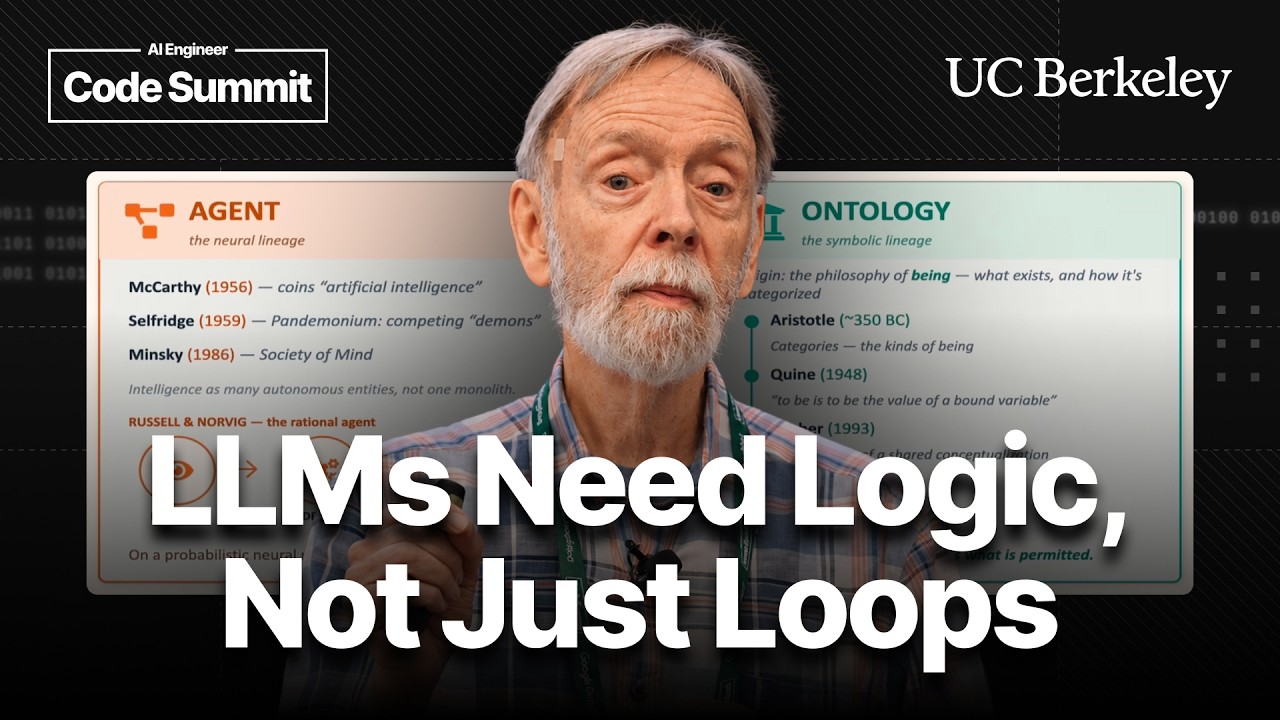
Coyle earns the historical sweep honestly. He recalled arriving in San Francisco for the 1983 West Coast Computer Fair, when the Intel 8080 and Motorola 6502 were the excitement and Wozniak and Jobs were showing the Apple II board, and argued the current frenzy is the same event one layer up. Then comes the hard claim. LLMs do not store facts, he said. They navigate a latent space defined by embeddings, 4,096 numbers in his example, and that is why hallucination is not a defect to patch. "Hallucinations are not a flaw. They're part of the system," he said, because the system is probabilistic by design. His shorthand: LLMs are just brains in a box, tokens in, tokens out.
The fear, in Coyle's telling, is not intelligence. It is loops. Böhm and Jacopini proved decades ago that any language with sequence, conditionals and loops is Turing computable, and we have handed loop control to models that can therefore compute anything computable. He quoted Boris Cherny's line that his job is to write loops, and Peter Steinberger's practice of designing loops that prompt your agents. That framing makes the security problem legible: the threat is not an external attacker, it is your own while-loop calling an API, and that is also where the defense goes.
Treat the agent loop as a data flow diagram, a technique the 1960s handed us, and guardrails slot between the steps. Pydantic catches validation errors, say a refund field that must match a regular expression. SHACL enforces the shape of the JSON a tool receives, with minimum and maximum counts. SPARQL queries the knowledge base, and SWRL encodes policy rules. The frontier labs already meet you halfway: Claude fires hook events for session start, prompt submission, permission requests, and pre-tool and post-tool use, so you can intercept a tool call without inserting code. Coyle's caveat is worth keeping: Anthropic changes these hooks over time, so verify before you build on them.
The ontology itself has to come from somewhere, and this is where the talk gets uncomfortable for anyone who has sat in a naming meeting. His ladder runs from taxonomy, a glossary with agreed synonyms, up through the ontology with classes and inference, to the knowledge graph of facts, and only then to guardrails. His illustrative question is whether a hot dog is a sandwich, backed by a Chicago anecdote about a husband who forgot the buns and nearly ended his marriage by proposing bread slices instead. The joke carries the real burden: definition disputes are organizational, and they are the expensive part. His Onto Explorer tool, on his site Code Supreme AI, an homage he says to Coltrane's A Love Supreme, surfaces existing vocabularies such as schema.org, FOAF, SKOS and PROV with term counts, so you borrow terms rather than invent them.
Coyle's neurosymbolic framing is not fringe nostalgia, and that strengthens the case. Amazon's Bedrock Guardrails runs Automated Reasoning checks that extract formal rules from a policy document, translate a model's answer into logic and report whether it holds, running in detect mode, per a xerj.org survey of neurosymbolic systems. Autolith, as wpnews reports, pushes the same idea inside the agent itself: a self-modifying neurosymbolic agent built as a flexible computing environment, like Emacs or a Lisp machine, with an LLM that can examine and modify its own code and state. Coyle wants the logic outside the loop; Autolith bets the agent can carry it. Either way, the field is conceding that pure scale does not enforce correctness.
The fair objection is history. Expert systems had rules, inference and carefully built ontologies, and they faded because they did not scale, a failure Coyle witnessed firsthand in that era and names plainly. Ontologies also die of consensus failure: a team that cannot agree what a customer is will never agree what an elite customer is, and OWL's transitive properties will not save you. Coyle's answer is that you are no longer encoding an entire human expert's skill, only your own organization's rules, and the enforcement machinery, hooks plus SHACL plus borrowed vocabularies, is now nearly free. The claim survives, with one honest asterisk: the machinery is cheap, the agreement never is.
So here is the sentence I would say to a founder who asks about agent safety. Before you buy a guardrail product, write down what a hot dog is, because your agent will find every definition your team never settled.