

Agentic AI Needs Ontologies for Guardrails, Says UC Berkeley Expert

Frank Coyle of UC Berkeley explains how ontologies act as essential guardrails for AI agents, combining probabilistic reasoning with formal logic for safer, more coherent systems.

7 min read
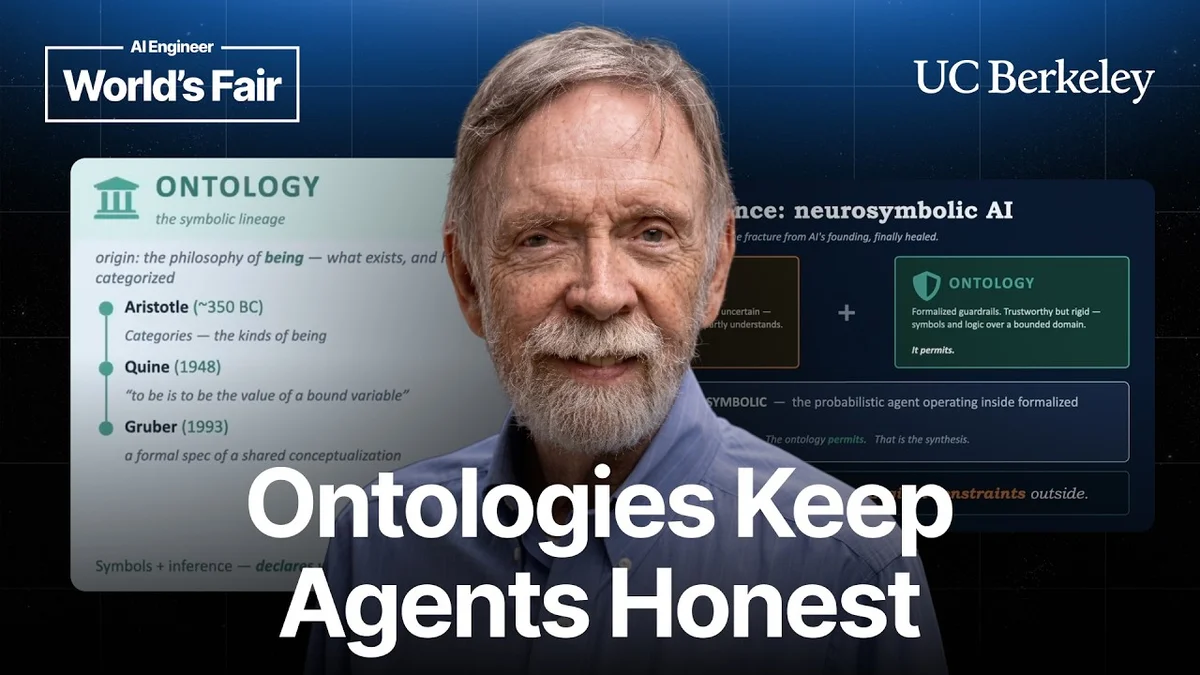
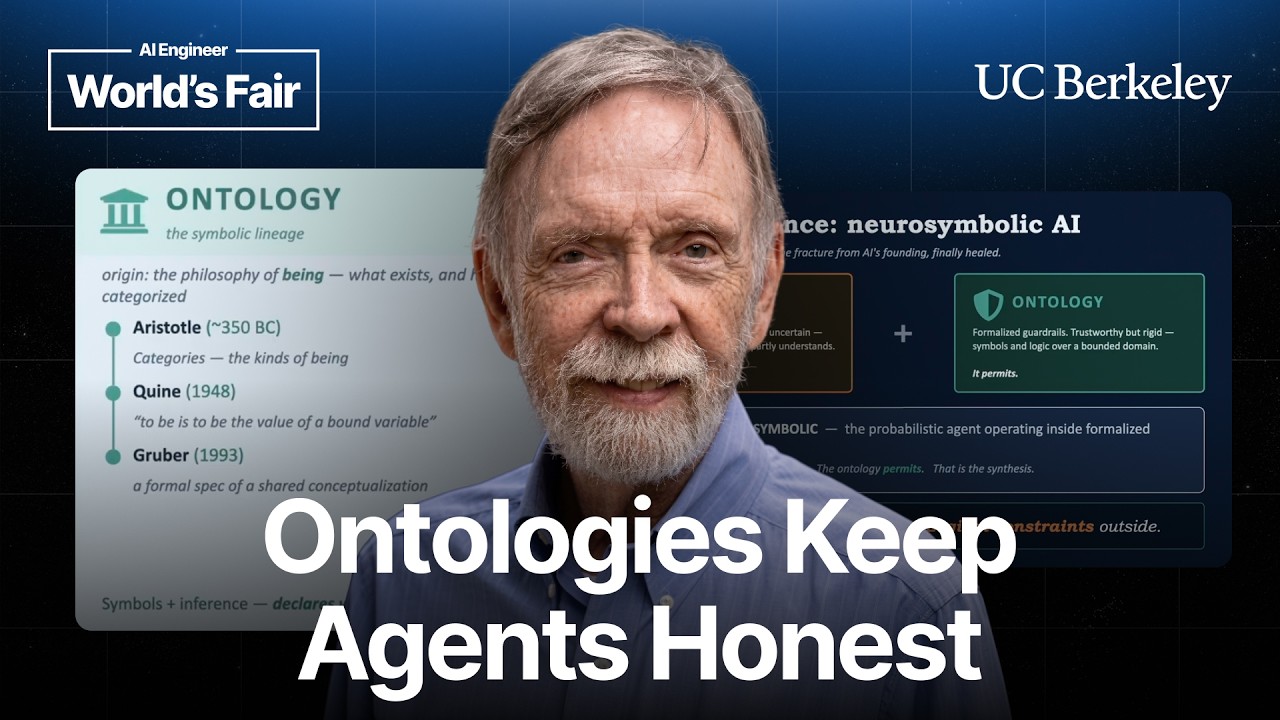
Frank Coyle of UC Berkeley presenting on agentic systems and ontologies
AI Engineer

Visual TL;DR. Agentic AI uses Probabilistic Reasoning. Probabilistic Reasoning requires Ontologies Needed. Ontologies Needed provide Formal Logic. Formal Logic enables Build Ontologies. Build Ontologies leads to Safer AI Systems. Ontologies Needed act as Guardrails for AI. Guardrails for AI achieves Safer AI Systems.

  1. Agentic AI: AI agents perceive, decide, and act, driving current technological advancements
  2. Probabilistic Reasoning: AI agents inherently operate with probabilities, needing structure for reliability
  3. Ontologies Needed: formal logic and structure are critical guardrails for AI agent coherence
  4. Formal Logic: ontologies provide a structured framework for AI agent decision-making
  5. Build Ontologies: combining probabilistic reasoning with formal logic for robust systems
  6. Safer AI Systems: ontologies enable more coherent and reliable AI agent operations
  7. Guardrails for AI: ontologies act as essential guardrails, ensuring AI agents operate reliably
Visual TL;DR
Visual TL;DR, startuphub.ai Ontologies Needed act as Guardrails for AI. Guardrails for AI achieves Safer AI Systems act as achieves Agentic AI Ontologies Needed Safer AI Systems Guardrails for AI From startuphub.ai · The publishers behind this format
Visual TL;DR, startuphub.ai Ontologies Needed act as Guardrails for AI. Guardrails for AI achieves Safer AI Systems act as achieves Agentic AI AI agents perceive, decide, and act,driving current technological advancements Ontologies Needed formal logic and structure are criticalguardrails for AI agent coherence Safer AI Systems ontologies enable more coherent andreliable AI agent operations Guardrails for AI ontologies act as essential guardrails,ensuring AI agents operate reliably From startuphub.ai · The publishers behind this format
Visual TL;DR, startuphub.ai Ontologies Needed act as Guardrails for AI. Guardrails for AI achieves Safer AI Systems act as achieves Agentic AI AI agents perceive,decide, and act,driving current… Ontologies Needed formal logic andstructure arecritical guardrails… Safer AI Systems ontologies enablemore coherent andreliable AI agent… Guardrails for AI ontologies act asessentialguardrails,… From startuphub.ai · The publishers behind this format
Visual TL;DR, startuphub.ai Agentic AI uses Probabilistic Reasoning. Probabilistic Reasoning requires Ontologies Needed. Ontologies Needed provide Formal Logic. Formal Logic enables Build Ontologies. Build Ontologies leads to Safer AI Systems. Ontologies Needed act as Guardrails for AI. Guardrails for AI achieves Safer AI Systems uses requires provide enables leads to act as achieves Agentic AI AI agents perceive, decide, and act,driving current technological advancements Probabilistic Reasoning AI agents inherently operate withprobabilities, needing structure forreliability Ontologies Needed formal logic and structure are criticalguardrails for AI agent coherence Formal Logic ontologies provide a structured frameworkfor AI agent decision-making Build Ontologies combining probabilistic reasoning withformal logic for robust systems Safer AI Systems ontologies enable more coherent andreliable AI agent operations Guardrails for AI ontologies act as essential guardrails,ensuring AI agents operate reliably From startuphub.ai · The publishers behind this format
Visual TL;DR, startuphub.ai Agentic AI uses Probabilistic Reasoning. Probabilistic Reasoning requires Ontologies Needed. Ontologies Needed provide Formal Logic. Formal Logic enables Build Ontologies. Build Ontologies leads to Safer AI Systems. Ontologies Needed act as Guardrails for AI. Guardrails for AI achieves Safer AI Systems uses requires provide enables leads to act as achieves Agentic AI AI agents perceive,decide, and act,driving current… ProbabilisticReasoning AI agentsinherently operatewith probabilities,… Ontologies Needed formal logic andstructure arecritical guardrails… Formal Logic ontologies providea structuredframework for AI… Build Ontologies combiningprobabilisticreasoning with… Safer AI Systems ontologies enablemore coherent andreliable AI agent… Guardrails for AI ontologies act asessentialguardrails,… From startuphub.ai · The publishers behind this format

In the rapidly evolving world of artificial intelligence, the ability of AI agents to operate reliably and coherently is paramount. Frank P. Coyle, PhD, an educator at UC Berkeley with decades of experience in computer science, recently delved into the critical role of ontologies in achieving this goal during a presentation at the AI Engineer World's Fair.

Agentic AI Needs Ontologies for Guardrails, Says UC Berkeley Expert - AI Engineer
Agentic AI Needs Ontologies for Guardrails, Says UC Berkeley Expert — from AI Engineer

The Convergence of Agents and Ontologies

Coyle highlighted the current AI landscape, noting that while the computer science degree was once a guaranteed path to employment, the rise of AI has shifted the focus. He emphasized that AI and agents are now the key areas to explore, posing the question of how to effectively navigate this new technological universe.

His core argument centered on the synergy between AI agents, which are probabilistic in nature, and ontologies, which provide formal structure and logic. Coyle explained that agents, conceived as entities that perceive, decide, and act, are the driving force behind many current AI applications. However, their probabilistic nature, while enabling creativity and pattern recognition, also leads to potential issues like hallucinations.

Ontologies, on the other hand, offer a formal specification of a shared conceptualization. Coyle traced their origins back to Aristotle's categories of being and their more recent formalization by philosophers like Quine and Gruber. He described ontologies as providing the necessary "guardrails" for AI agents, ensuring their outputs are grounded in logical constraints and world knowledge.

Building and Utilizing Ontologies

Coyle outlined two primary methods for building ontologies: top-down and bottom-up. The top-down approach involves experts defining entities, properties, and relationships, reminiscent of early expert systems. The bottom-up approach extracts information from data sources, such as documents and customer reviews, using techniques like named entity recognition and LLM mining.
He also stressed the importance of reusing existing ontologies, such as Schema.org, FOAF, Dublin Core, SKOS, and DBPedia (which powers Wikipedia), to avoid reinventing the wheel and to benefit from established knowledge structures.

The presentation also touched upon augmenting ontologies with technologies like RDFS and OWL (Web Ontology Language). Coyle explained how these can enable inference and enforce constraints, such as ensuring that if 'A' is an ancestor of 'B', and 'B' is an ancestor of 'C', then 'A' is an ancestor of 'C'. Functional properties, like 'has father', can also be constrained to ensure logical consistency.

The Role of Loops and Guardrails

Coyle then shifted to the concept of agents and loops, noting that while loops are fundamental to computation, they also present dangers like infinite loops, goal drift, and token cost blow-ups. He argued that ontologies, through RDFS and OWL, can act as the necessary guardrails to keep these loops in check and ensure agents operate within defined boundaries.

He provided a code example illustrating an agent loop, emphasizing how ontologies can be used to validate both the input to a tool call and the output received. This validation process, he explained, helps to ensure the agent's actions are reasonable and aligned with the desired outcomes.

A Philosophy of Making

Coyle concluded with a powerful educational philosophy, quoting Sister Corita Kent: "Nothing is a mistake. There is no win and no fail. There's only make." He encouraged a hands-on, iterative approach to learning and building, emphasizing the importance of engaging one's senses and actively creating rather than passively consuming information.

Ultimately, Coyle's message underscored the critical need for a structured, logical framework like ontologies to complement the probabilistic power of LLMs, leading to the development of more reliable, understandable, and safe AI agents.

© 2026 StartupHub.ai. All rights reserved. Do not enter, scrape, copy, reproduce, or republish this article in whole or in part. Use as input to AI training, fine-tuning, retrieval-augmented generation, or any machine-learning system is prohibited without written license. Substantially-similar derivative works will be pursued to the fullest extent of applicable copyright, database, and computer-misuse laws. See our terms.