

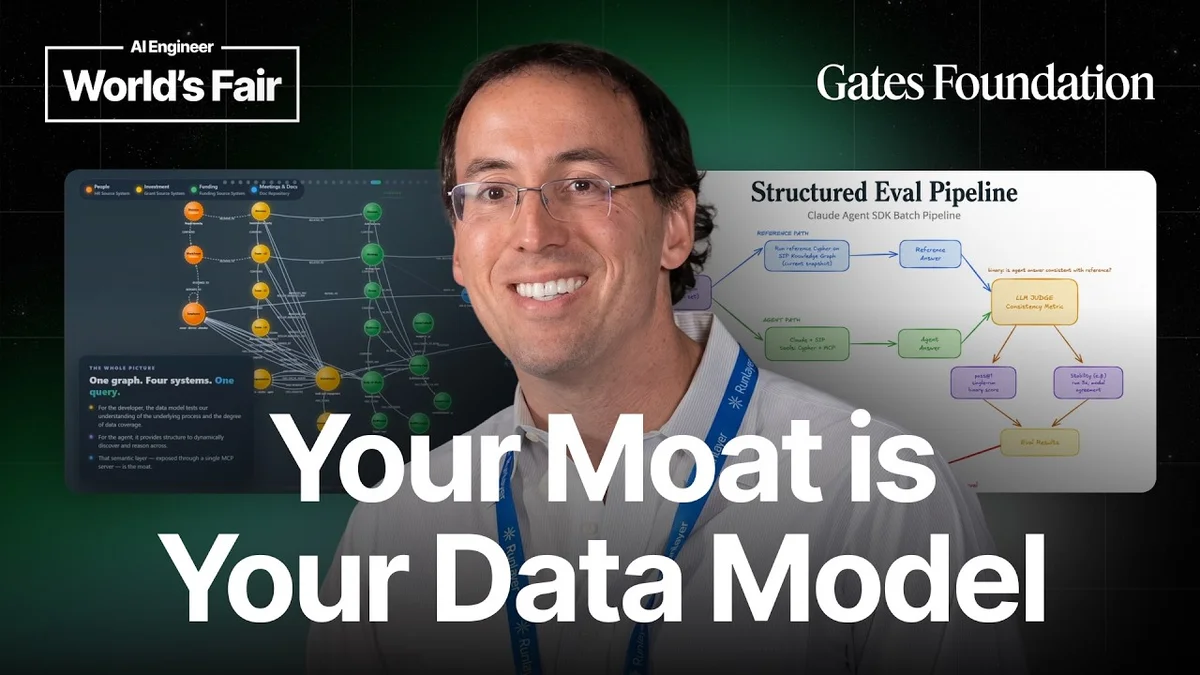
Gates Foundation's Mike Phipps on Data Models as AI Moats

Mike Phipps of the Gates Foundation details how a robust data model is key to building defensible AI, showcasing their Strategic Intelligence Platform (SIP).

Mike Phipps speaking at AI Engineer World's Fair on a stage with a 'World's Fair' backdrop.
AI Engineer
Visual TL;DR
AI LandscapeDriver
From the articlePhipps emphasized that in the rapidly evolving AI landscape, an organization's true defensible advantage lies not in the AI models themselves, but in its data model.
Production RealitiesDriver
production realities introduce constraints like monitoring, upkeep, and dependencies
From the articlePhipps articulated that while cloud code and rapid development can accelerate AI deployment, production realities introduce constraints.
Data Owner EngagementContext
criticality of engaging data owners for effective data model development
From the article 2 mentionsA significant aspect of building the SIP platform is the engagement with data owners.
Data Model MoatContext
true defensible advantage lies in robust data models, not just AI models
From the article 2 mentionsPhipps elaborated on the data model itself, explaining the use of multiple hierarchies and how they are represented within the graph.
Gates Foundation SIPCore
Strategic Intelligence Platform (SIP) designed to structure operational data
From the article 4 mentionsMike Phipps, Lead AI Engineer for Knowledge Management & Insights at the Gates Foundation, recently shared insights into the organization's "Strategic Intelligence Platform" (SIP) at the AI Engineer World's Fair.
Agentic RetrievalEffect
From the article 4 mentionsHe detailed how SIP was designed to structure operational data for agentic retrieval, creating a robust knowledge graph that underpins the foundation's AI initiatives.
Future WorkflowsEffect
SIP enables future agentic workflows and enhanced decision-making
From the article 3 mentionsThe user experience is designed around agentic chat and workflows, allowing agents to traverse the semantic graph.
AI InitiativesOutcome
From the articleHe detailed how SIP was designed to structure operational data for agentic retrieval, creating a robust knowledge graph that underpins the foundation's AI initiatives.
Contents(5)

Mike Phipps, Lead AI Engineer for Knowledge Management & Insights at the Gates Foundation, recently shared insights into the organization's "Strategic Intelligence Platform" (SIP) at the AI Engineer World's Fair. Phipps emphasized that in the rapidly evolving AI landscape, an organization's true defensible advantage lies not in the AI models themselves, but in its data model. He detailed how SIP was designed to structure operational data for agentic retrieval, creating a robust knowledge graph that underpins the foundation's AI initiatives.

Gates Foundation's Mike Phipps on Data Models as AI Moats - AI Engineer
Gates Foundation's Mike Phipps on Data Models as AI Moats, AI Engineer

The "Moat" of Data Modeling

Phipps articulated that while cloud code and rapid development can accelerate AI deployment, production realities introduce constraints. Organizations must decide how much of their deployed stack they want to own, considering monitoring, upkeep, and dependencies. Furthermore, user appetite for decentralized access and product differentiation from SaaS offerings are key considerations. For the Gates Foundation, the core competitive advantage is their deep understanding of internal processes and the tacit knowledge required to run AI effectively. "Our moat here was our understanding of our internal processes and the tacit knowledge needed for any AI, no matter how good AI gets," Phipps stated.

Structuring for Agentic Retrieval

The SIP platform aims to structure operational data for agentic retrieval by building a knowledge graph. Phipps explained the process, which begins with consolidating data from various systems of record, including HR, investments, and funding sources, into a data lakehouse. This unified data then goes through a data curation layer for pre-processing, extraction, and enrichment before being fed into the SIP platform. The user experience is designed around agentic chat and workflows, allowing agents to traverse the semantic graph. "It's a cross-system semantic graph layer that agents can reason across," Phipps explained.

The Criticality of Data Owner Engagement

A significant aspect of building the SIP platform is the engagement with data owners. Phipps highlighted that this engagement is critical for understanding the full meaning of data fields, the structure of datasets, how to join them, and their limitations and systematics. This procedural understanding and tacit knowledge are essential for AI to function effectively within an enterprise. The process involves extensive data curation, including filtering, deduplication, extraction of structured fields, semantic chunking for unstructured documents, and various forms of tagging and metadata creation. Governance, including PII masking and sensitive data classification, is also a crucial component.

The Gates Foundation's Data Landscape

To illustrate the complexity of the data they are modeling, Phipps provided an overview of the Gates Foundation's operations. In 2023 alone, the foundation managed over 2,000 grants, many exceeding $5 million, impacting over 100 countries. With approximately 4,000 employees and a total annual disbursement of over $7 billion, the foundation operates across numerous divisions like Global Development, Global Health, and Gender Equality. The SIP platform models this intricate structure, encompassing funding paths, investment portfolios, and the people involved.

The Future of SIP and Agentic Workflows

Phipps elaborated on the data model itself, explaining the use of multiple hierarchies and how they are represented within the graph. He also touched upon the integration of unstructured data, such as meeting documents, into the graph structure. Looking ahead, the focus is on continuing to fill out existing data, expanding the primary graph to additional enterprise-wide datasets, and developing more sophisticated agentic workflow experiences. These workflows aim to provide controlled generation of artifacts, reports, and search capabilities, offering a more governed experience compared to general chat interactions.

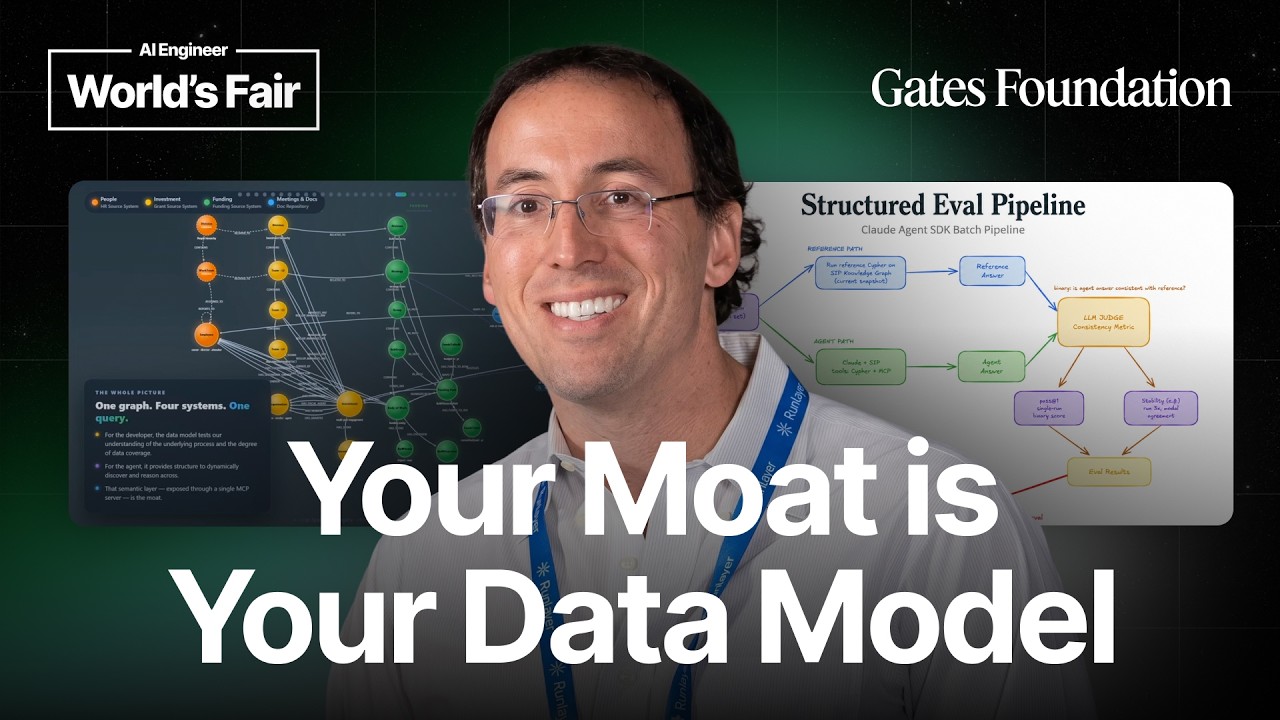
The presentation concluded with a look at the evaluation process for the SIP platform, emphasizing how evals help identify gaps and improve performance over time. Phipps expressed optimism about the platform's ability to unlock deeper insights from the foundation's vast data resources, ultimately supporting its mission to solve critical global problems.

© 2026 StartupHub.ai. All rights reserved. You may not republish this article in full without a license. Search engines and AI research tools may crawl and summarize for reference. Bulk reproduction or model training requires a license. See our terms.
Daniel Singer

Written by

Daniel Singer

Editor, StartupHub.ai

Daniel Singer is the editor of StartupHub.ai, a technology expert and thought leader on AI and its applications across sectors, from fintech and healthcare to developer tooling and consumer software. He writes and tests the tools covered here thoroughly and regularly, and built StartupHub.ai to give founders, operators and buyers a clearer read on what they are actually being sold.