

AI Synthetic Personas: Promise and Pitfalls

Ishan Anand of Insight Sciences explains the rise of AI synthetic personas, their potential, and critical failure modes, drawing parallels to weather forecasting.

4 min read
Ishan Anand speaking on stage about AI synthetic personas
AI Engineer

The use of Large Language Models (LLMs) to create synthetic personas has rapidly evolved from a niche experiment to a significant tool in market research and product development. Ishan Anand, Chief AI Officer at Insight Sciences, presented a "field guide" at the AI Engineer World's Fair, demystifying the technology, its potential, and its crucial limitations.
AI Synthetic Personas: Promise and Pitfalls - AI Engineer
AI Synthetic Personas: Promise and Pitfalls — from AI Engineer

Synthetic Personas: Beyond the Hype

Anand drew a parallel between synthetic personas and weather forecasting, both unlocked by advancements in compute and data. Like weather forecasts, synthetic personas operate within specific parameters and can become inaccurate when pushed beyond their limits. Anand emphasized that while the technology shows immense promise, understanding its failure modes is as important as recognizing its potential.

The core principle behind synthetic personas involves steering LLM outputs by assigning them a role or persona. This allows companies to test product concepts and messaging against simulated respondents. Anand highlighted that this field has seen significant market momentum, evidenced by increasing funding and media coverage.

Anand pointed to historical parallels, noting that as far back as the 1950s and 60s, companies like Simulmatics promised "people forecasts" based on raw statistics and early computing power, a feat that ultimately proved unsuccessful. Today, however, LLMs offer a new medium, language itself, to simulate human behavior and decision-making in ways previously impossible through purely numerical models.

Understanding Failure Modes

Despite their potential, Anand cautioned that synthetic personas are prone to several critical failure modes:

  • Latent Confounders: When LLMs lack sufficient context, they may infer or invent correlations that skew results. For instance, in a pricing experiment, an LLM might use price as a proxy for other variables (like expiration dates or competitor pricing) that humans would treat as fixed, leading to counterintuitive outcomes like increased purchase probability with higher prices. The lesson is to "richly ground" personas in detailed context within prompts.
  • Prompt Sensitivity: LLMs can exhibit extreme sensitivity to the wording and ordering of prompts. Minor changes can lead to significantly different outputs, a phenomenon more pronounced than in human respondents. Durability testing of personas is therefore essential.
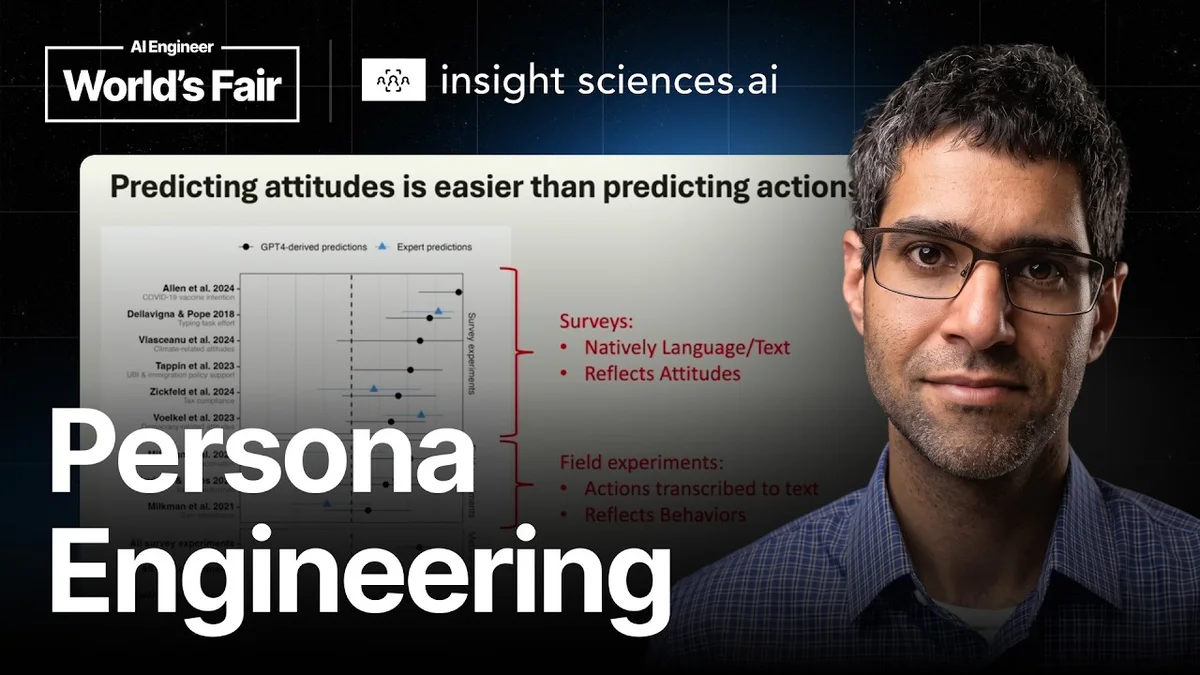
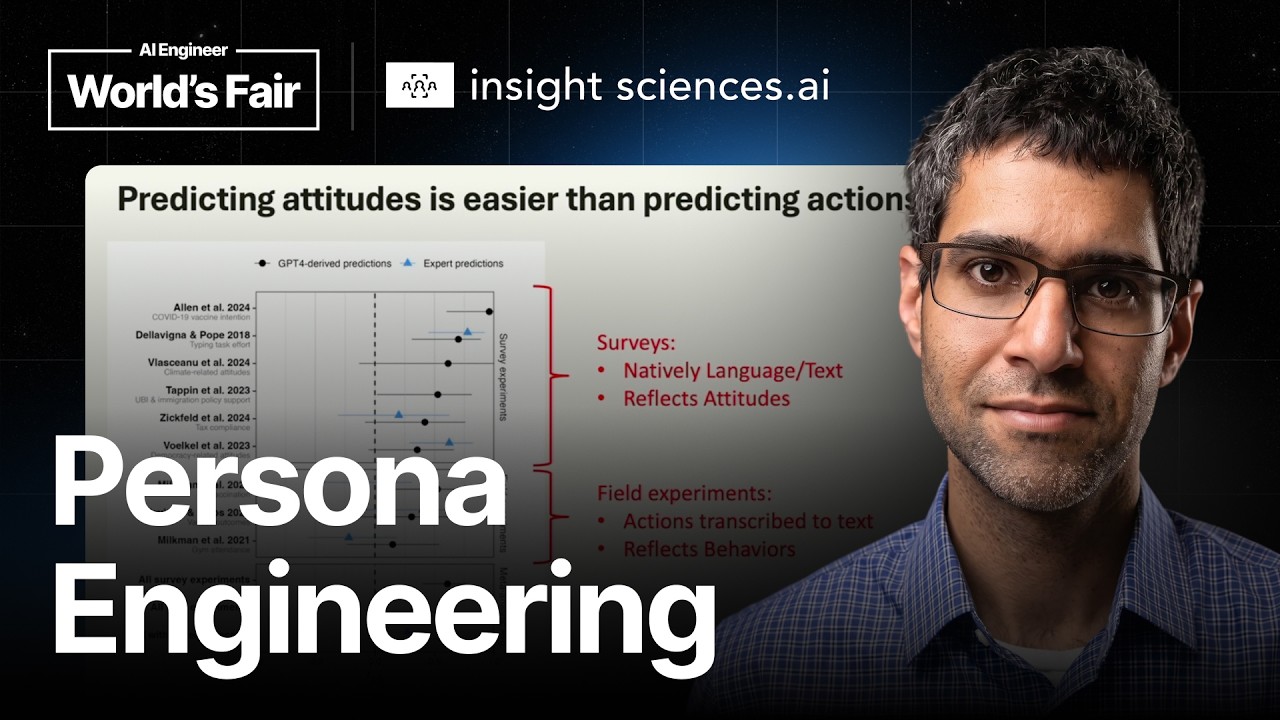
  • Attitudes vs. Actions: LLMs are trained on what people say, not necessarily what they do. This makes predicting stated attitudes easier than predicting actual behaviors, as attitudes are more readily available in text-based training data.

To illustrate the potential for LLMs to go astray, Anand shared research where LLMs, when prompted with a simple pricing question, exhibited an inverted U-shaped purchase probability curve, even showing increased purchase likelihood with higher prices. This was attributed to the LLM inferring unstated variables, like product freshness or competitor pricing, based on the price itself.

Techniques for Effective Synthetic Personas

Anand then discussed several techniques for building more robust synthetic personas:

  • Prompting: The foundational method involves clearly defining the persona's attributes and task within the prompt. Early work, like the Argyle paper, used text completion models with straightforward persona descriptions.
  • Fine-tuning: For more specific or nuanced personas, fine-tuning models on relevant data can improve alignment. The Subpop paper demonstrated how fine-tuning on survey data could improve persona accuracy, even for unseen demographic groups, suggesting LLMs possess latent understandings that can be unlocked through task-specific training.
  • Elicitation and Calibration: A more sophisticated approach involves eliciting responses in a text format that humans naturally use, and then mapping that text back to a numerical scale. This method, by capturing richer semantic information, can better reproduce the variability and distribution of human responses, not just average values.

StartupHub.ai data indicates that companies in this space, such as Insight Sciences, are seeing significant growth, with Insight Sciences having raised $80 million in 2023. This highlights the increasing adoption and perceived value of synthetic persona technology.

Measuring Alignment and the Future

Anand stressed that synthetic samples do not boost statistical significance; they are simulations, not replacements for human data. The key to their utility lies in validation against real human responses. Metrics should focus on comparing the distributions of data generated by synthetic personas against ground truth data, accounting for inherent human variability and inconsistency.

He concluded by emphasizing that synthetic personas are not a replacement for human research but a complementary tool. In an era where AI agents increasingly mediate human interactions, understanding the human-AI dynamic is crucial. Synthetic personas, when used thoughtfully and validated rigorously, can turn human data into a dynamic, queryable asset, extending research insights across the entire product development lifecycle.

© 2026 StartupHub.ai. All rights reserved. Do not enter, scrape, copy, reproduce, or republish this article in whole or in part. Use as input to AI training, fine-tuning, retrieval-augmented generation, or any machine-learning system is prohibited without written license. Substantially-similar derivative works will be pursued to the fullest extent of applicable copyright, database, and computer-misuse laws. See our terms.