

Decagon's CTO on Forward-Deployed Engineering

Decagon's CTO, Sunny Rekhi, details the company's forward-deployed engineering model, highlighting its evolution, the dual role of its teams, and the importance of scalability and customer empowerment.

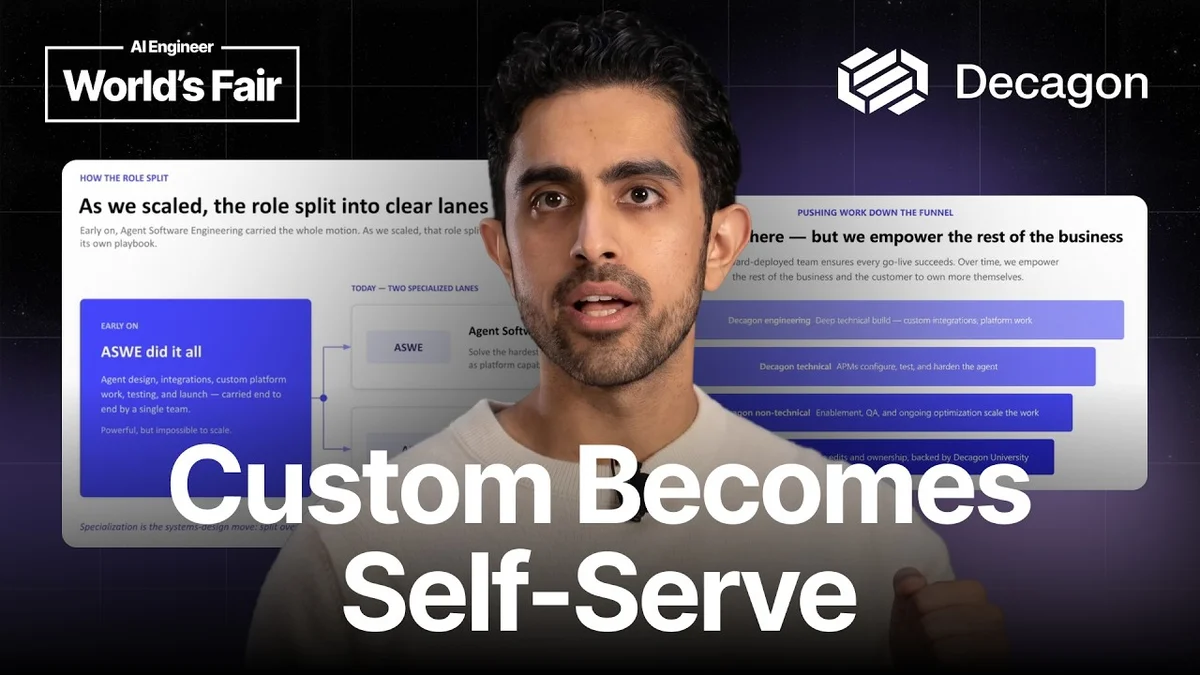
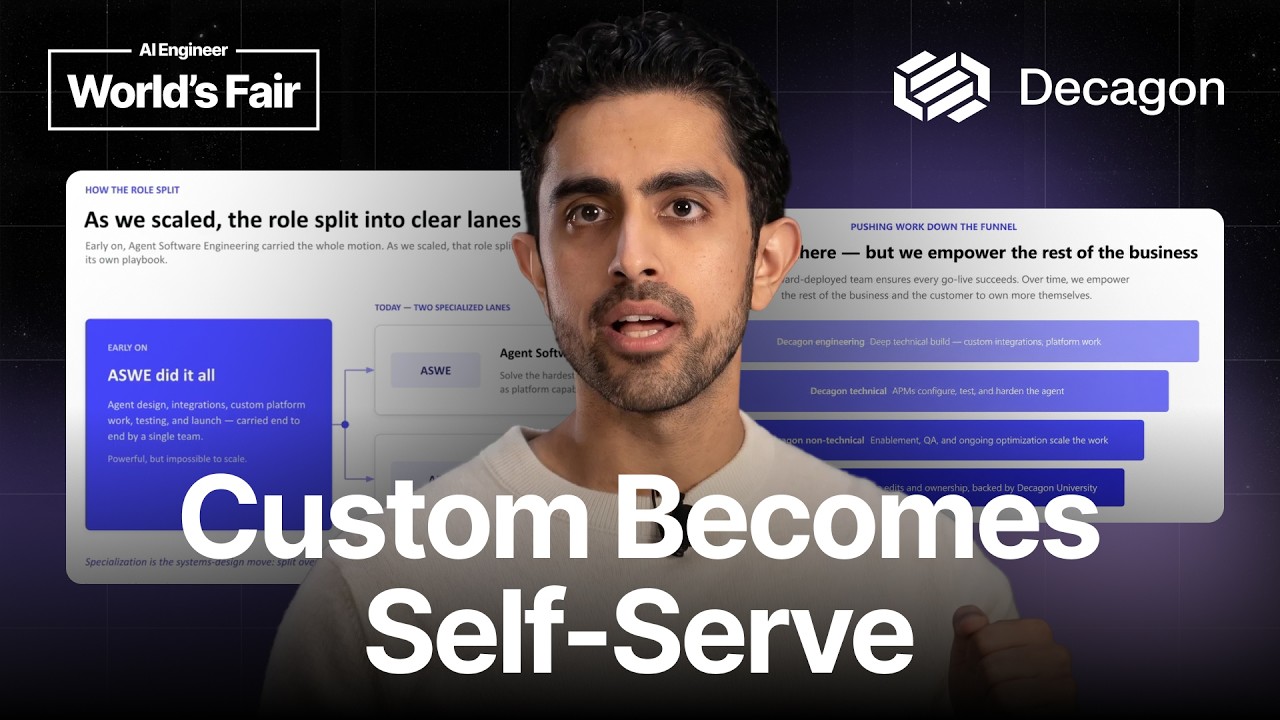
Sunny Rekhi, CTO of Decagon, presenting at AI Engineer World's Fair.
AI Engineer
Visual TL;DR
Traditional Support IssuesDriver
complex workflows, human agents, slow responses across multiple channels
From the articleSunny Rekhi, CTO of Forward Deployed Engineering at Decagon, recently shared insights into the company's unique approach to "forward-deployed engineering." Decagon offers a 24/7 AI customer service agent designed to replace traditional phone and email support with human-like interactions across multiple channels.
CTO Sunny RekhiCore
details Decagon's forward-deployed engineering model and its evolution
From the articleSunny Rekhi, CTO of Forward Deployed Engineering at Decagon, recently shared insights into the company's unique approach to "forward-deployed engineering." Decagon offers a 24/7 AI customer service agent designed to replace traditional phone and email support with human-like interactions across multiple channels.
Decagon AI AgentsCore
24/7 multilingual, omni-channel, human-like responses via phone or email
From the article 9+ mentionsRekhi explained that Decagon aims to handle complex customer support workflows that typically require human agents.
FDE Team Dual RoleContext
agent building for clients and integrating with backend systems
From the article 3 mentionsThis rapid scaling led to a restructuring of the FDE role.
Customer EmpowermentEffect
AI proactively reaches out for lease renewals, generating client revenue
From the article 9+ mentionsFor instance, the AI can proactively reach out to customers for lease renewals or extensions, integrating with backend systems to facilitate these actions.
Scalability FocusContext
scaling from 50 to 500 employees, maintaining quality and efficiency
From the articleHowever, he stressed that the scarcer skill is exercising restraint and considering scalability.
Restraint & ForesightContext
strategic growth, avoiding over-engineering, planning for future needs
From the articleHowever, he stressed that the scarcer skill is exercising restraint and considering scalability.
Contents(5)

Sunny Rekhi, CTO of Forward Deployed Engineering at Decagon, recently shared insights into the company's unique approach to "forward-deployed engineering." Decagon offers a 24/7 AI customer service agent designed to replace traditional phone and email support with human-like interactions across multiple channels.

Decagon's CTO on Forward-Deployed Engineering - AI Engineer
Decagon's CTO on Forward-Deployed Engineering, AI Engineer

Decagon's AI-Powered Customer Service

Rekhi explained that Decagon aims to handle complex customer support workflows that typically require human agents. The AI agents are multilingual and omni-channel, providing immediate, human-like responses via phone or email. Beyond just deflecting inbound queries, Decagon's model also seeks to generate revenue for its clients. For instance, the AI can proactively reach out to customers for lease renewals or extensions, integrating with backend systems to facilitate these actions.

The Dual Role of Forward-Deployed Engineering

Rekhi detailed two primary functions of Decagon's forward-deployed engineering (FDE) team. The first is "Agent building," which involves configuring the AI agent to work effectively for a specific enterprise client. This includes training the agent on operational procedures, brand tonality, and determining which user intents should be handed off to human agents. The second function is acting as the frontline for customer product asks. FDEs identify recurring requests from clients and ensure these are incorporated back into the core product, solving problems for multiple customers simultaneously.

Crucially, Rekhi emphasized that at Decagon, FDE is not a separate silo but is identical to product engineering. The same standards and reporting structures apply, blurring the lines between customer-facing problem-solving and core product development. "When I'm speaking with a Fortune 20 and they express a pain point, that is often a product feature that needs to get built and prioritized," Rekhi stated.

Scaling from 50 to 500 Employees

Decagon has experienced hypergrowth, expanding from 50 to 500 employees in just one year. This rapid scaling led to a restructuring of the FDE role. Initially, a single "Agent Software Engineer" handled everything from agent design and integrations to platform work and feature requests. With growth, the company split this into two specialized lanes: "Agent Builder," focusing on configuring agents using the UI and leveraging model intuition, and "Agent Software Engineer," focused on addressing customer product requests and integrating them into the platform.

The Importance of Restraint and Foresight

Rekhi highlighted the temptation for engineers to quickly solve individual customer problems using AI coding tools like Codex. However, he stressed that the scarcer skill is exercising restraint and considering scalability. "The failure mode is a black box of prompts and patches and no one can touch. Build the agent so the customer still owns it a year later," he advised. The ethos is to build agents that are owned by the customer and designed for long-term maintainability, avoiding brittle, one-off solutions.

Key Takeaways for Success

Rekhi shared several key lessons for forward-deployed teams:

  • Define Success Clearly: In deal scoping conversations, it's vital to pinpoint specific metrics and desired outcomes, ideally in writing.
  • Prioritize Requirements Gathering: Especially with large enterprises, upfront effort in understanding and aligning on requirements is crucial before development begins.
  • Leverage Industry Expertise: Staffing teams with industry experts who understand specific verticals can accelerate ramp-up and build credibility.
  • Empower the Business: The goal is to scale work by enabling customers and the broader business to own and manage solutions, rather than relying solely on the FDE team.
  • Turn Custom Work into Self-Serve: Identify manual processes and partner with product and engineering to build self-serve solutions, reducing custom engineering work.

Rekhi concluded by summarizing Decagon's success factors: moving fast, building trust through advisory roles, and consistently productizing custom work. He also shared his email, [email protected], for those interested in career opportunities.

© 2026 StartupHub.ai. All rights reserved. You may not republish this article in full without a license. Search engines and AI research tools may crawl and summarize for reference. Bulk reproduction or model training requires a license. See our terms.
Daniel Singer

Written by

Daniel Singer

Editor, StartupHub.ai

Daniel Singer is the editor of StartupHub.ai, a technology expert and thought leader on AI and its applications across sectors, from fintech and healthcare to developer tooling and consumer software. He writes and tests the tools covered here thoroughly and regularly, and built StartupHub.ai to give founders, operators and buyers a clearer read on what they are actually being sold.