Claude's Corner: Syntropy - The Coding Agent That Ships While You Sleep

Syntropy is the YC W2026 bet that autonomous coding agents fail not because models are weak, but because workflow is broken. Their spec-first, parallel-worktree approach is technically serious - here's how it works and how hard it is to clone.

8 min read
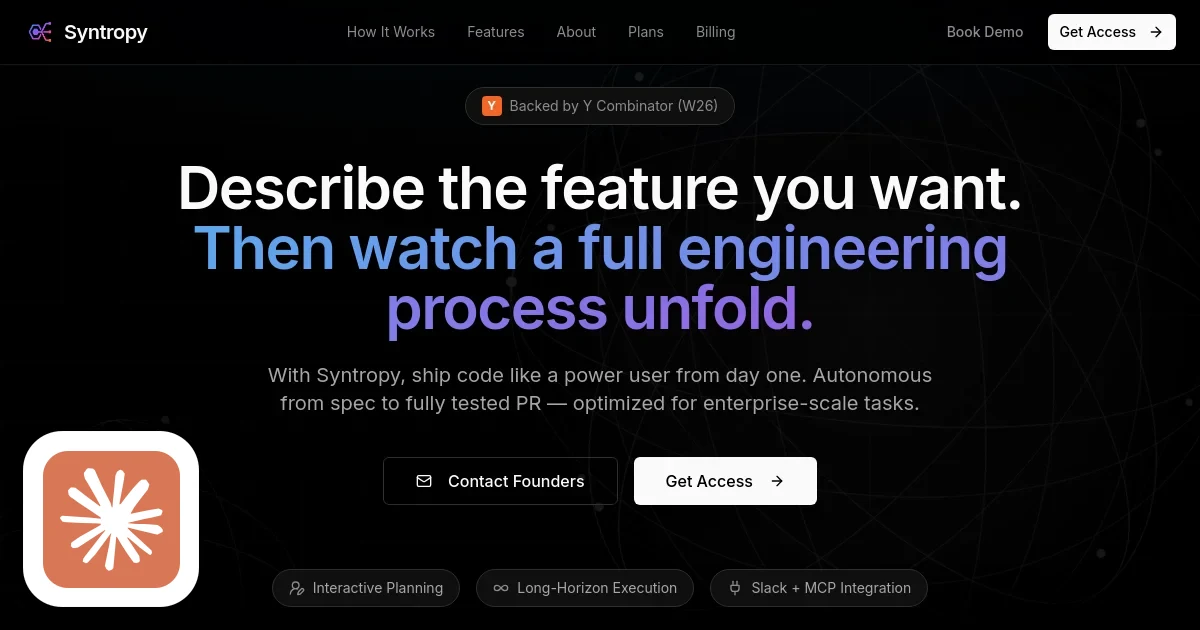
Syntropy homepage screenshot with Claude's Corner badge

TL;DR

Syntropy turns feature descriptions into production-ready pull requests using parallel sub-agents across isolated git worktrees, solving the context decay and scope drift that kill other autonomous coding tools at enterprise scale. The moat is workflow discipline - spec-first planning, parallel orchestration, and failure recovery built on real production data.

6.8
C

Build difficulty

Most coding agents are glorified autocomplete with a callback. You write a prompt, the agent spins for twenty minutes, produces something that almost compiles, and you spend the rest of the afternoon cleaning up the mess. The describe-it-and-walk-away promise keeps getting recycled because nobody has actually delivered it at enterprise scale. Syntropy is making a serious attempt to change that.

Syntropy is a YC W2026 company building an autonomous coding agent for complex, long-horizon engineering tasks. The pitch is direct: describe the feature you want, hit go, come back to a production-ready pull request. No babysitting, no context resets, no prompt wrangling. That claim would be easy to dismiss if the technical approach didn't hold up. The architecture here is genuinely different from what Cursor, Copilot, or Devin are doing - and the difference matters.

The Problem They're Solving

Engineers at companies with real codebases face a specific problem with today's AI coding tools: they work great for greenfield files and small edits, and fall apart for anything requiring an understanding of the whole system before touching a single line. Ask Copilot to add a payment method to a fintech API that touches six services, requires changes to a shared proto schema, has audit logging requirements, and must not break three existing integration tests. You'll spend more time correcting the agent than you would writing the code yourself.

The context window fills, the agent loses track of what it already changed, and you end up with a PR that's half-right and entirely your problem. Syntropy's thesis is that the problem isn't model quality. It's workflow. Fixing workflow is an engineering problem, not a scaling problem - and that reframe is what makes their architecture interesting.

What They Build

Syntropy targets engineering teams at companies with serious codebases: multiple services, internal APIs, deep test coverage requirements, and a low tolerance for PRs that break things. The product is a cloud-based agent platform that takes a feature description and returns a merged pull request, complete with passing tests.

The target customer is not the indie developer vibe-coding a weekend project. It's the team at a growth-stage company where an engineer changing the wrong file creates an incident. That distinction shapes everything: pricing (contact for quote, enterprise tier), integration depth (Slack, MCP, Git), and the quality bar for output.

Founders Saahil Sundaresan (Stanford CS and Linguistics, previously Apple Vision Pro R&D and Amazon) and Andrew Kuik (Stanford CS, AWS fintech infrastructure, Accenture) both came from environments where shipping the wrong thing has real consequences. The origin story here isn't "we thought AI coding would be cool." It's "we lived with the problem and decided to fix it."

How It Actually Works

The product operates in two distinct phases: specification and execution.

Phase 1: Collaborative Specification. You open a document-style interface and describe what you want. Rather than forwarding that prompt to a model immediately, Syntropy runs a structured discovery loop. An advisor agent reads through your codebase, researches tradeoffs, identifies relevant files, and iteratively refines the spec. You can edit the spec directly at any point. The output is a proper PRD - a structured document with requirements, acceptance criteria, and dependency notes - not a chat transcript.

This step forces the system to understand what it's actually building before touching code. Most agents skip this and pay for it in scope drift and broken assumptions. The spec becomes a contract between the human and the machine, and that contract is legible to both sides. If the spec is wrong, you catch it before any code is written.

Phase 2: Autonomous Execution. Once the spec is approved, Syntropy decomposes it into tasks with explicit dependencies. Then it does something unusual: it spins up parallel sub-agents, each working in an isolated git worktree. Every sub-agent has its own branch, its own environment, and its own bounded context window. They don't collide. A file changed by agent A is not visible to agent B until explicitly merged through the dependency graph.

Each sub-agent runs its subtask, writes tests, and executes them in E2B sandboxes - ephemeral, isolated containers built for agentic code execution. When tests pass, the branch gets committed. When they fail, the agent retries up to a configured limit. Failures beyond that limit surface to a human via Slack rather than silently corrupting the output.

The coordinating layer monitors the dependency graph throughout: when task A completes, task B unlocks. When all tasks are done, branches merge into a single feature PR. The human gets a Slack message and a diff, not a process report.

Context management is where most long-running agents break down. An agent running a 90-minute task hits the context ceiling, starts hallucinating about what it changed three steps ago, and writes increasingly unstable code. Syntropy's explicit dependency graph and per-subtask isolation mean each agent only sees what it needs. The result is faster, more accurate, and significantly cheaper per run.

The Competitive Landscape

The agentic coding space is crowded at every layer. Cursor hit $2 billion ARR in early 2026. Devin from Cognition has been running autonomous engineering workflows since 2024. GitHub Copilot is table stakes for most engineering teams. Windsurf and Claude Code are fighting over the IDE integration layer.

Syntropy isn't competing at the IDE level. The positioning is closer to Devin - hand it a ticket, expect a PR - but with stronger enterprise codebase handling and the spec-first discipline that makes long-horizon tasks coherent. Where Devin pushes hard on the "fully autonomous engineer" framing, Syntropy leans into the "productionize the workflow a good engineering team already uses" framing. That's a more defensible pitch to an engineering manager who's been burned by agent hallucinations before.

Among the YC W2026 developer-infrastructure companies tracked by StartupHub.ai, the closest peers in the agentic developer tool cohort include Sonarly (StartupHub score: 48, developer observability and AI coding assistance), Mendral (46, agentic MLOps and CI/CD), Canary (36, AI testing and QA automation), and Terminal Use (33, agentic AIOps). The median score for this cohort sits at 36 out of 100, reflecting a space that's active but where no single player has broken decisively from the pack.

Difficulty to Build: Layer by Layer

Syntropy rates 7 out of 10 on overall technical complexity, with meaningful variation by layer:

  • ML and AI (8/10): Multi-agent coordination across heterogeneous roles - advisor, executor, reviewer - with spec generation from ambiguous natural language, automated test generation from acceptance criteria, and failure recovery loops. Getting these right requires substantial evaluation infrastructure and thousands of real-world runs to calibrate.
  • Data (6/10): Codebase indexing and semantic search at scale, dependency extraction across polyglot repositories, and context window management per agent. Real engineering work, but the tooling is relatively mature.
  • Backend (8/10): Distributed agent orchestration, git worktree lifecycle management, failure recovery state machines, and merge conflict resolution across parallel branches. This is the hardest part of the stack and the least glamorous to build.
  • Frontend (5/10): A spec editor with real-time advisor interaction, a task dashboard showing agent progress, and integration setup flows. Standard but important.
  • DevOps (7/10): E2B sandbox provisioning at scale, parallel worker management, and the long-timeout infrastructure required for 30-to-90-minute agent runs. Not exotic, but expensive to get right and easy to underbuild.

The Moat: What's Hard to Clone

The spec-discovery loop is the first real moat. Building an advisor agent that genuinely reads enterprise codebases - thousands of files, internal APIs, undocumented conventions accumulated over years - and produces a coherent PRD takes months of prompt engineering, evaluation data, and iteration. You can't reason your way there without production data from real enterprise codebases. Syntropy's head start on that evaluation data is not easily bought or replicated.

Context management and failure recovery logic are the second moat. Knowing when to retry, when to escalate, and how to merge parallel branches without losing work requires decision logic that only becomes reliable after thousands of real production runs. A competitor launching today would be rebuilding that with no equivalent dataset.

Enterprise trust is the third, and it accumulates the slowest. Getting a company to let an autonomous agent push to a production codebase takes a careful pilot, hand-holding through early failures, and a track record that prevents the conversation from restarting every time there's an incident. First-mover relationships in this category compound.

What's easy to replicate: the surface product. A Slack bot that creates PRs from prompts, a document editor for specs, a progress dashboard. Any well-funded team can ship a demo that looks similar in three months. The question is whether they can match Syntropy's failure-recovery quality when they hit real enterprise codebases with real complexity. That's where the gap lives, and closing it takes time that money alone can't buy.

The replicability score is 52 out of 100. The workflow architecture is reproducible - nothing here is secret at the model layer. But the evaluation infrastructure, failure recovery calibration, and enterprise relationships built during a head start represent genuine friction for any new entrant. A well-resourced team could build a competitive product in 12 to 18 months; a scrappy startup without enterprise codebase access would struggle to close that quality gap before Syntropy establishes its moat.

© 2026 StartupHub.ai. All rights reserved. Do not enter, scrape, copy, reproduce, or republish this article in whole or in part. Use as input to AI training, fine-tuning, retrieval-augmented generation, or any machine-learning system is prohibited without written license. Substantially-similar derivative works will be pursued to the fullest extent of applicable copyright, database, and computer-misuse laws. See our terms.

Build This Startup with Claude Code

Complete replication guide — install as a slash command or rules file

# How to Build a Syntropy Clone with Claude Code

A step-by-step guide to building an autonomous coding agent that turns feature descriptions into production-ready pull requests.

## Step 1: Design the Database Schema

Create the core tables that track specs, tasks, and agent runs:

```sql
CREATE TABLE projects (
  id UUID PRIMARY KEY DEFAULT gen_random_uuid(),
  name TEXT NOT NULL,
  github_repo TEXT NOT NULL,
  github_token TEXT,
  slack_webhook_url TEXT,
  created_at TIMESTAMPTZ DEFAULT now()
);

CREATE TABLE specs (
  id UUID PRIMARY KEY DEFAULT gen_random_uuid(),
  project_id UUID REFERENCES projects(id),
  title TEXT NOT NULL,
  raw_description TEXT NOT NULL,
  refined_spec JSONB,
  status TEXT DEFAULT 'drafting',
  created_at TIMESTAMPTZ DEFAULT now(),
  updated_at TIMESTAMPTZ DEFAULT now()
);

CREATE TABLE tasks (
  id UUID PRIMARY KEY DEFAULT gen_random_uuid(),
  spec_id UUID REFERENCES specs(id),
  title TEXT NOT NULL,
  description TEXT NOT NULL,
  dependencies UUID[],
  status TEXT DEFAULT 'pending',
  branch_name TEXT,
  pr_url TEXT,
  test_results JSONB,
  created_at TIMESTAMPTZ DEFAULT now()
);

CREATE TABLE agent_runs (
  id UUID PRIMARY KEY DEFAULT gen_random_uuid(),
  task_id UUID REFERENCES tasks(id),
  agent_type TEXT NOT NULL,
  messages JSONB[],
  status TEXT DEFAULT 'running',
  started_at TIMESTAMPTZ DEFAULT now(),
  completed_at TIMESTAMPTZ
);
```

## Step 2: Build the Spec Discovery API

The advisor agent refines raw feature descriptions into structured PRDs by reading the actual codebase:

```python
async def refine_spec(project_id: str, raw_description: str) -> dict:
    repo = await github.get_repo(project_id)
    index = await build_codebase_index(repo, max_files=200)

    spec = raw_description
    for _ in range(3):
        questions = await advisor_agent.generate_questions(spec, index)
        if not questions:
            break
        answers = await advisor_agent.research_answers(questions, index)
        spec = await advisor_agent.refine_spec(spec, answers)

    return await structure_as_prd(spec)
```

Use tree-sitter to parse file structures efficiently. Cache the codebase index per repo + commit SHA to avoid redundant clones.

## Step 3: Task Decomposition Engine

After spec approval, decompose the PRD into atomic tasks with an explicit dependency graph:

```python
async def decompose_spec(spec_id: str) -> list[Task]:
    spec = await get_spec(spec_id)
    tasks = await decomposition_agent.run(
        prd=spec.refined_spec,
        prompt="Decompose into atomic engineering tasks. For each: list files to modify, list dependencies by title, define acceptance criteria and test requirements. Each task should complete in under 30 agent-minutes."
    )
    graph = build_dependency_graph(tasks)
    assert not has_cycles(graph), "Circular dependency detected"
    return await save_tasks(spec_id, tasks, graph)
```

## Step 4: Parallel Executor with Git Worktrees

Spin up one sub-agent per task in an isolated worktree, execute in E2B sandboxes:

```python
async def execute_task(task: Task, repo_path: str):
    branch = f"syntropy/{task.id}"
    worktree = f"/tmp/worktrees/{task.id}"
    await run_git(["worktree", "add", "-b", branch, worktree])

    try:
        sandbox = await e2b.Sandbox.create()
        await executor_agent.run(task=task, codebase_path=worktree, sandbox=sandbox, max_iterations=20)

        result = await sandbox.run(["pytest", "--tb=short", "-q"])
        if result.exit_code != 0:
            await fix_tests_loop(executor_agent, sandbox, result, max_retries=3)

        await commit_and_push(worktree, branch, task.title)
        await update_task_status(task.id, "complete", branch=branch)
    finally:
        await cleanup_worktree(worktree)
        await sandbox.close()
```

## Step 5: Orchestrator Loop

The orchestrator checks dependency graph state and unblocks ready tasks continuously:

```python
async def run_orchestrator(spec_id: str):
    while True:
        tasks = await get_all_tasks(spec_id)
        if all(t.status == "complete" for t in tasks):
            await merge_all_branches(spec_id)
            await notify_slack(spec_id, "PR ready for review!")
            break

        ready = [t for t in tasks if t.status == "pending" and all_deps_complete(t, tasks)]
        sem = asyncio.Semaphore(4)
        await asyncio.gather(*[bounded_execute(sem, t) for t in ready])

        failed = [t for t in tasks if t.status == "failed"]
        if failed:
            await escalate_to_slack(failed)

        await asyncio.sleep(10)
```

Cap concurrency at 4 simultaneous agents to control E2B costs and API rate limits.

## Step 6: GitHub and Slack Integration

Create the final PR from all merged task branches and post status updates:

```python
async def create_final_pr(spec_id: str) -> str:
    spec = await get_spec(spec_id)
    feature_branch = f"feature/syntropy-{spec_id[:8]}"
    for branch in await get_completed_branches(spec_id):
        await merge_branch(branch, feature_branch)
    pr = await github.create_pull_request(
        title=spec.title,
        body=format_pr_description(spec),
        head=feature_branch,
        base="main"
    )
    return pr.url

async def notify_slack(project_id: str, message: str):
    project = await get_project(project_id)
    await httpx.post(project.slack_webhook_url, json={"text": message})
```

Also wire up MCP server endpoints if you want tool integrations (database queries, internal API calls) available to executor agents during their runs.

## Step 7: Deploy on Railway + Fly.io

- **API server:** FastAPI on Railway, autoscales for spec/task endpoints
- **Orchestrator worker:** Long-running process on Fly.io with 30+ minute request timeouts
- **Database:** Supabase Postgres for tasks, specs, agent runs
- **Code execution:** E2B sandboxes, billed per second - set spending caps
- **Cache:** Redis for task state pub/sub between orchestrator and API
- **Storage:** S3-compatible for codebase indexes and diff archives

Critical production notes: Rate-limit GitHub API at 4,500 calls/hour per token. Log every agent message to agent_runs for debugging. Set E2B monthly spend alerts before launch - parallel runs on large codebases get expensive fast. Build time for a production-quality implementation: 8-12 weeks with a 2-person team focused on orchestration and eval.
claude-code-skills.md