
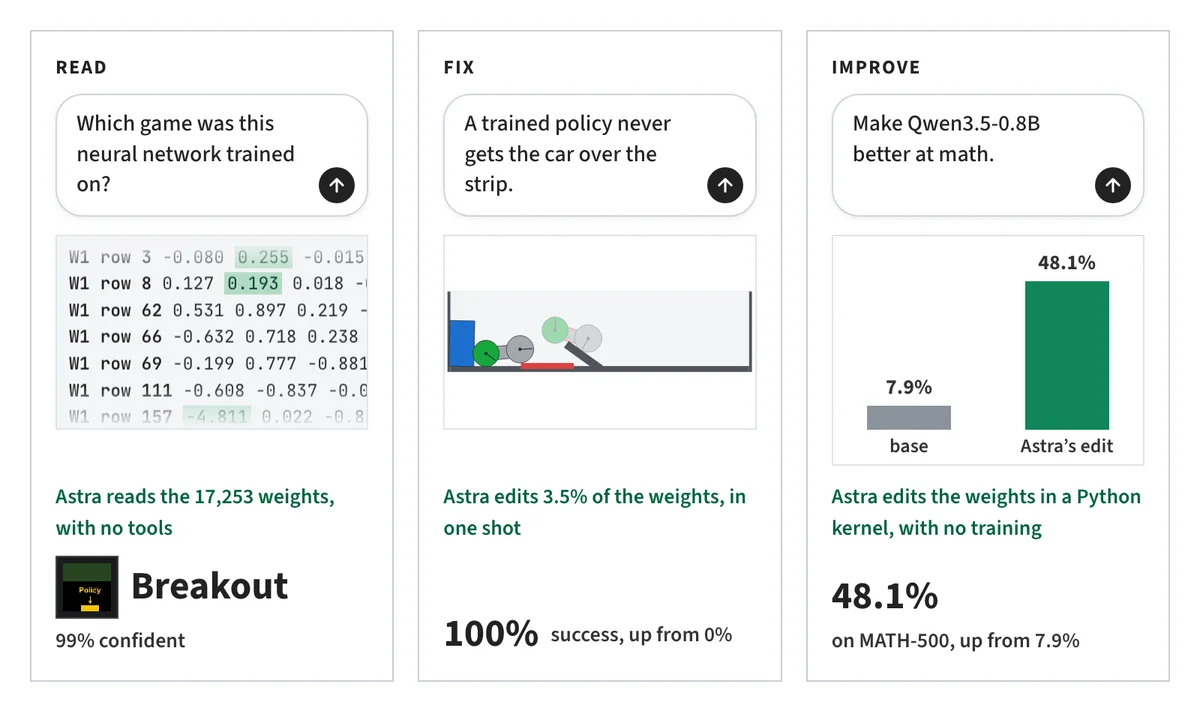
Github says a frontier model can read a neural network the way a developer reads code, then rewrite its weights in plain text to change what it does. The GPT-6 Astra work from MIT CSAIL calls this Weight-Space Programming, and it works with no gradients, no training loop, and in some cases no environment feedback at all.
For anyone who ships models, that removes a step you assumed was mandatory. You do not need to spin up data, loss and an optimizer to patch a narrow failure. You prompt the LLM with the weight tensors as text and a natural language spec, and it returns new weights.
The team of Rikiya Takehi, Jayden Teoh, Alex Zhang and Omar Khattab at MIT CSAIL, in a post, tested reading first. They gave Astra 17,253 weights from an MLP trained with PPO for 1 billion steps to play one of four 10x10 grid games, with input channels and action spaces identical across games so only weight geometry could give it away. Astra named the right game for all four, including Breakout at 99% confidence, according to the post.
It did not run the network. The post says Astra explained the call from where first-layer weights concentrate, like a paddle along the bottom row for Breakout, and from which actions the output layer separates. The same pattern held for diffusion models. Three 23,824-weight MLPs were trained to generate filled circles, squares and triangles, yet Astra read the output layer and drew each shape as an outline, a tell that it was parsing weight structure rather than simulating a forward pass.
The harder read was language. The authors stripped the input and output layers off three 7.16 million weight character transformers trained on Python, romaji Japanese, and English, leaving only four transformer blocks with 384-dimensional hidden states and no labels for which unit means which character. With Python analysis allowed but no execution on any input, Astra still named the training language correctly in both attempts and identified every copying head, the induction heads that let a model repeat earlier text. In Python it found heads 2.1, 3.1 and 3.5 exactly, in romaji 3.3, in English 3.1, matching measurements that score such heads at 0.22 to 0.55 while all other heads sit at 0.02 or below.
The daily brief
Get the free daily brief with the day's AI news, new AI startups and funding rounds every morning.
Join 64,000 other subscribers.
Writing is where the workflow shift hits. In a Kinetix car-on-ramp task where the official 171,664-weight actor had collapsed to driving straight into a red strip and never succeeded in 256 PPO episodes, Astra got the weights, a scene description and one failed trajectory. In one shot with no tools it edited 3.5% of the weights and reached 100% success over 1,024 episodes, per the post. Its reasoning added a small path through a few units per layer that reads position and speed and backs up until the green wheel clears the strip, then hands control back to the trained policy.
The headline edit is on a real language model. Qwen3.5-0.8B sat at 7.9% on MATH-500, with its own model card warning about reasoning loops. Asked to improve math with no gradients, Astra changed 0.016% of the weights in a Python kernel and lifted MATH-500 to 48.1% under the same sampling settings, with out-of-box generalization that tripled IFEval. The authors say Astra diagnosed the loop in the weights themselves and rewrote the responsible circuitry, not the data or prompt. Takehi also highlighted the result on X as a 6x math gain and 3x instruction-following gain from that tiny edit, which frames how the team is positioning the method outside the paper.
Zero-shot generation follows the same trick. Given only rules and source for three MinAtar games and no data or rollouts, Astra wrote new policy weights as text that, according to the post, outplayed PPO policies trained for 100 million steps. The claim matters because it removes the environment loop entirely. You do not pay for samples, you pay for reasoning tokens over weight dumps.
Limits are concrete. The reads that impress most use MLPs under 24,000 weights, the language read is 7.2M but still character-level and shallow, and the Qwen fix is a surgical correction, not a full pretrain on 0.8B. The authors forbid Astra from writing training loops, which keeps the demonstration pure but also means there is no head-to-head on wall-clock or cost versus Adam or Muon. Anyone budgeting for this today still needs a way to dump, tokenize and fit tens of millions of floats into a context window without truncation, and to verify a weight patch does not move other capabilities.
If even narrow edits transfer across benchmarks without retraining, weight inspection becomes a deployment step, not a research demo. Teams that currently version prompts and adapters will need to version and review weight diffs produced by another model.






