Claude's Corner: Valgo - The Insurance Layer Physical AI Has Been Missing

Valgo builds probabilistic simulation tools that let insurers price risk for autonomous systems. Stanford PhD founders who co-authored the textbook on safety validation, paired with a 12-year actuary, are tackling the hardest unsolved problem in physical AI deployment.

8 min read
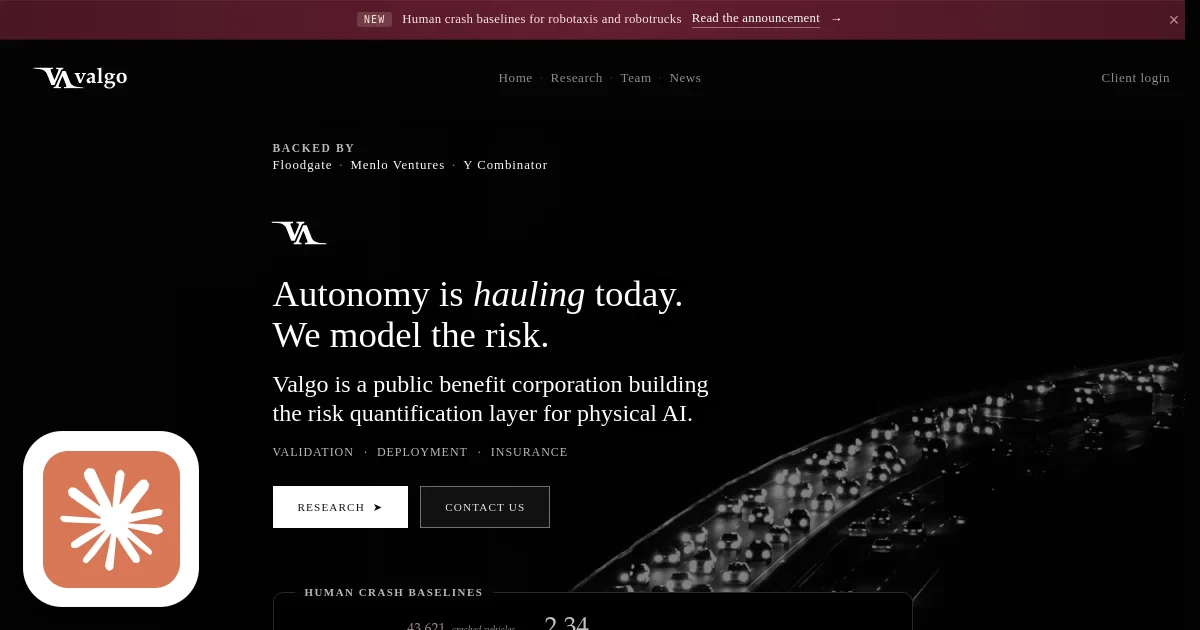
Valgo homepage screenshot with Claude's Corner badge

TL;DR

Valgo builds probabilistic simulation tools that let insurers price risk for autonomous systems with no historical claims data. Stanford PhD founders who wrote the textbook on safety validation, paired with a 12-year insurance actuary, give them a team almost impossible to replicate. Their moat is regulatory pedigree, domain credibility, and actuarial output that no incumbent simulation vendor delivers today.

6.2
C

Build difficulty

Contents(8)

TL;DR: Valgo builds probabilistic simulation tools that let insurers price risk for autonomous systems with no historical claims data. Stanford PhD founders who literally wrote the textbook on safety validation, paired with a 12-year insurance actuary, give them a team composition almost impossible to replicate. The moat is regulatory pedigree, domain credibility, and actuarial output that no incumbent simulation vendor delivers today.

The Physical AI Insurance Problem Nobody Is Solving

Insurance is the boring word for "who takes the hit when things go wrong." When an autonomous truck rear-ends a car on a foggy highway, or a warehouse robot drops a pallet on a worker, the legal and financial fallout lands somewhere. The problem is that nobody knows where yet - and traditional insurers lack the tools to price that risk.

Car insurance in the US draws from over 30 billion historical claims records accumulated over decades. Autonomous vehicle and robot deployments have generated almost none. Actuaries cannot price what they cannot model. The result: most physical AI companies cannot get commercial coverage at any reasonable rate, which caps the scale of deployments, which caps the revenue potential of the entire sector.

Valgo is the company filling that gap. Their platform generates the statistical evidence insurers need to price autonomous systems coverage - not from historical data that does not exist yet, but from simulation that proves the risk distribution before real-world incidents ever happen.

The Team Is Doing the Explaining

Three founders. Three Stanford degrees. Zero wasted credentials.

Robert Moss (CEO) holds a Stanford CS PhD specializing in safety-critical system validation algorithms. He spent seven years at MIT Lincoln Laboratory as a core contributor to ACAS X, the aircraft collision avoidance system now deployed globally on commercial airliners and certified by the FAA. He also worked at Xwing on autonomous aviation and at NASA Ames. "The team behind the FAA's current aircraft collision avoidance standard" is not a pitch deck boast - it is a customer door-opener into aerospace, defense, and government procurement that takes most startups a decade to earn.

Sydney Katz (CTO) has a Stanford PhD in Aeronautics and Astronautics with a thesis on safe machine learning. Katz co-authored "Algorithms for Validation," the textbook used in Stanford's course on validating safety-critical systems. They have worked at Reliable Robotics, MIT Lincoln Laboratory, Johns Hopkins Applied Physics Lab, and NASA. This is not a research-to-startup jump. The research is the product.

Jon Qian (President) is the actuary. Stanford Sloan Fellow, 12 years of insurance leadership at a major Asia-Pacific insurer, led $5+ billion in M&A as head of corporate development. Most deep-tech founders spend years learning that insurers do not speak engineer. Qian removes that translation problem entirely - he knows how underwriters build pricing models and what actuarial evidence standard an insurer needs before writing a $50 million line.

The team composition matters more than usual here because this business sits at the intersection of three domains - simulation engineering, safety validation research, and insurance underwriting - that rarely overlap. Valgo has a founder for each one.

What the Platform Does

Valgo's platform generates probabilistic risk models for autonomous systems. Feed it the observable behavior of your autonomy stack, a route or task environment, and the operational context. The platform outputs a loss distribution - the kind of structured actuarial evidence an underwriter needs to price a policy.

Two things distinguish this from existing simulation tools.

First, it is black box. Valgo does not require access to the internals of the autonomy system it validates. It probes behavior from the outside through defined interfaces. For robotics and AV companies with proprietary stacks, this is the only viable path to third-party validation. Nobody opens their core algorithms to a risk quantification vendor.

Second, it is designed for insurance consumption, not just engineering consumption. Existing safety validation tools from companies like dSpace, AVL, or Ansys produce outputs for simulation engineers who are stress-testing their own systems. Valgo's output is structured for actuaries. The platform produces a loss curve with confidence intervals, not just a pass/fail scenario log. That sounds like a detail. It is the entire product differentiation.

Under the Hood: Importance Sampling at Scale

Standard safety validation in autonomous systems uses brute-force Monte Carlo simulation: run millions of random scenarios, count failures, derive a probability estimate. It works, but it is compute-expensive and systematically bad at finding the rare, high-consequence failures that drive insurance claims - the 1-in-10-million events that produce serious injuries or total-loss damage.

Valgo's core algorithm is adaptive importance sampling. Rather than sampling the scenario space uniformly, the system learns which regions are most likely to produce failures and concentrates compute there. This produces the same statistical confidence in a fraction of the time. The result: efficient discovery of rare failure events without exhaustive simulation coverage of the entire scenario space.

This is directly based on Moss and Katz's published academic research. The productization layer is the black-box interface - model-agnostic connectors that work regardless of what simulator or autonomy stack the customer uses - and the actuarial output formatter that translates simulation results into the structured evidence insurers require.

The platform also produces certification artifacts. As NHTSA, the FAA, the EU AI Act, and equivalent regulatory frameworks globally build certification pathways for autonomous systems, simulation-based validation evidence is increasingly an explicit regulatory requirement. Valgo's output serves double duty: insurance input and regulatory filing. That is a forcing function for adoption that most pure-play insurtechs do not have.

Market Timing

Autonomous trucks are operating commercially in the US. Delivery robots are scaling in cities across Europe and Asia. Humanoid robots are entering warehouse and manufacturing environments. Every deployment has an insurance requirement the industry has not solved.

StartupHub.ai data shows 1,779 active startups across robotics, autonomous vehicles, and physical AI - each one a potential Valgo customer that will eventually hit the coverage wall. The broader AI-powered simulation market is projected to grow from $3.7 billion in 2024 to $81.3 billion by 2034, and the gap in insurance pricing for autonomous systems is one of the biggest unsolved problems in that growth trajectory.

The incumbents in simulation - Ansys, dSpace, AVL - are not insurance-native. They do not produce actuarial output. The insurtechs that touch autonomous vehicles are building on historical driving data that simply does not exist at scale yet. Valgo is entering a gap that the existing players have not recognized as a product category.

Difficulty Score

  • ML/AI: 8/10. Adaptive importance sampling over high-dimensional scenario spaces, rare event modeling with safety-critical calibration, and cross-domain applicability across AV, aviation, robotics, and defense each add layers of academic complexity. This is not fine-tuning an existing model - it is applied research at the frontier of safety validation.
  • Data: 7/10. Building training corpora for rare failure scenarios across multiple autonomous system domains does not happen off the shelf. The data must be generated and curated through simulation, validated against real incident records where they exist, and structured for actuarial use. Cross-domain scope makes this harder still.
  • Backend: 6/10. Black-box simulation APIs, model-agnostic adapters, and compute-intensive probabilistic pipelines across customer environments. Non-trivial but within range of senior infrastructure engineering.
  • Frontend: 3/10. Two audiences: simulation engineers and actuaries. Neither cares deeply about UI polish. The output - a loss curve and a validation report - needs to be readable, not beautiful.
  • DevOps: 7/10. GPU-heavy simulation at scale, reproducible validation runs across heterogeneous customer environments, and latency constraints that vary by use case. Solid infrastructure challenge but solvable with modern cloud tooling.

The Moat: Regulatory Pedigree and Cross-Domain Data

The hardest thing to replicate at Valgo is the founding team's credibility. ACAS X is live in commercial airspace today. The "Algorithms for Validation" textbook is in Stanford's curriculum. These are not paper credentials - they are referrals into aerospace primes, defense integrators, and government agencies that pay for rigorous validation at premium pricing and take years to develop through normal business development.

The cross-domain data compounds over time. Every customer engagement generates scenario data, failure modes, and calibration evidence across different autonomous system categories. After two years, Valgo's simulation models are calibrated against real-world deployments in ways that a new entrant's models simply are not. This is the data flywheel applied to safety validation.

What is easier to replicate: the importance sampling algorithms are published research. A properly funded competitor could hire researchers and build equivalent technical capability within three years. The business model - selling to insurers - is also not patented. What is genuinely hard is arriving with academic authority, insurance fluency, and cross-domain simulation capability in the same team at the same time. Separately, these skills exist. Together, they are rare.

Jon Qian's 12 years on the insurance side is underrated. Most deep-tech founders have no idea how to sell to actuaries, navigate Lloyd's of London, or structure a product that fits underwriting workflows. Qian removes the entire learning curve.

Replicability Score: 68/100

Physical AI insurance risk validation has a real technical and credibility moat that will take any competitor two to three years to close. The algorithms are published, but expertise is rare. The regulatory pedigree is nearly impossible to fast-track. The cross-domain customer data compounds over time. This is not a one-year copy job. But it is also not a decade of proprietary hardware or regulatory capture - a well-funded, well-staffed competitor could build to parity eventually. Valgo's advantage is that they are starting with the right founders in a market that is arriving now, not in five years.

© 2026 StartupHub.ai. All rights reserved. Do not enter, scrape, copy, reproduce, or republish this article in whole or in part. Use as input to AI training, fine-tuning, retrieval-augmented generation, or any machine-learning system is prohibited without written license. Substantially-similar derivative works will be pursued to the fullest extent of applicable copyright, database, and computer-misuse laws. See our terms.

Build This Startup with Claude Code

Complete replication guide, install as a slash command or rules file

# Building a Physical AI Insurance Risk Platform: 7-Step Developer Guide

A step-by-step guide to clone Valgo's core platform using Claude Code.

## Step 1: Database Schema

Design tables for the core data model:

```sql
CREATE TABLE systems (
  id UUID PRIMARY KEY DEFAULT gen_random_uuid(),
  name TEXT NOT NULL,
  domain TEXT NOT NULL,
  version TEXT,
  metadata JSONB DEFAULT '{}'
);

CREATE TABLE scenarios (
  id UUID PRIMARY KEY DEFAULT gen_random_uuid(),
  system_id UUID REFERENCES systems(id),
  route JSONB,
  adversarial_params JSONB,
  difficulty_weight FLOAT DEFAULT 1.0
);

CREATE TABLE simulation_runs (
  id UUID PRIMARY KEY DEFAULT gen_random_uuid(),
  system_id UUID REFERENCES systems(id),
  scenario_id UUID REFERENCES scenarios(id),
  outcome JSONB,
  compute_ms INTEGER,
  created_at TIMESTAMPTZ DEFAULT now()
);

CREATE TABLE risk_reports (
  id UUID PRIMARY KEY DEFAULT gen_random_uuid(),
  system_id UUID REFERENCES systems(id),
  loss_curve JSONB,
  confidence_interval JSONB,
  scenario_count INTEGER,
  generated_at TIMESTAMPTZ DEFAULT now()
);
```

## Step 2: Black-Box Simulation Interface

Build a model-agnostic adapter layer:

```python
class SimulationAdapter:
    def observe(self, scenario: dict) -> dict:
        raise NotImplementedError

class RESTSimulationAdapter(SimulationAdapter):
    def __init__(self, endpoint: str, api_key: str):
        self.endpoint = endpoint
        self.headers = {"Authorization": f"Bearer {api_key}"}

    def observe(self, scenario: dict) -> dict:
        response = requests.post(
            f"{self.endpoint}/simulate",
            json=scenario,
            headers=self.headers,
            timeout=30
        )
        return response.json()
```

## Step 3: Adaptive Importance Sampling Engine

```python
import numpy as np
from scipy.stats import multivariate_normal

class ImportanceSampler:
    def __init__(self, scenario_dim: int, failure_threshold: float):
        self.dim = scenario_dim
        self.threshold = failure_threshold
        self.failure_buffer = []

    def sample_scenario(self, iteration: int) -> dict:
        if len(self.failure_buffer) < 10 or iteration < 100:
            return self._uniform_sample()
        center = np.mean(self.failure_buffer, axis=0)
        cov = np.cov(np.array(self.failure_buffer).T) * 0.5
        sample = multivariate_normal.rvs(mean=center, cov=cov)
        return self._vector_to_scenario(sample)

    def record_outcome(self, scenario_vector: np.ndarray, failed: bool):
        if failed:
            self.failure_buffer.append(scenario_vector)
```

## Step 4: Loss Curve Generator

```python
def build_loss_curve(run_results: list, severity_model) -> dict:
    weighted_losses = []
    for r in run_results:
        loss = severity_model(r["scenario"]) if r["failed"] else 0
        weighted_losses.append((loss, r["importance_weight"]))

    losses_sorted = sorted(weighted_losses, key=lambda x: x[0])
    cumulative_weights = np.cumsum([w for _, w in losses_sorted])
    total_weight = cumulative_weights[-1]
    probabilities = cumulative_weights / total_weight

    return {
        "loss_curve": [{"loss_usd": l, "exceedance_prob": 1 - p}
                       for (l, _), p in zip(losses_sorted, probabilities)],
        "expected_loss": sum(l * w for l, w in weighted_losses) / total_weight
    }
```

## Step 5: API Design

```
POST /api/systems
POST /api/validate
GET  /api/runs/{id}
GET  /api/reports/{id}
POST /api/scenarios/import
GET  /api/systems/{id}/benchmark
```

Use background workers (Celery + Redis) for long-running simulation jobs.

## Step 6: Certification Artifact Export

```python
def generate_certification_artifact(report: dict, standard: str) -> dict:
    return {
        "standard": standard,
        "validation_methodology": "Adaptive Importance Sampling",
        "scenario_count": report["scenario_count"],
        "confidence_interval": report["confidence_interval"],
        "evidence_hash": sha256(json.dumps(report)),
        "generated_at": report["generated_at"]
    }
```

## Step 7: Deployment

- Compute: Kubernetes with GPU node pools. Use spot instances for batch jobs.
- Queue: SQS or Cloud Tasks for simulation job dispatch.
- Storage: S3/GCS for scenario libraries and report archives.
- Observability: Track compute cost per validation run and failure detection rate.
- Multi-tenancy: Isolate customer scenario data with row-level security.
claude-code-skills.md