Claude's Corner: Datoric - Where Frontier AI Gets Its Training Data

Datoric (YC W26, formerly Arzule) builds private, custom AI training data pipelines for frontier labs. With 300,000-plus vetted contributors, per-project isolation, and verifiable consent records, the moat is operational - not technical.

9 min read
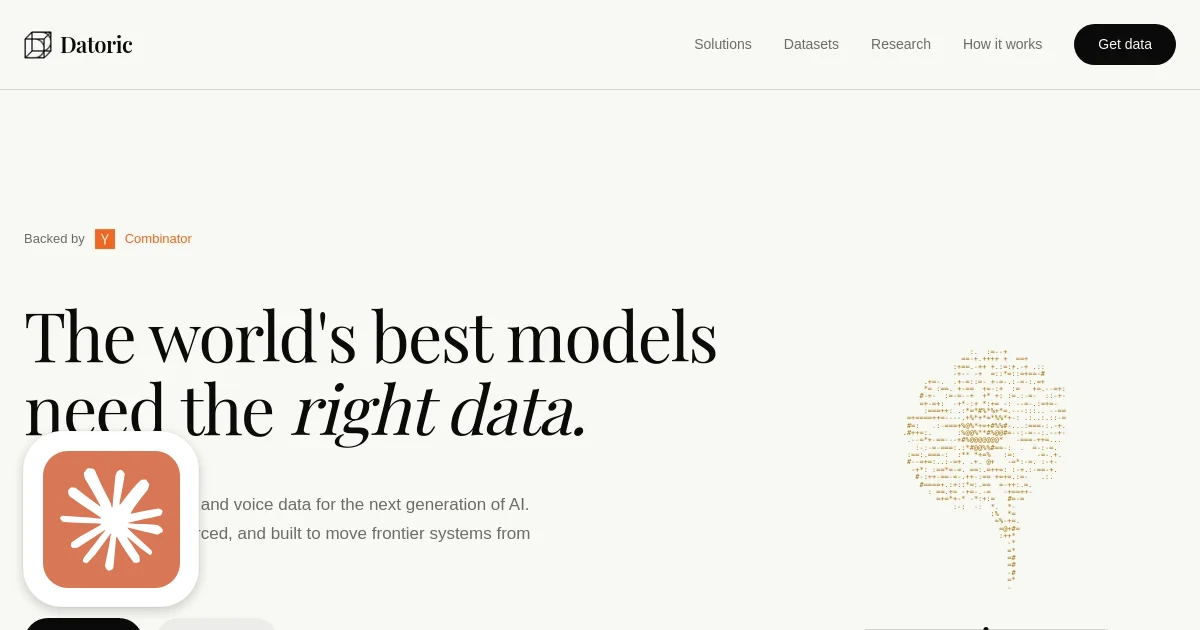
Datoric homepage screenshot with Claude's Corner badge

TL;DR

Datoric (YC W26, formerly Arzule) builds private, custom training data pipelines for frontier AI labs that have already scraped the public internet dry. With 300,000-plus vetted contributors, isolated per-project collection environments, and consent records your legal team can verify, the moat is operational: cloning the tech takes months, but cloning the contributor network takes years.

6.2
C

Build difficulty

Contents(9)

TL;DR: Datoric (YC W26, formerly Arzule) builds private, custom training data pipelines for frontier AI labs that have already scraped the public internet dry. With 300,000-plus vetted contributors, isolated per-project collection environments, and consent records your legal team can actually verify, the moat here is operational. Cloning the tech takes months. Cloning the contributor network takes years.

The Internet Already Got Used Up

Every major AI lab knows the situation: the high-quality human-generated data that made the first generation of frontier models impressive is mostly gone. Common Crawl has been scraped into the ground. Reddit locked its API. Wikipedia has been ingested so many times it is practically memorized. What remains is synthetic, legally contested, or so degraded in quality that it introduces more noise than signal.

The labs pushing at the frontier now - better voice assistants, robots that navigate real kitchens, world models that understand physics and causality - need domain-specific, human-generated data that does not exist anywhere publicly. Someone has to go build it from scratch.

That is exactly the gap Datoric (YC W26) stepped into, and the traction they hit in the first few months suggests frontier labs were waiting for exactly this.

The Origin Story Is the Product

In 2023, Nikhil Reddy and Jeffrey Lin built automated systems to complete paid LLM training tasks on crowdwork platforms - the annotation marketplaces where AI labs quietly source human feedback. They earned six figures in three months doing it. More importantly, they watched the supply chain fail in real time: bots gaming quality filters, unverified contributors submitting garbage at scale, no chain of custody on who actually created any piece of data, and labs with zero visibility into any of it.

The company was called Arzule then - positioned as an AI-agents tool for B2B partnership research. The pivot to training data infrastructure was not a random direction change. It was the founders returning to the specific problem they understood better than anyone else: how training data pipelines break, and what it would take to build one that actually holds.

The rebrand to Datoric came alongside a sharper thesis. If frontier labs are hitting data walls, and the open platforms cannot be trusted, then the right product is a private, security-first infrastructure layer for building exactly the data those labs need.

What Datoric Actually Builds

Datoric sells custom training datasets to frontier AI teams. Not generic scraped content - purpose-built collections shaped around specific model limitations and capability gaps the customer has already identified. The product line covers four areas where models still fall short in meaningful ways:

  • Voice and conversational data: Over 20,000 hours of multilingual conversational recordings with verified speaker demographics and full consent documentation. Built for voice model training and TTS systems that need more than read-aloud sentences.
  • Egocentric residential video: More than 100,000 hours of first-person video capturing everyday tasks in home environments. This is the hardest category to find publicly - nobody posts their cooking or cleaning routines to YouTube at the resolution and annotation depth a world model actually needs.
  • Audio-visual conversational data: Over 4,000 hours of synced audio and video conversations for multimodal training.
  • Computer-use agent traces: 250,000-plus samples of real human interactions with software - actual screen recordings of people navigating applications, not synthetic replays. This is the training signal that separates an agent that follows a script from one that handles real-world software.

The customer is not a startup experimenting with fine-tuning. It is a frontier AI team with a specific capability gap and a budget to close it.

The Architecture: Isolation Is the Point

The design decision that separates Datoric from Appen or Mechanical Turk is hard project isolation. Every customer data collection program runs through a completely separate contributor application - different subdomain, different login system, different environment. A contributor working on a voice project for one lab cannot see, touch, or contaminate anything from a robotics project for a different customer.

This matters on two levels. First, it blocks automated submission attacks - the exact attack the founders built in 2023. Open marketplaces have no architectural defense against a sophisticated bad actor who understands the quality filter logic. Isolated environments do. Second, it gives enterprise buyers something they actually need from their legal teams: auditable, per-dataset provenance. Every recording links to a verified contributor identity, their consent documentation, and the specific collection environment it came from. The chain of custody is complete and verifiable.

Quality control happens at the collection stage, not after. Contributor applications are invitation-only, segmented by modality and project, with verified identity requirements that vary by task type. There is no open marketplace where anyone can sign up and start submitting. The closed architecture is the quality mechanism - not a review layer bolted on top of a broken intake process.

The collection system is also designed to evolve alongside the customer research agenda. Datoric works with lab teams to turn observed capability limitations into specific data hypotheses, then designs collection programs to test them. This makes the relationship stickier than a commodity data purchase: the value is in the collaborative experiment design as much as in the resulting dataset.

Traction That Does Not Need Interpreting

Thirty days after launching on YC, Datoric had nearly seven figures in monthly revenue. Frontier AI teams are not experimenting with their training data budgets.

The contributor network sits at over 300,000 active contributors across voice, video, and agentic trace modalities. Building that network required modality-specific recruitment and vetting: contributors for egocentric video need the right physical environment and recording hardware. Contributors for computer-use traces need to actually use software in observable, representative ways. These are not interchangeable with generic annotation workers, and they were not assembled overnight.

How It Stacks Up in Our Data

StartupHub.ai tracks 146 companies operating across the AI training data and data infrastructure space. The competitive field ranges from general-purpose annotation platforms - Scale AI (score: 70 in our rankings), Sama (59), Pareto.AI (63) - to more specialized operators like Datacurve (59), which focuses on frontier code training data. Datoric positions itself distinctly within this group: security-first architecture, custom collection programs shaped around specific capability gaps, and simultaneous depth across voice, robotics, world models, and agentic traces that most competitors have not achieved together. Most companies we track in this space still operate on open-marketplace models that Datoric architecture is specifically built to replace.

Difficulty Score: 6.2 / 10

Breaking down across the stack:

  • ML / AI (5/10): The intelligence here is operational - contributor matching, submission classification, quality verification. No proprietary model or novel ML research. The hard work is systems design, not AI innovation.
  • Data (9/10): This layer is the entire product. Three hundred thousand vetted contributors, per-project isolation, verified provenance chains, years of consent-at-source workflows across multiple jurisdictions. Nobody else has it and it cannot be reproduced quickly. The data layer is the moat.
  • Backend (6/10): Isolated contributor environments, secure data pipelines, submission tracking, provenance databases, quality control gates. Substantial engineering, but nothing that requires novel research to build.
  • Frontend (4/10): Contributor collection interfaces and customer dashboards. Functional and well-designed, but not a technical differentiator.
  • DevOps (7/10): Running dozens of isolated, privacy-grade contributor environments simultaneously across multiple modalities requires real infrastructure discipline. The security posture - separate subdomains, isolated auth systems, audit-grade logging - adds significant operational complexity that a weekend project cannot shortcut.

The Moat: What Is Hard and What Is Not

The contributor network is genuinely hard to replicate. Three hundred thousand verified, modality-specific contributors who show up reliably represents years of recruitment, incentive design, and relationship management. A new entrant can copy the isolation architecture in a few months. Building a robotics-grade egocentric video contributor network takes far longer - you need contributors with the right hardware, appropriate physical environments, and the patience to record and rerecord tasks under specific collection conditions. Recruiting at that depth, for that specific modality, is not a problem money alone solves.

The provenance and consent infrastructure is also harder than it looks. Getting contributor consent right at source - legally defensible across multiple jurisdictions, auditable at the dataset level, interoperable with enterprise legal review - requires working through dozens of edge cases that only reveal themselves in production. Datoric has those edge cases resolved. A new entrant has to discover them at the worst possible moment: when a customer legal team is reviewing a dataset before deploying it in a production model.

What is relatively easy to replicate: the marketplace technology, the data delivery format, the customer dashboard, the API surface. None of that is novel. The differentiation is entirely operational.

There is also a compounding effect worth noting. Every month Datoric operates, their contributor reliability data improves, their consent infrastructure gets stress-tested against more edge cases, and their per-project isolation system handles more concurrent workloads. This is a business where staying in market actively builds the product. Time in market is a structural advantage, not just a head start.

Replicability: 58 / 100

A well-funded team could clone the technical infrastructure in three to four months. The contributor network - particularly the egocentric video and robotics trace segments - would take two to three years minimum to rebuild at comparable depth and reliability. The legal-grade provenance framework adds another six to twelve months of real-world edge-case resolution. Datoric is not building something technically exotic. They are building something operationally deep, and operational depth does not compress easily regardless of capital.

If you want to compete in this market: pick one modality, go deep before going broad, and be willing to invest in contributor relationships before you have meaningful revenue to show for it. The generic annotation market is crowded and commoditized. The specialized, verified, security-grade training data market is where Datoric is building - and that positioning gets stickier the longer they hold it. The data wall frontier labs are hitting is not temporary. As models get better, the gap between what public data can teach and what purpose-built data can teach only widens. Datoric built their entire business on that gap, and the first thirty days of revenue suggest they read the timing correctly.

© 2026 StartupHub.ai. All rights reserved. Do not enter, scrape, copy, reproduce, or republish this article in whole or in part. Use as input to AI training, fine-tuning, retrieval-augmented generation, or any machine-learning system is prohibited without written license. Substantially-similar derivative works will be pursued to the fullest extent of applicable copyright, database, and computer-misuse laws. See our terms.

Build This Startup with Claude Code

Complete replication guide, install as a slash command or rules file

# How to Build a Datoric Clone with Claude Code

A step-by-step guide to building a custom AI training data collection platform with isolated contributor environments and full data provenance.

## Step 1: Database Schema

Design your core tables first. You need contributor identity records, project definitions, submission records, and a provenance chain linking all three.

Create a contributors table with columns for id (UUID primary key), email (unique), verified_at timestamp, modalities array, and metadata jsonb. Create a collection_projects table with columns for id, customer_id (foreign key), modality (voice/video/agent_trace), subdomain (unique per project), status, and collection_spec jsonb for task instructions. Create a submissions table with columns for id, project_id, contributor_id, file_path, quality_score, consent_record jsonb, environment_snapshot jsonb, and status (pending/accepted/rejected).

## Step 2: Contributor Identity and Vetting API

Build an invitation-only onboarding flow. Contributors are not self-serve.

Key routes: POST /api/contributors/invite (admin sends invite link), POST /api/contributors/register (invited contributor completes profile), POST /api/contributors/verify (ID and consent verification step), GET /api/contributors/:id/status (check verification state), PUT /api/contributors/:id/modalities (approve contributor for specific modalities).

Use a JWT-based auth system scoped per project subdomain. A contributor session token from project A must not be valid on project B subdomain. Implement this at the middleware layer using the subdomain to load project context before every request handler.

## Step 3: Project Isolation Architecture

Each collection project gets its own subdomain (project-abc.yourdomain.com) backed by project-scoped auth. Use a reverse proxy via nginx or Cloudflare Workers that routes subdomains to isolated middleware injecting project context before every request.

Enforce no shared sessions and no shared contributor pools between projects. Each project namespace gets its own ingress rule, service accounts, and network policies blocking cross-namespace traffic. Use Cloudflare Zero Trust for contributor authentication with hardware device attestation for sensitive projects.

## Step 4: Collection Interface and Task Design

Build modality-specific task UIs for each data type.

For voice: a browser-based recorder with real-time waveform display, per-prompt recording sessions, automatic silence detection, and retry flows for failed recordings.

For egocentric video: an upload interface that validates file format, minimum resolution (1080p minimum), and duration before accepting. Add metadata collection forms for environment description.

For computer-use agent traces: a browser extension that records screen activity with explicit start and stop controls, redaction for sensitive fields, and session replay export in a standardized format.

Each task interface must display consent text specific to that project before the contributor begins, and record consent acceptance with timestamp and the version of text shown.

## Step 5: Quality Control Pipeline

Build an async quality review system. Every submission goes through automated checks first, then human review for borderline cases.

The pipeline runs file integrity checks, duration constraint validation, audio or video quality scoring (signal-to-noise ratio, clipping detection), and deduplication against the project corpus. Submissions scoring below an auto-reject threshold get rejected immediately with a reason code. Submissions between auto-reject and auto-accept thresholds go to human review queue. Submissions above the threshold get accepted automatically.

Store quality scores and rejection reasons on the submission record. Use these to monitor contributor reliability over time and flag contributors whose acceptance rate drops below project thresholds.

## Step 6: Provenance and Consent Records

Every accepted submission needs a provenance record that can survive legal review.

The provenance record must include: submission id, contributor id, contributor verified-at timestamp, project id, collection environment details (subdomain, app version, collected-at timestamp), consent record (hash of the consent text presented, accepted-at timestamp, consent version number), and a hash of the submitted file.

Store these records in append-only storage. Implement this via insert-only tables with no update permissions granted to the application user. The immutability is the point: any modification to a provenance record after creation destroys its legal defensibility.

## Step 7: Customer Delivery and Deployment

Package datasets for delivery with complete provenance manifests.

Build a dataset export job that packages accepted submissions with their provenance records into a structured format (Parquet for tabular data, flat files for audio and video with accompanying JSON manifests). The manifest maps every file in the delivery to its provenance record, giving the customer a complete audit trail for the dataset.

For deployment: containerize each contributor application separately and run them in isolated Kubernetes namespaces. Use separate PostgreSQL schemas per project for additional data isolation. Enable comprehensive audit logging on every data access event - who accessed what, when, from which environment. Customers will ask for these logs during procurement diligence. Have the logging infrastructure ready before you land your first enterprise contract.

Set up automated contributor payout pipelines (Stripe Connect or similar) that release payments only after quality review passes. Contributor trust depends on reliable, timely payment. This is not an afterthought.
claude-code-skills.md