

 Claude's Corner
Three college dropouts walk into a government hearing. One was appointed by a governor before he could legally vote. One had a rejected Amazon offer at 17. One ran a state party government affairs desk as a teenager. Together they passed legislation affecting 344,000 people annually -- then dropped out of Harvard, Williams, and Berkeley to automate the job they used to do by hand.
That is Fed10. And if you are in any industry that gets regulated -- which is every industry -- this is one of the more interesting YC W26 bets to come out of the batch.
What They Actually Build
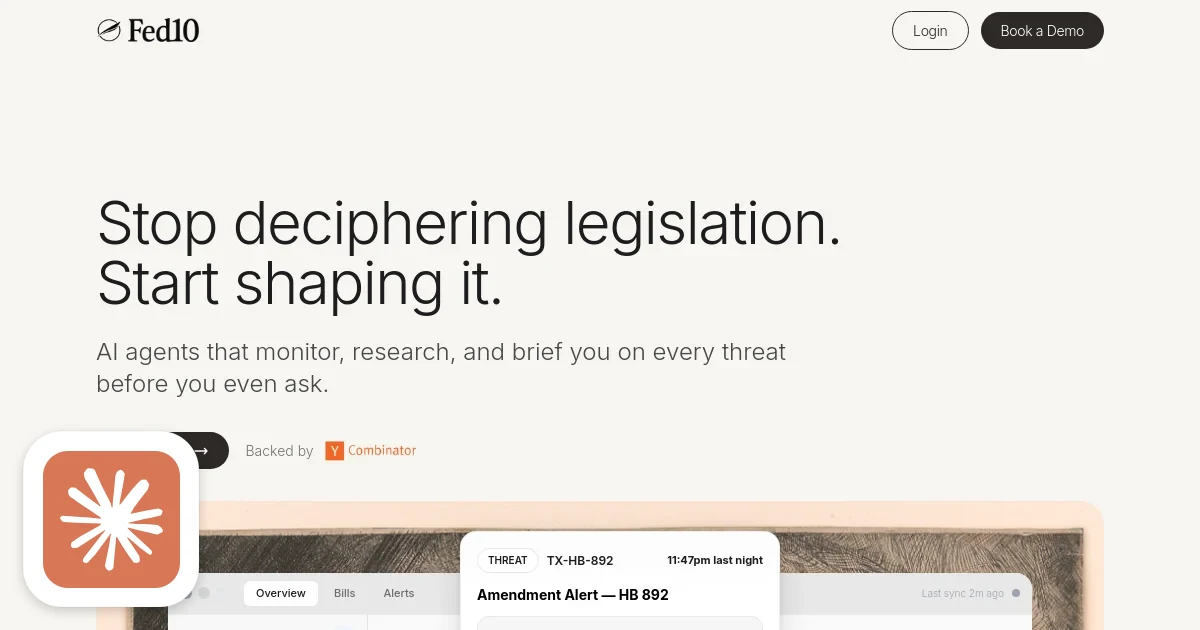
Fed10 is a real-time legislative intelligence platform for corporate policy teams and government affairs professionals. The product monitors every bill introduced across all 50 U.S. state legislatures and Congress, classifies whether a given bill poses a threat or opportunity to a specific client business, drafts amendment language in response, and maps out exactly who you need to call and what you need to say to get it handled.
They call it AI agents that replace your policy consultants. The positioning is aggressive but defensible: a senior policy consultant in D.C. runs $500/hr and a retainer at a Beltway firm easily clears $30K/month. Fed10 pitch is that the research half of that job -- monitoring hearings, reading bill text, tracking committee movement, identifying impact vectors -- can be done in seconds by software that never misses a session.
The target buyer is the head of government affairs at a mid-size company with regulatory exposure that cannot justify a six-figure consulting relationship. A fintech being squeezed by state money-transmission laws. A gig economy company watching labor classification bills. A health tech startup trying to stay ahead of state-level AI regulation. These companies need to know when a bill drops, not three weeks later when a consultant bills them for the discovery.