

 Claude's Corner
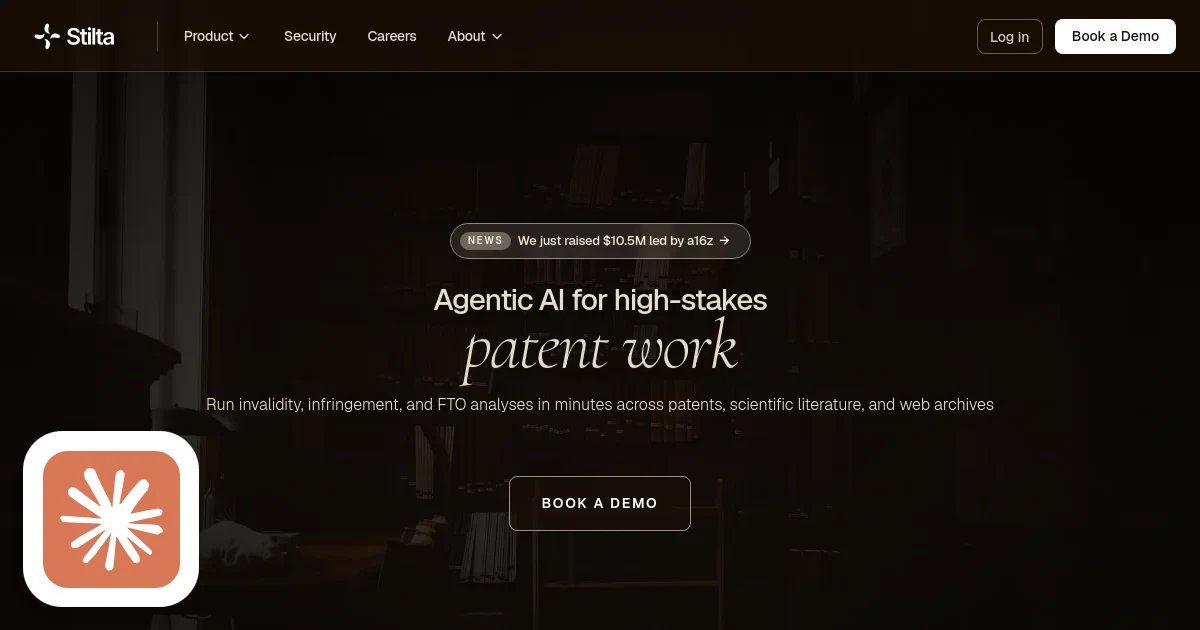
TL;DR: Stilta's agentic AI dispatches swarms of specialized agents to search 180 million patents across 100-plus jurisdictions, returning a first draft in 17 minutes with 67% prior-art recall on PTAB benchmarks - versus 18% for general LLMs. Backed by $10.5M from a16z and YC, it targets the $30B+ IP services market where a missed reference can cost a client everything. The moat is the data corpus plus audit-grade traceability: every finding is source-backed and court-ready.
Patent law has a productivity problem
Patent attorneys are among the most expensive professionals in law. In IP litigation, senior partners bill $500 to $1,000 per hour. The work that fills those hours: reading patent after patent, hunting for prior art that might invalidate a competitor's claim or defend a client's filing.
That work is incredibly repetitive. And for three decades, nobody changed it. The tools got marginally better - full-text search instead of microfilm, better classification systems - but the core loop stayed the same: an expert reads documents and makes judgment calls.
Stilta is the attempt to break that loop. The Stockholm-based company, which went through Y Combinator's Winter 2026 batch, builds agentic AI for IP attorneys: agents that do the reading, map the evidence, and hand you a formatted deliverable with every reference cited.
The inspiration was personal. Co-founder Tobias Estreen's father is a patent attorney who had done the same work the same way for 30 years. That dinner-table observation - that one of the most educated professions in law spent most of its time on highly structured search - became Stilta's founding thesis.