

MCP Tasks: Why Agents Aren't Supporting Them

Cornelia Davis of Temporal explains why MCP tasks are complex and why adoption is slow, previewing V2 improvements.

8 min read
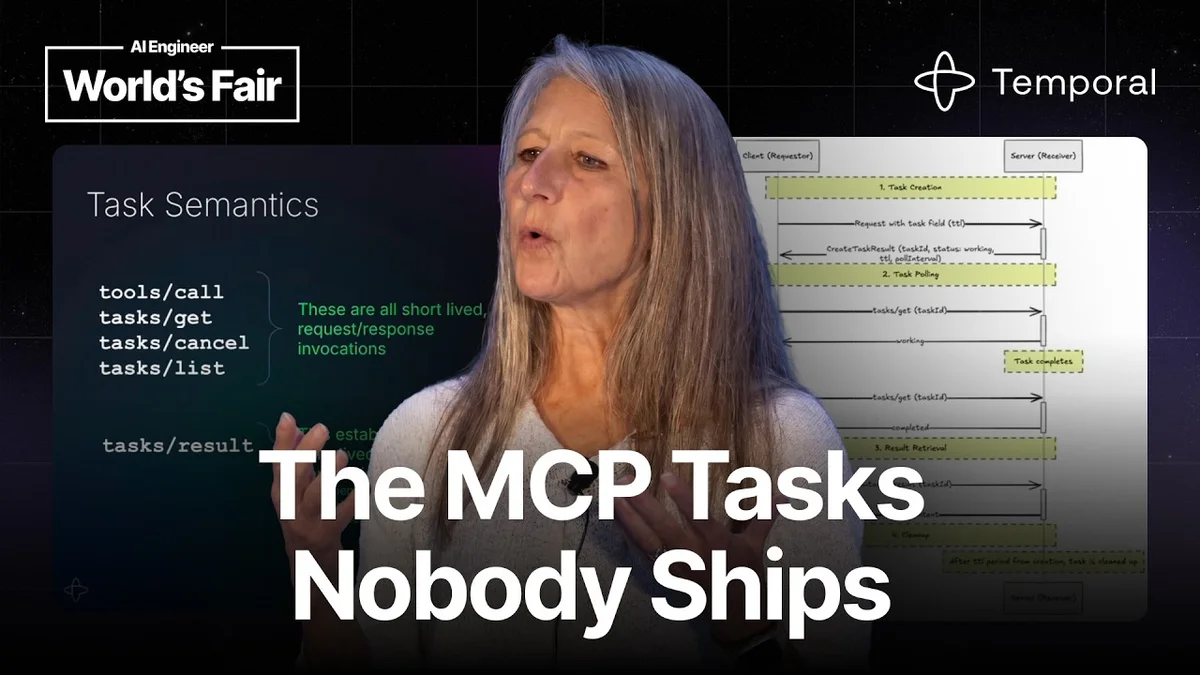
Cornelia Davis presenting on MCP Tasks at AI Engineer World's Fair
AI Engineer

Visual TL;DR. MCP Tasks V1 leads to Complexity & Durability. Complexity & Durability causes Agents Not Supporting. MCP Tasks V1 part of Stateful 'task_list'. Stateful 'task_list' contributes to Complexity & Durability. Temporal's Role explains Agents Not Supporting. Temporal's Role previews MCP Tasks V2. MCP Tasks V2 enables Improved Adoption. Agents Not Supporting drives need for MCP Tasks V2.

  1. MCP Tasks V1: initial version marked experimental, leading to developer hesitancy and slow adoption
  2. Complexity & Durability: stateful protocols, long-running tasks, network disruptions, server crashes, client/server offline
  3. Agents Not Supporting: hesitancy due to complexity and experimental nature of the MCP Tasks specification
  4. Temporal's Role: Cornelia Davis explains challenges and previews V2 improvements at AI Engineer World's Fair
  5. Stateful 'task_list': key challenge in V1, lacking filtering capabilities and robust state management
  6. MCP Tasks V2: future improvements addressing V1 complexities and enhancing durability and state management
  7. Improved Adoption: expected outcome as V2 addresses complexities and provides more robust solutions
Visual TL;DR
Visual TL;DR, startuphub.ai MCP Tasks V1 leads to Complexity & Durability. Complexity & Durability causes Agents Not Supporting. Agents Not Supporting drives need for MCP Tasks V2 leads to causes drives need for MCP Tasks V1 Complexity & Durability Agents Not Supporting MCP Tasks V2 From startuphub.ai · The publishers behind this format
Visual TL;DR, startuphub.ai MCP Tasks V1 leads to Complexity & Durability. Complexity & Durability causes Agents Not Supporting. Agents Not Supporting drives need for MCP Tasks V2 leads to causes drives need for MCP Tasks V1 Complexity &Durability Agents NotSupporting MCP Tasks V2 From startuphub.ai · The publishers behind this format
Visual TL;DR, startuphub.ai MCP Tasks V1 leads to Complexity & Durability. Complexity & Durability causes Agents Not Supporting. Agents Not Supporting drives need for MCP Tasks V2 leads to causes drives need for MCP Tasks V1 initial version marked experimental,leading to developer hesitancy and slowadoption Complexity & Durability stateful protocols, long-running tasks,network disruptions, server crashes,client/server offline Agents Not Supporting hesitancy due to complexity andexperimental nature of the MCP Tasksspecification MCP Tasks V2 future improvements addressing V1complexities and enhancing durability andstate management From startuphub.ai · The publishers behind this format
Visual TL;DR, startuphub.ai MCP Tasks V1 leads to Complexity & Durability. Complexity & Durability causes Agents Not Supporting. Agents Not Supporting drives need for MCP Tasks V2 leads to causes drives need for MCP Tasks V1 initial versionmarkedexperimental,… Complexity &Durability stateful protocols,long-running tasks,network… Agents NotSupporting hesitancy due tocomplexity andexperimental nature… MCP Tasks V2 future improvementsaddressing V1complexities and… From startuphub.ai · The publishers behind this format
Visual TL;DR, startuphub.ai MCP Tasks V1 leads to Complexity & Durability. Complexity & Durability causes Agents Not Supporting. MCP Tasks V1 part of Stateful 'task_list'. Stateful 'task_list' contributes to Complexity & Durability. Temporal's Role explains Agents Not Supporting. Temporal's Role previews MCP Tasks V2. MCP Tasks V2 enables Improved Adoption. Agents Not Supporting drives need for MCP Tasks V2 leads to causes part of contributes to explains previews enables drives need for MCP Tasks V1 initial version marked experimental,leading to developer hesitancy and slowadoption Complexity & Durability stateful protocols, long-running tasks,network disruptions, server crashes,client/server offline Agents Not Supporting hesitancy due to complexity andexperimental nature of the MCP Tasksspecification Temporal's Role Cornelia Davis explains challenges andpreviews V2 improvements at AI EngineerWorld's Fair Stateful 'task_list' key challenge in V1, lacking filteringcapabilities and robust state management MCP Tasks V2 future improvements addressing V1complexities and enhancing durability andstate management Improved Adoption expected outcome as V2 addressescomplexities and provides more robustsolutions From startuphub.ai · The publishers behind this format
Visual TL;DR, startuphub.ai MCP Tasks V1 leads to Complexity & Durability. Complexity & Durability causes Agents Not Supporting. MCP Tasks V1 part of Stateful 'task_list'. Stateful 'task_list' contributes to Complexity & Durability. Temporal's Role explains Agents Not Supporting. Temporal's Role previews MCP Tasks V2. MCP Tasks V2 enables Improved Adoption. Agents Not Supporting drives need for MCP Tasks V2 leads to causes part of contributes to explains previews enables drives need for MCP Tasks V1 initial versionmarkedexperimental,… Complexity &Durability stateful protocols,long-running tasks,network… Agents NotSupporting hesitancy due tocomplexity andexperimental nature… Temporal's Role Cornelia Davisexplains challengesand previews V2… Stateful'task_list' key challenge inV1, lackingfiltering… MCP Tasks V2 future improvementsaddressing V1complexities and… Improved Adoption expected outcome asV2 addressescomplexities and… From startuphub.ai · The publishers behind this format

Cornelia Davis, a Principal Technologist at Temporal, recently addressed the perplexing question of why MCP tasks are not yet widely supported by agents. Speaking at the AI Engineer World's Fair, Davis highlighted that the complexity and experimental nature of the MCP Tasks specification, first released in November, are the primary reasons behind this hesitancy.

MCP Tasks: Why Agents Aren't Supporting Them - AI Engineer
MCP Tasks: Why Agents Aren't Supporting Them — from AI Engineer

Understanding MCP Tasks Complexity

Davis explained that the initial version of the MCP Tasks protocol (V1) was marked as experimental, which often leads developers to adopt a wait-and-see approach. She elaborated on the inherent complexities, particularly those related to stateful protocols and the challenges of handling long-running tasks. These include dealing with infrastructure issues like network disruptions, server crashes, and the need for tasks to remain durable even when clients or servers go offline.

A key challenge in V1, as Davis pointed out, was the 'task_list' endpoint, which was stateful and lacked filtering capabilities. This meant that with a large number of agents and tasks, clients would have to sift through millions of tasks to find the one they needed to interact with. Furthermore, the 'task_result' endpoint, used for eliciting responses, involved a complex protocol with long-running connections that proved difficult to manage, especially in cases of connection failures.

MCP Tasks V2 and Future Improvements

Davis then introduced MCP Tasks V2, which is slated for release in July and promises significant improvements. A major change is the move towards a stateless core, which is a significant simplification for distributed systems. The protocol will also feature extensions for server-rendered UIs via MCP Apps and long-running workflows through the Tasks extension. Additionally, authorization will be more closely aligned with OAuth and OpenID Connect, and a formal deprecation policy will be introduced to ensure smoother protocol evolution.

During her presentation, Davis showcased a live demo illustrating a purchase order processing use case. This demo highlighted how MCP tasks enable long-running, asynchronous operations, such as validating invoices against an ERP system, requesting human approval, and reconciling data. She demonstrated the workflow, including the ability to signal into a long-running process, showcasing the power of these asynchronous task capabilities.

The Importance of Durability and State Management

A crucial aspect emphasized throughout the talk was the concept of durability. Davis quoted the spec, stating that "Tasks are durable state machines that carry information about the underlying execution state of the request they wrap." This means tasks must survive infrastructure failures and allow interaction once systems are back online. She stressed that clients SHOULD persist task IDs to durable storage to ensure polling can resume after crashes or restarts, noting that while the spec recommends this, it's not yet a strict requirement.

Finally, Davis touched upon the scaling challenges, particularly the inefficiency of millions of clients polling for task updates simultaneously. She hinted at upcoming improvements in the notification part of the tasks protocol, which would allow for a more efficient, event-driven approach rather than constant polling. She also mentioned that the experimental code for this is already open source and that Temporal is working on providing both client and server implementations for the protocol layer, aiming to make it easier for developers to adopt.

© 2026 StartupHub.ai. All rights reserved. Do not enter, scrape, copy, reproduce, or republish this article in whole or in part. Use as input to AI training, fine-tuning, retrieval-augmented generation, or any machine-learning system is prohibited without written license. Substantially-similar derivative works will be pursued to the fullest extent of applicable copyright, database, and computer-misuse laws. See our terms.