


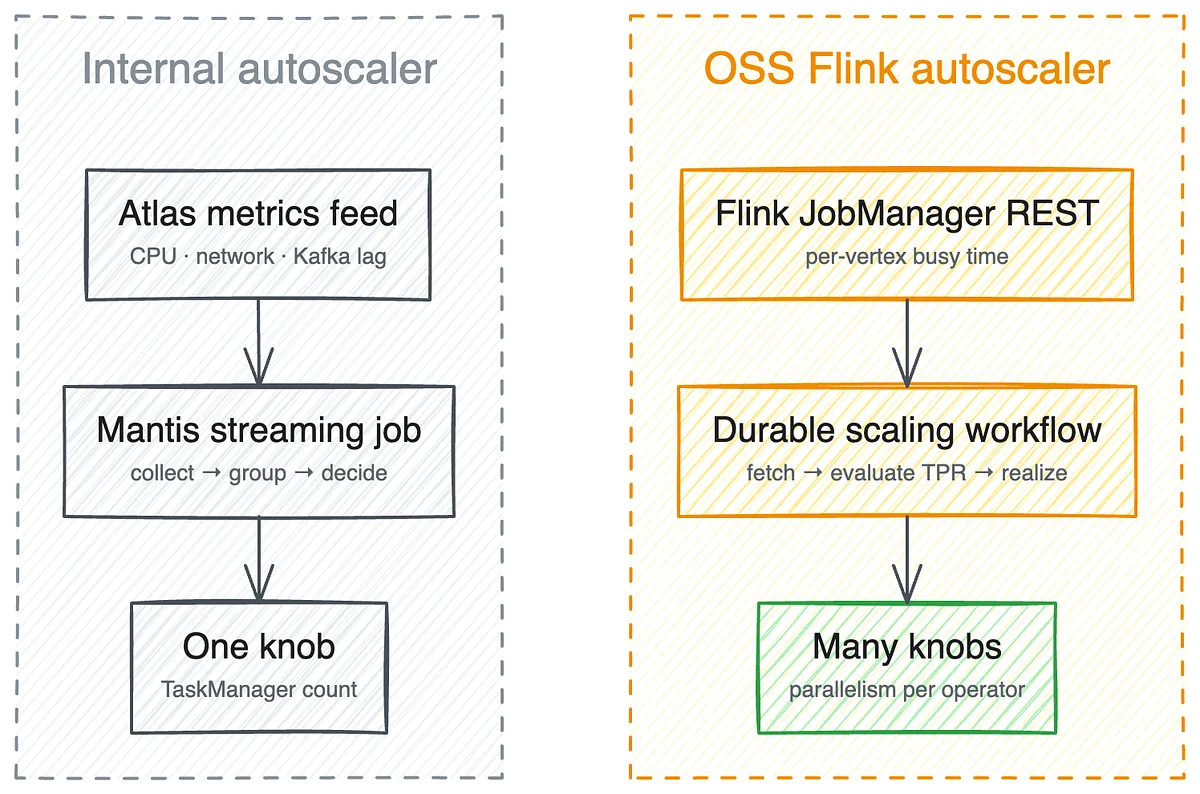
Visual TL;DR
30,000+ Flink JobsDriver
From the article 4 mentionsNetflix operates over 30,000 Apache Flink jobs, a scale that makes efficient resource management, particularly autoscaling, non-negotiable.
In-house Autoscaler (2019)Core
built an external observer system monitoring Flink jobs via Atlas telemetry
From the articleThe company initially built an in-house autoscaler around 2019.
Reduced Resource UsageOutcome
From the articleThis approach successfully reduced resource usage by 25-45% for simpler, single-operator pipelines.
Limitations of External ViewDriver
coarse container metrics and single TaskManager knob insufficient for complex jobs
Consolidate AutoscalersContext
strategic shift to merge two distinct Flink autoscaling systems into one
From the article 9+ mentionsThe turning point came with the maturation of the Apache Flink community's own autoscaler.
Open-Source SolutionCore
adopting and contributing to a single open-source Flink autoscaler
From the article 7 mentionsThe streaming giant detailed its journey with two distinct autoscaling systems in a recent Netflix Tech Blog post, revealing a strategic shift towards adopting and contributing to open-source solutions.
Cost SavingsOutcome
achieving significant cost reductions through optimized resource allocation
From the article 3 mentionsOne team, the client telemetry and logging group, reported a 58% reduction in annualized Flink compute expenditures, equating to approximately $1.1 million in savings.
Improved StabilityOutcome
enhanced system reliability and performance for complex Flink workloads
From the article 2 mentionsThis efficiency stems from dynamic adaptation to traffic cycles, continuous resource adjustment, and improved resource utilization through uniform container dimensions.