

Claude Sonnet 4.6 Ups the AI Ante

Anthropic's Claude Sonnet 4.6 launches with major upgrades in coding, reasoning, and computer use, plus a 1M token context window.

Claude Sonnet 4.6 Ups the AI Ante
Key Takeaways
  • 1
    Claude Sonnet 4.6 offers significant performance gains in coding, reasoning, and computer use.

  • 2
    The model now boasts a 1M token context window, enabling it to process much larger amounts of information.

  • 3
    Sonnet 4.6 is now the default model for Free and Pro users on claude.ai, with pricing unchanged.
Contents(3)

Anthropic has unveiled Claude Sonnet 4.6, its latest Sonnet model, marking a substantial upgrade across key AI capabilities. The company reports notable improvements in coding proficiency, computer interaction, long-context reasoning, agent planning, knowledge work, and design.

A Leap in Performance

Sonnet 4.6 delivers performance that Anthropic claims previously required their top-tier Opus models. Early testers, including developers, have shown a strong preference for Sonnet 4.6 over its predecessor, Sonnet 4.5, and even over the November 2025 Claude Opus 4.5. This suggests a significant leap in efficiency and effectiveness for everyday office tasks.

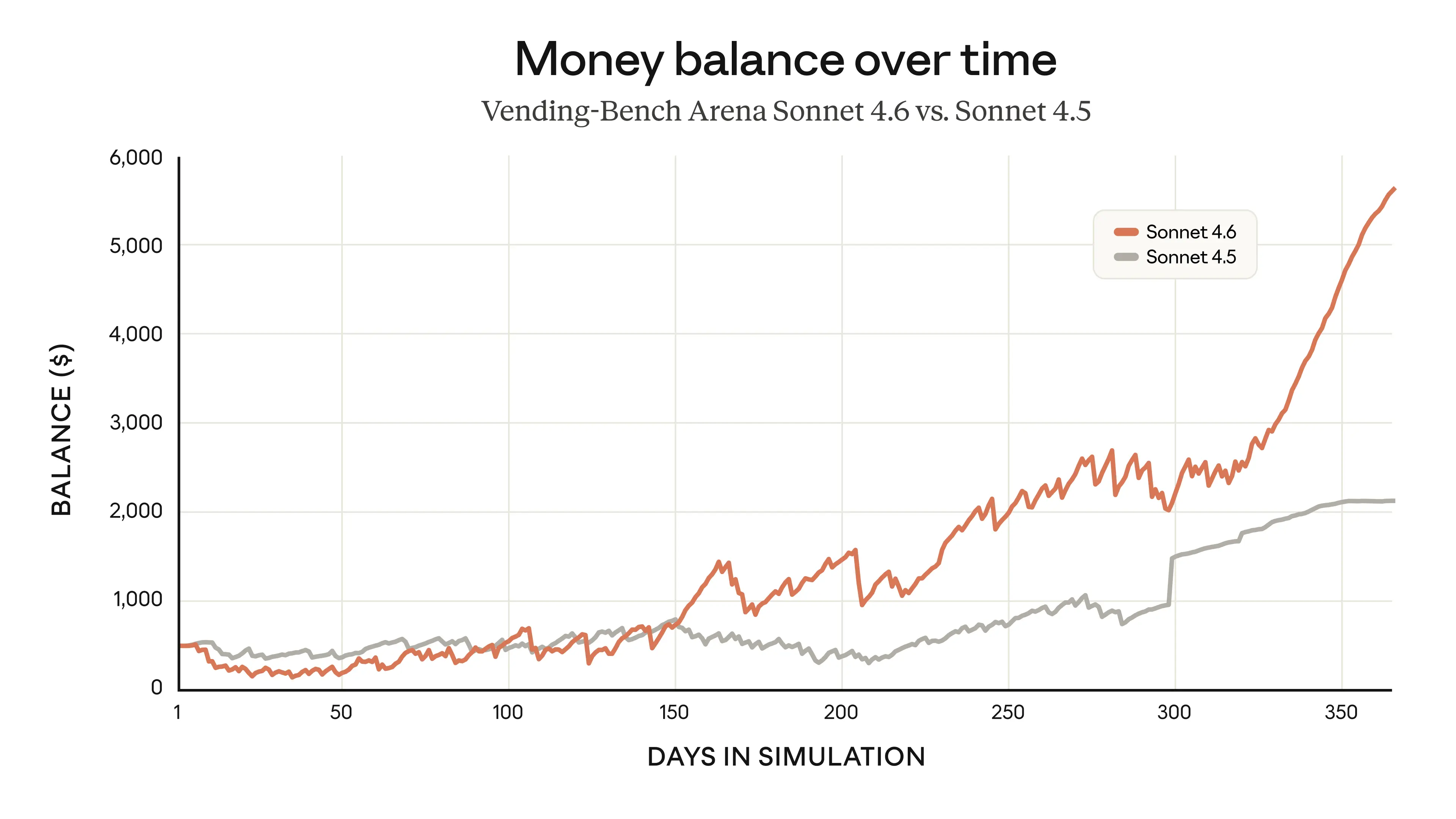
A standout feature is the expanded 1M token context window, currently in beta. This allows the model to ingest and reason over vast amounts of data, such as entire codebases or extensive documentation, in a single prompt. This capability was demonstrated in the Vending-Bench Arena, where Sonnet 4.6 employed a strategic approach to maximize profits over a simulated business lifecycle.

Mastering Computer Interaction

The model also shows marked improvements in its ability to interact with computer systems. Unlike previous AI models that required custom connectors for specialized software, Sonnet 4.6 can navigate and operate applications like a human user would, using a virtual keyboard and mouse. This advancement addresses the challenge of automating tasks within legacy systems.

Anthropic highlights the OSWorld benchmark, which simulates real-world software interactions, as evidence of progress. Sonnet 4.6 demonstrates human-level capability in tasks like complex spreadsheet manipulation and multi-step web form completion. While still not matching expert human users, the rapid progress in this area is notable, making AI more practical for a wider range of work.

The company also addressed security concerns related to computer use, particularly prompt injection attacks. Safety evaluations indicate Sonnet 4.6 offers improved resistance to these attacks, performing comparably to the more advanced Opus 4.6 model.

Broader Availability and Safety

Claude Sonnet 4.6 is now the default model for users on both the Free and Pro plans within claude.ai and Claude Cowork. Pricing remains consistent with Sonnet 4.5. Anthropic emphasizes that extensive safety evaluations confirm Sonnet 4.6 is as safe, or safer, than previous models, exhibiting a positive and prosocial character.

On the Claude Developer Platform, Sonnet 4.6 introduces adaptive and extended thinking, alongside context compaction in beta for managing long conversations. For API users, web search and fetch tools are now more intelligent, automatically processing search results to improve response quality and token efficiency.

While Sonnet 4.6 offers impressive capabilities, Anthropic notes that Claude Opus 4.6 remains the choice for tasks demanding the deepest reasoning, such as complex codebase refactoring or multi-agent workflow coordination.

© 2026 StartupHub.ai. All rights reserved. You may not republish this article in full without a license. Search engines and AI research tools may crawl and summarize for reference. Bulk reproduction or model training requires a license. See our terms.
Daniel Singer

Written by

Daniel Singer

Editor, StartupHub.ai

Daniel Singer is the editor of StartupHub.ai, a technology expert and thought leader on AI and its applications across sectors, from fintech and healthcare to developer tooling and consumer software. He writes and tests the tools covered here thoroughly and regularly, and built StartupHub.ai to give founders, operators and buyers a clearer read on what they are actually being sold.