

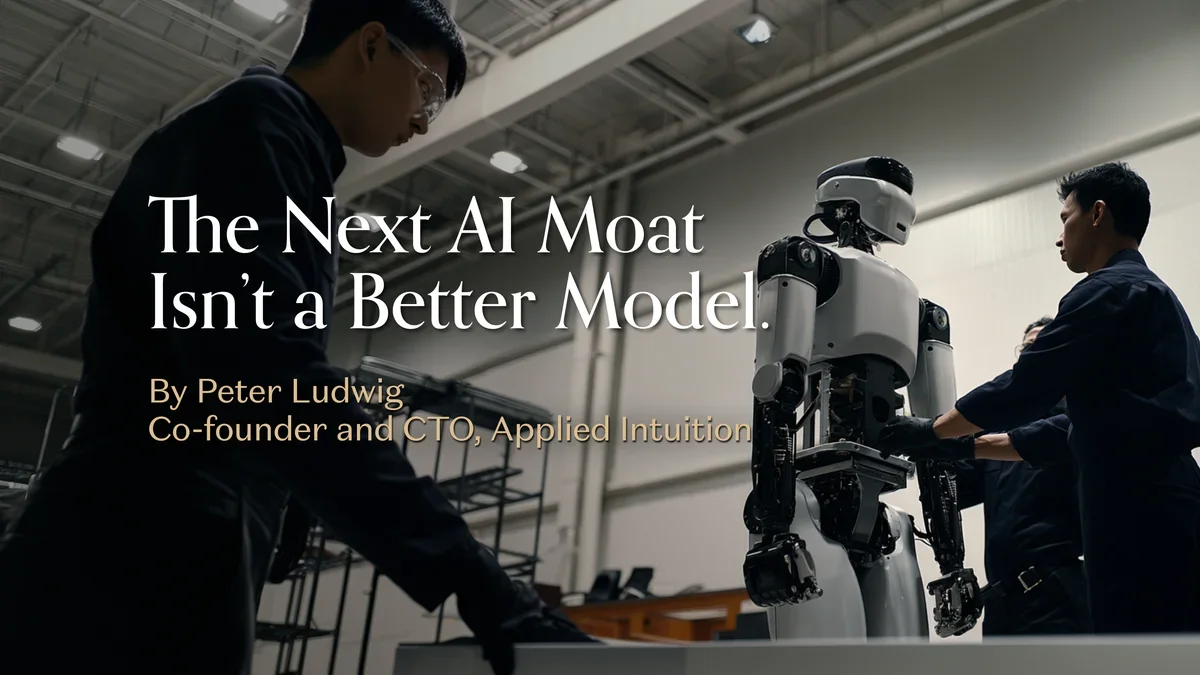
AI's Physical Future: Beyond the Model

The real AI moat lies not in smarter models, but in intelligent engineering systems that can rapidly deploy and iterate on them.

8 min read
Abstract visualization of interconnected AI models and engineering systems.
The future of physical AI depends on robust engineering systems, not just advanced models.· a16z Blog

Visual TL;DR. AI Model Focus leads to Stagnant Engineering Systems. Stagnant Engineering Systems creates Gap: Model to Machine. Gap: Model to Machine results in Slow Deployment. Slow Deployment highlights Pipeline Dictates Pace. Pipeline Dictates Pace requires Intelligent Engineering Systems. Intelligent Engineering Systems enables Speed as Safety. Intelligent Engineering Systems provides Systems Compound.

  1. AI Model Focus: industry investment overwhelmingly favors smarter AI models, neglecting deployment systems
  2. Stagnant Engineering Systems: how requirements become software, validated, deployed, and improved remains stagnant
  3. Gap: Model to Machine: vast gap between cutting-edge AI model and a certified, operational machine
  4. Slow Deployment: 20% model improvement doesn't guarantee faster deployment, requiring extensive integration
  5. Pipeline Dictates Pace: the surrounding engineering system, not just the model, dictates deployment speed
  6. Intelligent Engineering Systems: the real AI moat lies in systems that rapidly deploy and iterate models
  7. Speed as Safety: rapid iteration and deployment capacity become a critical safety mechanism
  8. Systems Compound: intelligent engineering systems, not just models, offer compounding advantages
Visual TL;DR
Visual TL;DR, startuphub.ai Gap: Model to Machine results in Slow Deployment. Slow Deployment highlights Pipeline Dictates Pace. Pipeline Dictates Pace requires Intelligent Engineering Systems results in highlights requires AI Model Focus Gap: Model to Machine Slow Deployment Pipeline Dictates Pace Intelligent Engineering Systems From startuphub.ai · The publishers behind this format
Visual TL;DR, startuphub.ai Gap: Model to Machine results in Slow Deployment. Slow Deployment highlights Pipeline Dictates Pace. Pipeline Dictates Pace requires Intelligent Engineering Systems results in highlights requires AI Model Focus Gap: Model toMachine Slow Deployment Pipeline DictatesPace IntelligentEngineering… From startuphub.ai · The publishers behind this format
Visual TL;DR, startuphub.ai Gap: Model to Machine results in Slow Deployment. Slow Deployment highlights Pipeline Dictates Pace. Pipeline Dictates Pace requires Intelligent Engineering Systems results in highlights requires AI Model Focus industry investment overwhelmingly favorssmarter AI models, neglecting deploymentsystems Gap: Model to Machine vast gap between cutting-edge AI model anda certified, operational machine Slow Deployment 20% model improvement doesn't guaranteefaster deployment, requiring extensiveintegration Pipeline Dictates Pace the surrounding engineering system, notjust the model, dictates deployment speed Intelligent Engineering Systems the real AI moat lies in systems thatrapidly deploy and iterate models From startuphub.ai · The publishers behind this format
Visual TL;DR, startuphub.ai Gap: Model to Machine results in Slow Deployment. Slow Deployment highlights Pipeline Dictates Pace. Pipeline Dictates Pace requires Intelligent Engineering Systems results in highlights requires AI Model Focus industry investmentoverwhelminglyfavors smarter AI… Gap: Model toMachine vast gap betweencutting-edge AImodel and a… Slow Deployment 20% modelimprovement doesn'tguarantee faster… Pipeline DictatesPace the surroundingengineering system,not just the model,… IntelligentEngineering… the real AI moatlies in systemsthat rapidly deploy… From startuphub.ai · The publishers behind this format
Visual TL;DR, startuphub.ai AI Model Focus leads to Stagnant Engineering Systems. Stagnant Engineering Systems creates Gap: Model to Machine. Gap: Model to Machine results in Slow Deployment. Slow Deployment highlights Pipeline Dictates Pace. Pipeline Dictates Pace requires Intelligent Engineering Systems. Intelligent Engineering Systems enables Speed as Safety. Intelligent Engineering Systems provides Systems Compound leads to creates results in highlights requires enables provides AI Model Focus industry investment overwhelmingly favorssmarter AI models, neglecting deploymentsystems Stagnant Engineering Systems how requirements become software,validated, deployed, and improved remainsstagnant Gap: Model to Machine vast gap between cutting-edge AI model anda certified, operational machine Slow Deployment 20% model improvement doesn't guaranteefaster deployment, requiring extensiveintegration Pipeline Dictates Pace the surrounding engineering system, notjust the model, dictates deployment speed Intelligent Engineering Systems the real AI moat lies in systems thatrapidly deploy and iterate models Speed as Safety rapid iteration and deployment capacitybecome a critical safety mechanism Systems Compound intelligent engineering systems, not justmodels, offer compounding advantages From startuphub.ai · The publishers behind this format
Visual TL;DR, startuphub.ai AI Model Focus leads to Stagnant Engineering Systems. Stagnant Engineering Systems creates Gap: Model to Machine. Gap: Model to Machine results in Slow Deployment. Slow Deployment highlights Pipeline Dictates Pace. Pipeline Dictates Pace requires Intelligent Engineering Systems. Intelligent Engineering Systems enables Speed as Safety. Intelligent Engineering Systems provides Systems Compound leads to creates results in highlights requires enables provides AI Model Focus industry investmentoverwhelminglyfavors smarter AI… StagnantEngineering… how requirementsbecome software,validated,… Gap: Model toMachine vast gap betweencutting-edge AImodel and a… Slow Deployment 20% modelimprovement doesn'tguarantee faster… Pipeline DictatesPace the surroundingengineering system,not just the model,… IntelligentEngineering… the real AI moatlies in systemsthat rapidly deploy… Speed as Safety rapid iteration anddeployment capacitybecome a critical… Systems Compound intelligentengineeringsystems, not just… From startuphub.ai · The publishers behind this format

Everyone's chasing the next killer AI model, betting that bigger and smarter will automatically translate to more autonomous machines. This prevailing assumption, however, misses a critical math problem. As Peter Ludwig, co-founder and CTO of Applied Intuition, argues, deployed physical AI is a product of two variables: model capability and the capacity of the surrounding engineering system. For years, industry investment has overwhelmingly favored the former, leaving the latter, how requirements become software, how it's validated, deployed, and improved, stagnant.

The gap between a cutting-edge AI model and a certified, operational machine is vast. A 20% improvement in model benchmarks doesn't guarantee faster deployment. Instead, it necessitates extensive integration, millions of test scenarios, hardware validation, fleet rollout, and continuous monitoring. The pipeline, not the model, dictates the pace.

When a model is delivered, teams can spend months simply proving its safety for deployment. This is why even remarkable advancements like world models won't single-handedly usher in full autonomy. Each model leap merely shifts the bottleneck downstream, from perception to validation and integration.

The assumption that digital AI's agentic revolution will seamlessly transfer to physical AI is flawed. Digital agents operate on documents and code; physical AI work lives in sensor data, simulation logs, and fleet telemetry. An agent unfamiliar with disengagements or perception regressions is a liability, not a productivity tool.

True progress requires an agentic platform built for physical systems. This platform needs to integrate state-of-the-art models with the data, tools, and domain expertise specific to physical AI. It demands an architecture that combines intelligence with domain-specific evaluation and governance, not just a chatbot layered onto existing tools.

Speed as a Safety Mechanism

The reflexive objection to agents in safety-critical systems is that automation implies speed at the cost of errors. However, in these domains, the feedback loop's speed is a safety feature. Rapid iteration allows for earlier defect detection and correction.

Automating development and validation workflows, while retaining human oversight for certification and final judgment, is key. High-stakes agents propose; humans decide. This isn't a temporary concession but the correct permanent architecture for physical AI engineering systems.

Systems, Not Just Models, Compound

The true compounding effect comes from building intelligent engineering systems that feed into and accelerate model improvement. This creates an agentic flywheel: field performance issues are mined for data, synthetic scenarios expose gaps, requirements are updated, software is validated and deployed, generating new data that enhances models and agents.

Applied Intuition's Dana platform exemplifies this. By building an agentic platform grounded in their decade of experience, they've seen development cycles shorten dramatically, with deployments moving from weeks to multiple times daily. This acceleration expands the scope of what's feasible, making complex autonomous machines development possible.

Without this focus on engineering systems, the next decade of physical AI risks a widening gap between lab demos and real-world deployment. The companies that master operationalizing intelligence, not just developing it, will define the future.

© 2026 StartupHub.ai. All rights reserved. Do not enter, scrape, copy, reproduce, or republish this article in whole or in part. Use as input to AI training, fine-tuning, retrieval-augmented generation, or any machine-learning system is prohibited without written license. Substantially-similar derivative works will be pursued to the fullest extent of applicable copyright, database, and computer-misuse laws. See our terms.