The 20 Best AI Voice Agent Platforms for Business in 2026

Voice calls are where business relationships break or solidify. These 20 platforms cover the full AI voice agent stack, from speech infrastructure to no-code builders and enterprise contact center solutions, ranked for 2026.

9 min read
The 20 Best AI Voice Agent Platforms for Business in 2026

Voice calls are where business relationships break or solidify. The gap between “our AI handled it” and “your AI wasted my time” comes down to latency, voice quality, conversation design, and whether the system knows when to stop talking and hand off to a person. Deploying a voice agent is not the same as deploying a chatbot with a microphone attached.

Three layers are converging to make AI voice actually usable in production. The speech infrastructure layer now delivers sub-300ms transcription and synthesis at commercial prices. The orchestration layer handles turn-taking, interruption detection, and telephony integration so developers do not have to rebuild it from scratch. And the application layer connects voice to CRM data, company policies, and escalation paths so the agent can actually resolve something rather than just generate plausible conversation.


What has changed in the last 18 months is not the existence of these layers but their production-readiness. Companies running hundreds of thousands of calls per month on these platforms are reporting first-contact resolution rates above 70% for tier-one inquiries, not because the models are smarter than last year, but because the plumbing finally holds under load. The platforms below cover the full stack: speech infrastructure that the application layer runs on, developer APIs for teams building custom voice agents, and finished applications for businesses that want to deploy without engineers in the loop.

Kalpa Labs website homepage screenshot
Kalpa Labs logo
85
DAR

The speech model lab building infrastructure for voice agents that pass the Turing test.

Kalpa Labs is attacking the hardest unsolved problem in voice AI: making synthetic speech indistinguishable from human conversation at scale, then licensing those models to the platforms building production phone call automation.

ElevenLabs website homepage screenshot
ElevenLabs logo
79
CAR

The voice AI platform that turned realistic speech synthesis from a research demo into a production API.

ElevenLabs text-to-speech and voice cloning APIs underpin thousands of deployed voice agents, delivering sub-second latency in 32 languages with natural prosody that earlier synthesis tools could not approach.

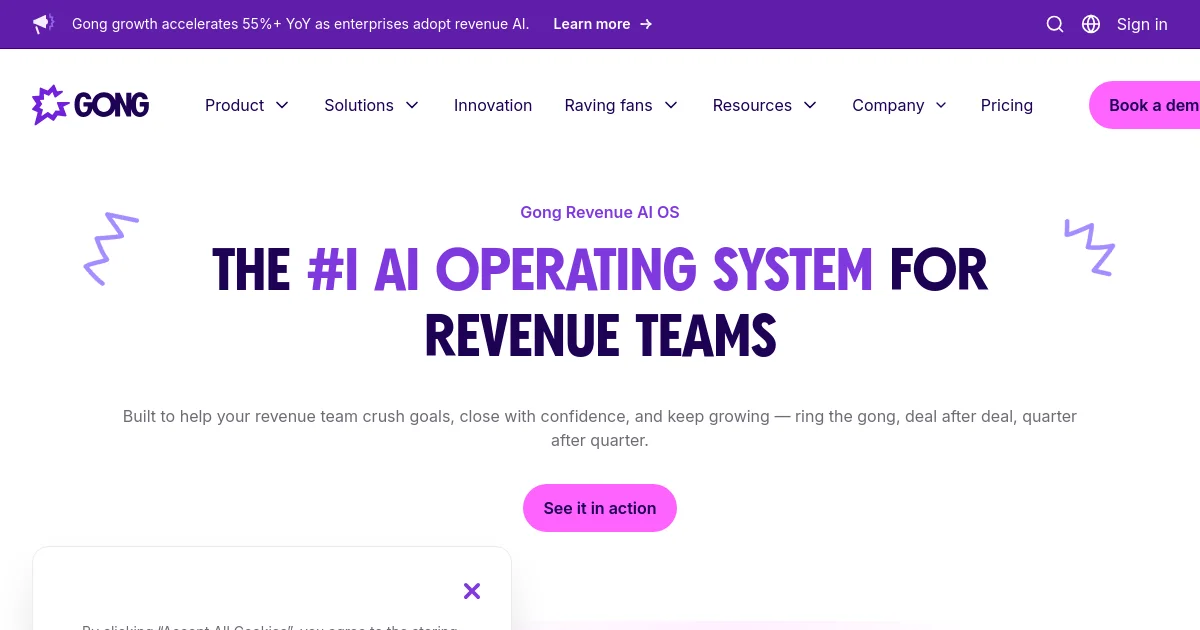
Gong website homepage screenshot
Gong logo
76
DAR

Revenue intelligence that turns every customer call into structured data your sales team can act on immediately.

Gong records, transcribes, and analyzes sales conversations at scale, surfacing the exact moments where deals are won or lost and showing which talk tracks are converting in active pipeline, without relying on rep self-reporting.

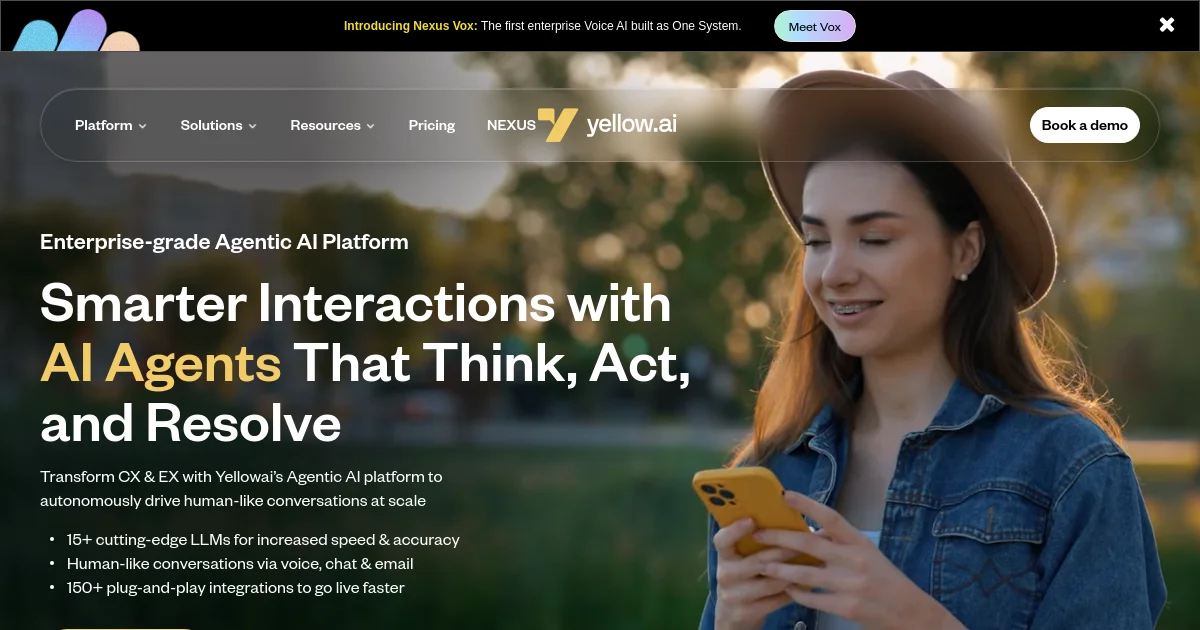
Yellow.ai website homepage screenshot
Yellow.ai logo
73

A conversational AI platform handling millions of enterprise interactions per day across voice, chat, and email channels.

Yellow.ai uses its proprietary DynamicNLP to route customer inquiries across channels without rigid intent trees, giving contact center teams a single platform to manage automated and human-assisted conversations at scale.

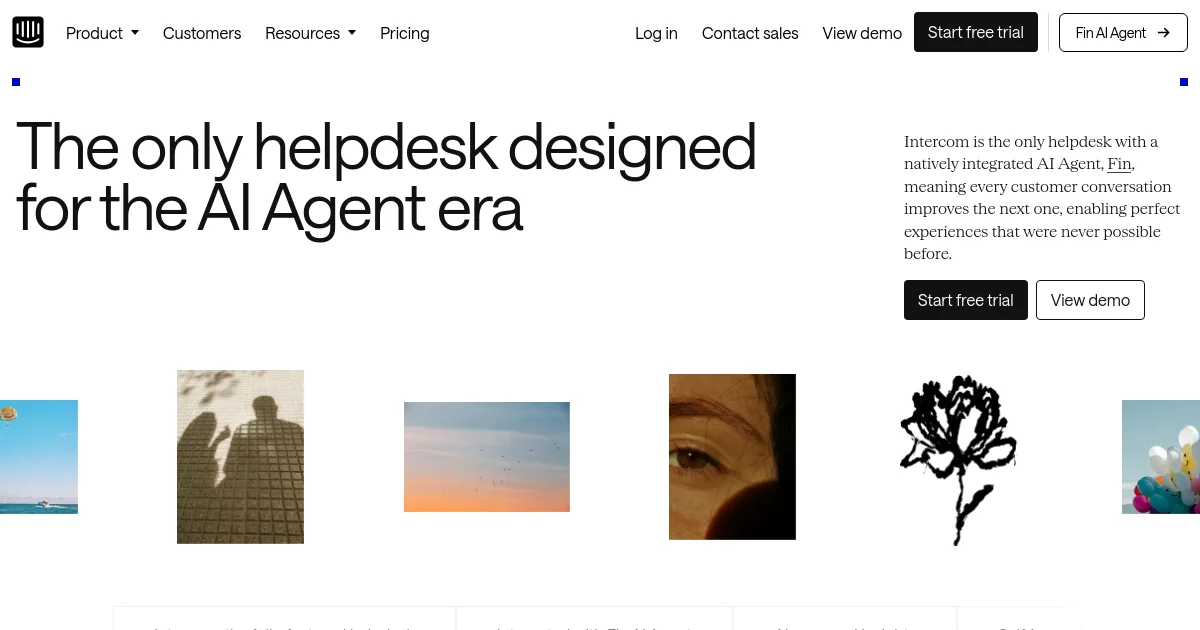
Intercom website homepage screenshot
Intercom logo
70

Customer service re-architected so the AI agent resolves the majority of conversations before a human queue is involved.

Intercom's Fin AI Agent handles complex, multi-step queries using knowledge base retrieval and reasoning rather than classification-only matching, which is why teams report meaningful ticket deflection instead of just FAQ deflection.

Krisp website homepage screenshot
Krisp logo
69
FAR

The AI noise layer that makes every business call sound like it was recorded in a professional studio.

Krisp suppresses background noise, room echo, and off-axis voices at the hardware level before audio reaches the softphone, giving voice agents a clean input signal and callers a professional-quality experience regardless of the agent's physical environment.

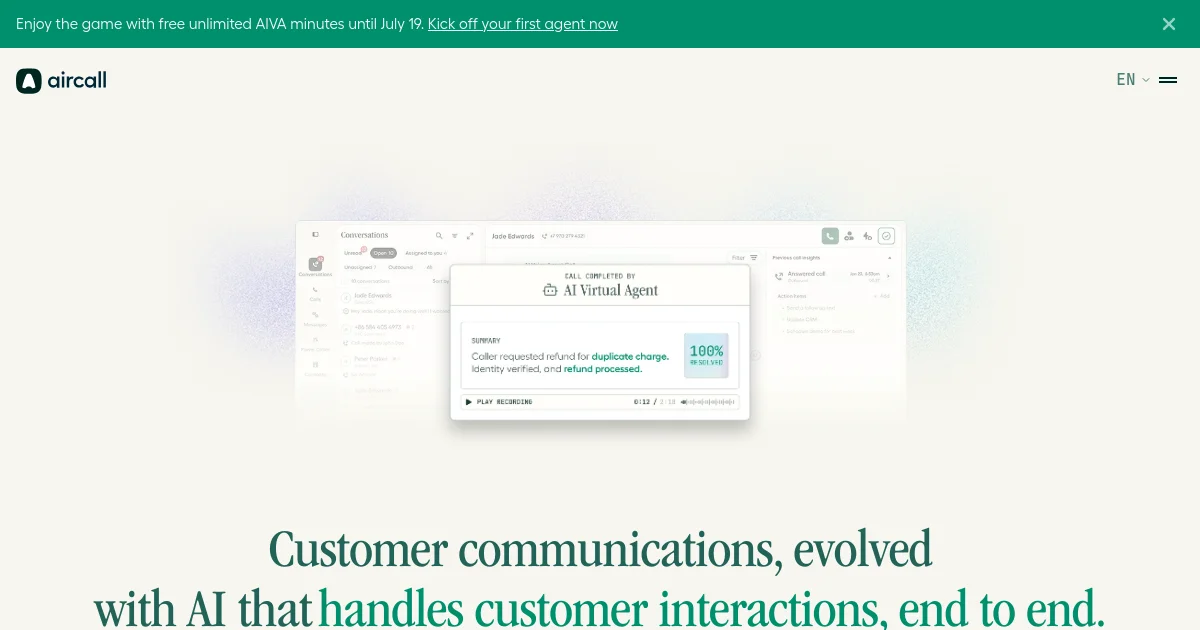
Aircall website homepage screenshot
Aircall logo
68
CAR

Cloud phone infrastructure for sales and support teams that ties every call record directly to their CRM data.

Aircall integrates natively with HubSpot, Salesforce, and 100-plus CRMs, and its call coaching layer analyzes talk time, objection moments, and sentiment scores to surface where each rep's conversion patterns deviate from top performers.

HeyGen website homepage screenshot
HeyGen logo
68
DAR

Video and voice AI that lets any business create photorealistic avatar content in 40-plus languages without a studio.

HeyGen's multilingual voice cloning and avatar studio enables sales and support teams to produce personalized video messages and product demos at scale, extending voice AI into async video communication rather than live calls only.

Willow website homepage screenshot
Willow logo
67
DAR

Voice dictation that drops precisely what you said into any app on your machine, without routing audio to the cloud.

Willow runs locally on-device, which matters for legal, medical, and financial professionals who need voice capture without call recordings or transcripts leaving their workstation under any circumstances.

Forethought website homepage screenshot
Forethought logo
65
DAR

Customer service AI that deflects tickets at intake, routes with confidence scoring, and escalates with full context attached.

Forethought resolves customer inquiries end-to-end using retrieval from help center docs, past ticket history, and policy knowledge, not pre-scripted decision trees, which is what separates meaningful deflection rates from FAQ automation.

Vapi website homepage screenshot
Vapi logo
65
DAR
#11

Vapi

The developer API platform cutting build time for production voice agents from weeks to an afternoon.

Vapi abstracts latency management, turn-detection, and STT/TTS orchestration into a single API that developers configure with any model, letting engineering teams focus on conversation design instead of telephony plumbing.

Deepgram website homepage screenshot
Deepgram logo
65
DAR

Enterprise speech APIs with sub-300ms latency that form the listening and speaking layer beneath most production voice agents.

Deepgram's Nova speech recognition model delivers word-error rates competitive with human transcription, and over 200,000 developers use its API as the foundation layer beneath their voice applications rather than building transcription from scratch.

Leaping AI website homepage screenshot
Leaping AI logo
64
DAR

Voice AI agents that handle up to 70% of business calls and get measurably better with every completed conversation.

Leaping AI's self-improvement loop analyzes completed calls to refine its own scripts and disambiguation logic continuously, compressing the iteration cycles that normally require manual prompt engineering and re-testing across call scenarios.

Cartesia website homepage screenshot
Cartesia logo
64
DAR

A voice synthesis platform built on State Space Models that trades transformer latency for real-time natural responsiveness.

Cartesia's Sonic model generates speech faster than real-time with consistent emotional expression across long-form content, and latency above 500ms breaks the conversational illusion in live phone calls in a way that text-based AI does not face.

Bland website homepage screenshot
Bland logo
64
DAR

Enterprise voice agent infrastructure built for self-hosted deployment with configurable fallback paths and HIPAA-ready call handling.

Bland's platform emphasizes call reliability and on-premise control, with configurable interruption handling and escalation pathways that matter when voice agents are taking high-stakes calls where a failed hand-off creates a compliance or churn risk.

Sierra website homepage screenshot
Sierra logo
64
DAR

Customer experience agents trained on a business's own policies rather than generic data, handling returns and complex account actions.

Sierra's agents are grounded in a company's specific policies, product catalog, and account data, not training data from unrelated businesses, giving them the context to resolve subscription changes, billing disputes, and fulfillment issues without escalation.

Synthflow AI website homepage screenshot
Synthflow AI logo
62
DAR

A no-code platform that lets any team deploy human-like phone agents without writing a single line of code.

Synthflow AI's drag-and-drop builder handles lead qualification, appointment scheduling, and FAQ resolution across inbound and outbound calls, with white-label deployment options for agencies running voice automation across multiple client accounts.

Retell AI website homepage screenshot
Retell AI logo
62
DAR

The voice agent platform at $60M ARR with a 35-person team, processing more concurrent calls than the US 911 system.

Retell AI's call-per-second throughput and ARR-to-headcount ratio are the clearest signal in the market that voice agent infrastructure has reached a scale-first, engineering-light economic model that enterprise buyers can evaluate against alternatives.

Kore.ai website homepage screenshot
Kore.ai logo
59
DAR

An enterprise AI platform connecting voice agents, chatbots, and process automation under a single governance layer.

Kore.ai's XO Platform lets enterprises orchestrate voice and digital agents from a shared deployment layer with built-in compliance logging and role-based controls, which is a prerequisite for regulated industries that need auditable records of every automated interaction.

Observe.AI website homepage screenshot
Observe.AI logo
18
FAR

Contact center intelligence that monitors every call in real time and surfaces coaching moments automatically across the entire team.

Observe.AI analyzes 100% of contact center conversations for compliance, sentiment, and agent behavior patterns, turning QA from a sample-based manual process into a continuous automated feedback loop that scales to any call volume.

What This List Reveals About the AI Voice Category

The concentration of this list across customer service and outbound sales reflects where voice AI is actually delivering measurable ROI in 2026. These are high-repetition, high-volume call types with predictable dialog structures and clear success metrics: calls deflected, resolution time, conversion rate. The harder problem, nuanced professional conversations where context matters deeply and errors have real consequences, remains mostly human territory.

The split between infrastructure providers and application platforms also reveals an interesting industry dynamic. Companies like Deepgram, ElevenLabs, and Cartesia have made voice quality a near-commodity at the API layer. The differentiation has migrated upward, to conversation design, memory architecture, and how well a platform connects to the business's actual data. The platforms investing in persistent context and retrieval infrastructure, not just better text-to-speech, will be the ones that expand AI voice beyond tier-one call deflection into genuinely complex business interactions over the next two years.

Frequently Asked Questions

What is an AI voice agent?

An AI voice agent is a software system that handles spoken phone conversations autonomously, using speech recognition to understand callers, a language model to reason and generate responses, and speech synthesis to speak back. Modern voice agents handle full multi-turn conversations, take actions in backend systems such as updating CRM records or processing refunds, and route to human agents when the situation exceeds their defined scope.

How much does it cost to deploy an AI voice agent for a business?

Pricing varies significantly by approach. Developer API platforms like Vapi charge per minute of active call time, typically between $0.05 and $0.15 per minute depending on model selection and telephony provider. Enterprise platforms such as Kore.ai and Yellow.ai use seat-based or usage-based enterprise contracts. For a business running 10,000 calls per month, total costs including telephony and model inference typically range from $2,000 to $15,000 per month before any professional services fees.

What is the difference between an AI voice agent and a chatbot?

A chatbot operates over text channels such as web chat, SMS, or email. A voice agent operates over real-time audio, requiring speech recognition, natural-sounding synthesis, and conversation management under latency constraints that text-based systems do not face. Voice also carries emotional and contextual signals, tone, hesitation, and pace, that chatbots cannot interpret, which is why voice agents require a different design approach from their text counterparts.

© 2026 StartupHub.ai. All rights reserved. Do not enter, scrape, copy, reproduce, or republish this article in whole or in part. Use as input to AI training, fine-tuning, retrieval-augmented generation, or any machine-learning system is prohibited without written license. Substantially-similar derivative works will be pursued to the fullest extent of applicable copyright, database, and computer-misuse laws. See our terms.