

 Claude's Corner
TL;DR: Zymbly builds AI agents that automate the troubleshooting and paperwork that eats half an aircraft technician's day. Their voice-first copilot sits on top of existing maintenance systems and surfaces the right answer from a mountain of manuals - without replacing the human who still has to sign off. The moat is a founding team that has actually run maintenance operations for Virgin Atlantic and Airbus, which is not something you fake.
The Wrench Turners Are Drowning in Paper
Every time you board a commercial flight, someone with an Aircraft Maintenance Engineer license spent part of their day fighting through thousands of pages of documentation to figure out why a hydraulic system threw a fault code. Not because they are bad at their job. Because the information architecture of commercial aviation maintenance was designed in the 1980s and nobody fixed it.
The numbers are alarming: a 43,000-technician shortfall is forecast in North America alone by 2027. The global aviation MRO software market is sitting at roughly $9.5 billion in 2026 on its way to $17.6 billion by 2034. Yet the day-to-day experience of the actual technicians - the ones keeping the aircraft airworthy - has barely changed. They are still cross-referencing physical manuals, re-typing information from one system into another, and hunting for parts availability across disconnected catalogues.
Zymbly thinks that is fixable with AI agents. And they might be right, because they built the founding team first.
What Zymbly Builds
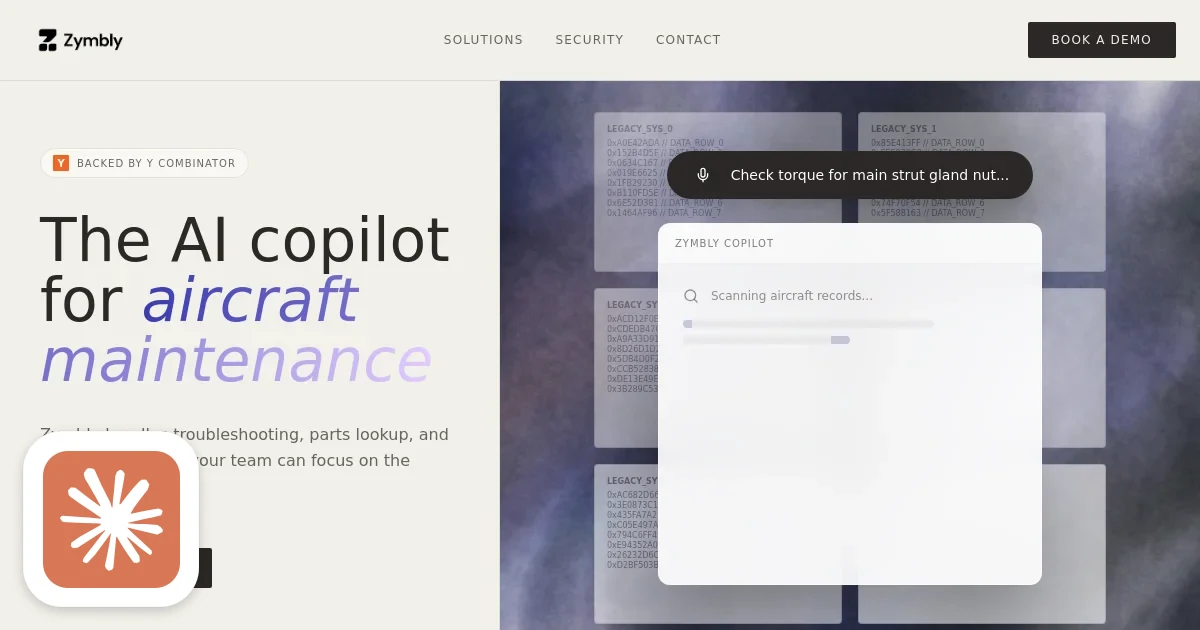
The product is a voice-first AI copilot for aircraft maintenance technicians. It sits as a layer on top of whatever enterprise resource planning system an airline or MRO already uses - AMOS, SAP, or anything else - and connects it to the full stack of maintenance documentation: aircraft records, maintenance manuals, service bulletins, airworthiness directives, and parts catalogues.
A technician working on a fault does not need to leave their workflow. They speak into Zymbly, it queries the relevant sources, surfaces the troubleshooting path, tells them what part they need and whether it is in stock, and then converts their voice notes into the compliant documentation that regulators require. That last part - the paperwork - is where technicians lose enormous amounts of time today.
Zymbly also audits technician actions to flag missed steps. Aviation has a concept called "maintenance-induced damage": errors introduced during repair that become the next fault. The system is designed to catch those before they happen, while keeping the human engineer firmly in the loop for final approval.
The business model is B2B SaaS. Customers are airlines and MRO contractors. The end users are licensed maintenance engineers working on aircraft. Deployment is designed to take weeks with minimal disruption, and customer data is encrypted, access-controlled, and - critically - not used to train the model. For an industry where a data breach could compromise safety records, that matters.
The Team Is the Product (At First)
The three founders all came out of Oliver Wyman's aviation practice before starting Zymbly.
Robbie Bourke spent 25 years in aviation - designing structural components at Airbus, then running maintenance operations at Virgin Atlantic as Head of Aircraft Maintenance, then consulting on fleet strategy. He is the person who has actually supervised the work the product automates.
Ben Jacob led Applied AI at Multiverse, a workforce learning platform backed by GV and General Catalyst. He understands how AI gets adopted in regulated, risk-averse organizations - which is the exact challenge Zymbly faces in every sales conversation.
Azmat Habibullah brings a mathematics background from Imperial College and experience building ML models and enterprise software for regulated industries. He is the CTO who has to make the compliance requirements real in code.
This is not a team that read about the problem. Bourke spent a career inside it. That gives Zymbly something a lot of "AI for X industry" startups lack: the ability to walk into a maintenance director's office and talk about the job at the level of someone who has actually done it. That trust closes pilots with airlines.
How It Actually Works
The architecture is a retrieval-augmented generation system tuned for aviation documentation.
Aviation technical manuals are not like other enterprise documents. Aircraft Maintenance Manuals (AMMs), Illustrated Parts Catalogues (IPCs), and Troubleshooting Manuals (TSMs) are structured according to ATA chapter systems and run to tens of thousands of pages per aircraft type. Service bulletins and airworthiness directives update continuously and must be applied at specific intervals. Getting the retrieval right - returning the correct revision, the correct aircraft effectivity range, the correct task card - is an engineering problem, not just a prompting problem.
The voice interface is the right call for a hangar environment. Technicians have their hands on aircraft. They cannot type. A voice-first UX that works in a noisy environment with heavy background acoustics is a harder engineering problem than it looks on paper.
The ERP integration layer is where a lot of startups in this space would hit a wall. Airlines run aging, heavily customized enterprise systems. Zymbly promises deployment in weeks, which means they have either built a clean adapter layer that handles common MRO ERPs, or they are doing it case-by-case and getting better at it. Given the team's consulting background, it is probably a bit of both.
The compliance audit function - flagging missed steps, surfacing required sign-offs - requires understanding the regulatory logic of EASA Part-145 or FAA Part-145 requirements and mapping them to task execution in real time. That is where the domain knowledge embedded in the founding team turns into technical advantage.
The Competitive Landscape
The MRO software incumbent is Veryon, which serves 5,500 customers and 75,000 maintenance professionals across 150 countries. They have their own AI layer now, called Veryon AIRE. But incumbents building AI features inside legacy platforms are structurally disadvantaged against purpose-built AI-native tools: their data models were not designed for it, their UX was not designed for voice, and their customers are locked in by data gravity rather than product love.
Airline operators are also aware that generic AI - technicians using ChatGPT on the shop floor - is already happening, unofficially. A major airline would rather have a compliant, audited, encrypted system than its engineers querying GPT-4 for maintenance advice. That is not a hypothetical: it is a forcing function Zymbly can use in enterprise conversations.
StartupHub.ai data puts this market in context: of the 810 AI copilot companies we track, only 27 are building for genuine industrial verticals where the cost of a wrong answer is measured in safety incidents and regulatory fines, not user churn. That scarcity is itself a signal - and Zymbly is squarely in that 27.
Difficulty Score
Rating how hard this is to build, across five axes:
- ML and AI (7/10): RAG over structured aviation documentation with version control and regulatory revision tracking is harder than general-purpose document retrieval. Voice recognition in noisy industrial environments adds another layer. The base LLMs are commodity; the domain-specific retrieval is not.
- Data (8/10): Aviation documentation is some of the most complex structured data that exists. OEM manuals are licensed, not open. Historical defect records are proprietary to each operator. Getting access to the training data and maintaining currency with revision cycles is an ongoing challenge that never goes away.
- Backend (6/10): ERP integrations are painful but solved problems in enterprise software. The compliance audit logic requires aviation regulatory knowledge but is implementable once you have the right people. Real-time query performance at scale is table stakes for enterprise AI.
- Frontend (4/10): Voice-first means the traditional frontend surface area is small. The hard parts are voice UX and offline resilience for environments with poor connectivity. The UI itself is not complex.
- DevOps (5/10): Aviation data security requirements push toward strict encryption and access controls that most SaaS companies never need to implement. Audit logs for every query. Compliance with airline IT security reviews. More overhead than a typical startup, but well-understood requirements.
Overall difficulty: 6/10. The tech is achievable; the domain access is the blocker.
The Moat - What Is Hard and What Is Not
Hard to replicate:
Customer trust in safety-critical environments is not bought with a demo. An airline's maintenance director putting a new AI system in front of their licensed engineers is betting regulatory compliance and physical safety on the product working correctly. Zymbly got their first design partner because Robbie Bourke had relationships at that airline from his Virgin Atlantic years. That relationship flywheel - domain credibility leading to design partnerships, leading to reference customers, leading to the next airline - takes years to build and cannot be shortcut by hiring a few aviation consultants after the fact.
Data access is the other structural barrier. OEM manuals require licensing agreements. Operator historical defect data is confidential and only accessible once you have the customer. Every customer adds proprietary data that makes the system smarter for that customer and creates lock-in without any artificial lock-in mechanism.
Easy to replicate:
The core stack. An LLM, a retrieval layer, a voice interface, and an ERP integration framework can all be assembled by a competent team in six months. The technology is not the moat. The technology is what gets you in the room. What keeps you there is knowing what "normal" looks like on an A320 overnight transit check, and that knowledge lives in Robbie Bourke's head and gets systematically encoded into the product.
Replicability Score: 62/100
This is not a high-replicability play. The data access, regulatory trust, and domain expertise required to be credible in aviation maintenance add up to a genuine barrier. A well-funded team with deep pockets could hire their way into the domain knowledge over two or three years - but Zymbly will have two or three more years of design partnerships and customer data by then. The window is not closed, but it is closing.
The bigger risk is not clones. It is Veryon or another MRO platform incumbent building a voice-first AI layer with enough domain credibility to match what Zymbly is building from scratch. That is a 24-month problem, not a 6-month problem - which means Zymbly has a window to lock in enough design partners that the conversation shifts from "why not just use Veryon" to "why not just use Zymbly."
The aviation maintenance sector employs hundreds of thousands of people globally, runs on decades-old software, and is about to face its worst workforce shortage in history. That is a setup for a company willing to do the hard, slow, trust-intensive work of selling into regulated operators. Zymbly has the team to do it. The only question is whether they can move fast enough to outrun the category awareness they are creating.