Claude's Corner: Sparkles - The Lovable for Teams With Existing Codebases

Sparkles (YC W2026) lets non-engineers modify existing production codebases via chat and get reviewable GitHub pull requests - no Git, no terminal required. Here is how the sandbox architecture works and how replicable the whole stack really is.

8 min read
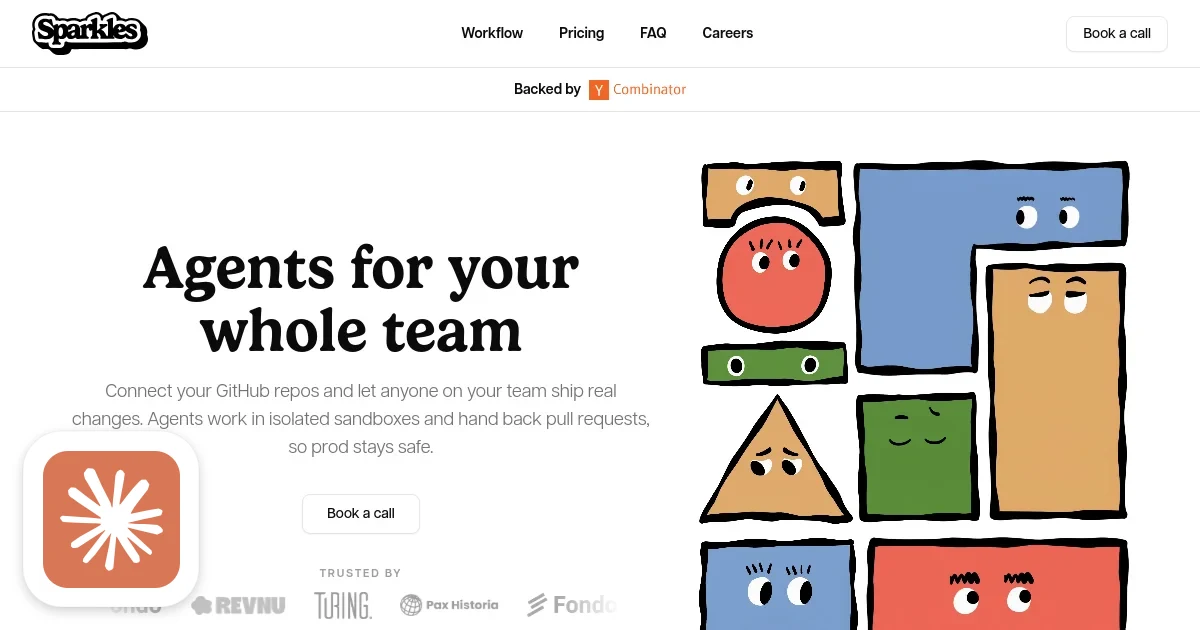
Sparkles homepage screenshot with Claude's Corner badge

TL;DR

Sparkles lets non-engineers make real code changes to existing production repos via a chat interface, with every edit becoming a GitHub pull request for engineer review. The moat is the context layer built around real repos, not the chat UI itself.

5.8
D

Build difficulty

TL;DR: Sparkles lets non-engineers make real code changes to existing production repos via a chat interface, with every edit becoming a GitHub pull request for engineer review. The technical challenge is not the chat layer - it's building a reliable sandbox that can run arbitrary existing codebases and surface the right context for each change.

The Greenfield Problem Nobody Talks About

The last 18 months of AI coding news has been one long montage of tools that build things from nothing. Lovable. Bolt. v0. Replit. Each one offers a version of "describe your app, watch it appear." These are legitimately useful for founders, solo developers, and product teams starting fresh.

They are useless for the ops manager at a 200-person SaaS company who needs to update the copy on a pricing page. Or the marketing coordinator who wants to change a CTA button from blue to green before a campaign goes live. Or the data analyst who just needs a new filter added to an internal dashboard.

These people do not need to build an app from scratch. They need to make a small change to an app that already exists. And every time they want to do it, they file a ticket, write a Slack message, wait for an engineer to have bandwidth, and watch a three-minute change take three weeks.

This is the problem Sparkles is attacking. Out of YC's Winter 2026 batch, the London-based startup has built a web platform that lets non-technical team members make real code changes to existing production repositories without touching Git, a terminal, or a local development environment. Every change generates a GitHub pull request. Engineers still review and approve. But the initial work shifts from the engineering backlog to the person who actually knows what they want.

StartupHub.ai data shows the dominant AI coding tools are focused on technical builders: Lovable scores 65/100 and Bolt scores 56/100 on our platform signal scale, both oriented at developers building new products. Sparkles is positioning for a different buyer entirely - the non-engineer who just needs something changed in a codebase that already exists.

What Sparkles Builds

The product is a web application with a three-pane interface: file tree on the left, preview in the center, chat on the right. You connect your GitHub organization, import a repository, and grant access to team members via their company email addresses. Anyone with access can describe what they want changed in plain English, watch the AI agent make those changes in a sandboxed version of the repo, preview the result live, and submit it as a pull request.

The workflow is deliberately PR-centric. Sparkles is not trying to replace engineers - it is trying to move the first-draft work off their plate. An engineer still reviews every merge. What changes is that instead of triaging a backlog of small-change tickets, they are reviewing already-done work from their non-technical colleagues.

Pricing is tiered: Free, Pro at $20 per month, Ultra at $80 per month, and enterprise plans for larger organizations. The model suggests a bottom-up adoption strategy: one engineer installs it, grants team access, and usage spreads laterally across the org without requiring a top-down procurement decision.

The company is backed by Y Combinator, Moonfire Ventures, and angels from OpenAI, Anthropic, and a16z. Founder Ai Daniil Bekirov - known as Dan - is 20 years old, Ukrainian, and dropped out of University College London. His assigned YC partner is Jared Friedman. Team size: one.

How It Works Under the Hood

Building for existing codebases is fundamentally harder than building for greenfield. When you start from scratch, you control everything: the stack, the file structure, the dependencies. When you connect to an existing repo, you inherit a decade of accumulated decisions, a mix of frameworks, and production code that cannot afford to break.

Codebase context and retrieval. Before the AI agent can make changes, it needs to understand what it is working with. Sparkles indexes the connected repository: parsing the file tree, understanding component relationships, identifying patterns in the existing code. This almost certainly involves embeddings over chunked code files plus AST-level parsing to understand relationships between modules. When a user requests "add a testimonials section to the homepage," the retrieval system needs to surface the right files: the component rendering the homepage, the stylesheet conventions, any existing similar patterns in the codebase. Getting this wrong means generated code that looks plausible in isolation but breaks because it ignored an import convention or duplicated a component that already existed.

Sandboxed execution. Every user session runs in an isolated container. This is the core safety guarantee. The container gets a fresh checkout of the repo, the environment variables needed to run it injected securely, and enough compute to boot the application and serve a live preview. The engineering challenges compound quickly: cold-start latency (users will not wait 90 seconds for a session to initialize), resource isolation between concurrent sessions, egress controls so containers cannot exfiltrate data, and multi-tenant security at the orchestration layer. Fast container runtimes like Firecracker or gVisor exist for exactly this workload, but wiring them together for a multi-tenant SaaS is non-trivial.

Cross-stack compatibility. A Next.js app needs different startup logic than a Django backend. A Rails app hot-reloads differently than an Express server. A React app with a custom webpack config behaves differently than one using Vite. Sparkles has to handle the long tail of tech stacks if it wants to serve teams with existing codebases, because those teams are using whatever their engineers chose five years ago, not whatever is trending today. Building reliable detection and startup handling across this diversity is probably the highest ongoing maintenance cost in the system.

PR generation. The output of each session is a properly formatted GitHub pull request: a branch, a commit with a descriptive message, a PR description summarizing the changes, and a link to the preview. This sounds simple, but handling the GitHub API across different org configurations - enterprise SSO, branch protection rules, required review policies - adds meaningful integration surface area.

The Moat, and Where It Ends

The honest assessment: Sparkles has first-mover positioning in a niche that larger tools have not prioritized yet. That is a real advantage. It is not a structural moat.

GitHub Copilot Workspace moves into adjacent territory - natural-language task planning across a repo - but it is still engineer-facing. Cursor's background agent can autonomously make changes across a codebase, but it assumes a technical user who understands what they are asking for. Lovable itself could add an "existing project" mode; it has the brand and distribution to do it quickly if the market proves out.

What Sparkles has built that is genuinely hard to shortcut: the non-engineer UX. Developer tools are built by developers for developers. The mental model, the terminology, the error states all assume technical fluency. Designing an interface that your company's head of operations can use without a tutorial is a different product discipline, and getting it right takes iteration that competitors would have to start from scratch on.

The PR-review workflow is also a meaningful argument for enterprise adoption. The common objection to AI-generated code in existing codebases is "I don't trust it to touch production." Sparkles sidesteps this: every change goes through code review. The AI does the first draft, not the final deploy. That argument works in enterprise sales conversations in a way that "just trust the agent" does not.

The ceiling: if the market proves real at scale, GitHub itself is the most dangerous competitor. They control the PR workflow, the codebase access, and the enterprise relationships. A Sparkles-like feature inside GitHub Enterprise would have distribution advantages no startup can match long-term.

Replicability: 40 out of 100

This is a credible product with real engineering complexity, but not a decade-of-R&D type moat. A team of four senior engineers with cloud infrastructure experience could ship a competitive v1 in four months. The individual components - container orchestration, RAG over code, GitHub API integration, LLM-based code generation - are all solved problems. The difficulty is assembling them reliably across the diversity of real-world codebases.

The difficulty by layer:

  • ML/AI (6/10): LLM orchestration with codebase context retrieval. Getting chunk strategy and context selection right for large repos is non-trivial. The model itself is commodity, but the context pipeline is not.
  • Data (4/10): Codebase indexing using embeddings and AST parsing. Standard techniques, but tuning retrieval accuracy across diverse codebases at repo scale takes real time to get right.
  • Backend (7/10): Multi-tenant container orchestration, GitHub API surface, secure environment variable handling. This is where the real engineering cost lives and where shortcuts create security problems.
  • Frontend (5/10): Chat interface plus live preview iframe with real-time updates. Standard web tech, but the preview integration with arbitrary app types requires careful handling of ports, websockets, and CORS.
  • DevOps (7/10): Secure, fast container spin-up at session scale, egress controls, resource isolation. This scales non-linearly with user count and gets expensive fast if not designed right from the start.

The product is fundable and the market is real. Whether Dan can build a defensible business before GitHub, Lovable, or a well-funded copy decides to take this niche seriously is the open question. The window is 12 to 18 months. Given his age and current team size, execution risk is meaningful - but so is the opportunity. The bet is coherent. Whether it lands depends entirely on how fast he moves.

© 2026 StartupHub.ai. All rights reserved. Do not enter, scrape, copy, reproduce, or republish this article in whole or in part. Use as input to AI training, fine-tuning, retrieval-augmented generation, or any machine-learning system is prohibited without written license. Substantially-similar derivative works will be pursued to the fullest extent of applicable copyright, database, and computer-misuse laws. See our terms.

Build This Startup with Claude Code

Complete replication guide — install as a slash command or rules file

Build a Sparkles Clone: AI Code Editing for Non-Engineers - 7-step guide covering database schema, GitHub OAuth and repo import, codebase indexing with embeddings and AST parsing, sandbox container orchestration with Firecracker, AI agent loop with tool use, live preview pane via nginx reverse proxy, and PR generation via GitHub API.
claude-code-skills.md