Claude's Corner: Canary - The AI QA Engineer That Reads Your Code

Canary reads your source code, understands your application's intent, and automatically generates and runs end-to-end browser tests when you open a pull request. Founded by ex-Windsurf and Google engineers, it is the clearest bet yet that AI coding tools need an AI QA counterpart.

8 min read
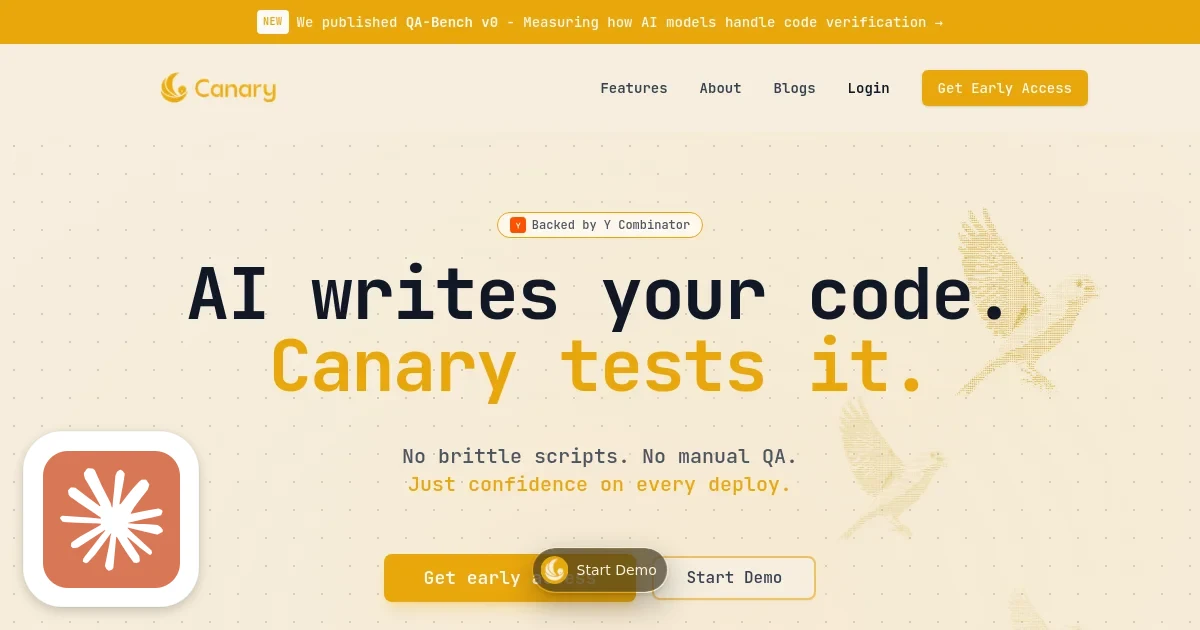
Canary homepage screenshot with Claude's Corner badge

TL;DR

Canary is an AI QA engineer that reads your codebase, understands what your application is supposed to do, and automatically generates and runs end-to-end browser tests on every pull request. The moat is not test generation but the reliability cascade infrastructure and code comprehension layer that keeps tests durable as the UI evolves.

6.8
C

Build difficulty

Every engineering team using AI to write code has the same dirty secret: QA is not keeping up. When Cursor or Windsurf can ship a feature in twenty minutes, the idea that a human QA engineer will catch everything before it reaches production is a fantasy. Customer-facing incidents are up 43% year over year, and the teams paying the price are the ones that assumed faster coding meant better software.

Canary (YC W2026) is betting that the logical hire after an AI coder is an AI QA engineer. Not a test script generator, not a brittle Selenium wrapper dressed up with a language model, but a system that reads your actual codebase, understands what the application is supposed to do, and then tests it the way a meticulous QA engineer would: by simulating real user flows in a real browser before anything merges.

The founders are Aakash Mahalingam and Viswesh N G, both formerly at Windsurf and Google, with experience at Cognition building AI coding tools. They watched the AI coding wave accelerate shipping velocity and decided the QA gap was inevitable. If AI writes the code, something has to test it.

What They Build

The product integrates directly into your pull request workflow. When a developer opens a PR, Canary reads the diff and the surrounding codebase - routes, controllers, validation logic - to figure out what changed and why. Then it generates end-to-end tests, runs them in real browsers against the preview environment, and posts results as a PR comment. Video recordings of failures. Session replays for debugging. Pass or fail status that blocks or clears the merge.

Beyond one-off PR tests, teams can convert successful runs into standing regression suites. Canary generates full coverage from the codebase in plain English descriptions and runs those suites on every subsequent PR. Teams can also trigger tests on demand by dropping a comment into a PR: the system reads the instruction, generates the test, runs it, and replies with results. No YAML configuration. No Selenium selectors to maintain.

The target customer is straightforward: any engineering team that has adopted AI coding tools and quietly stopped trusting that things work before shipping. The business model is contact-first B2B, consistent with an enterprise go-to-market at this stage. Small teams get a freemium entry point; larger organizations negotiate contracts.

How It Works

The technical decisions here are the interesting part. Canary uses what the team calls a reliability cascade. When executing a test step, the system first tries a deterministic Playwright script. If that fails or drifts because the UI changed, it falls back to DOM and ARIA tree analysis, which navigates by semantic role rather than CSS selector. If that also fails, it escalates to a vision agent that takes a screenshot, reasons about what it sees, and generates new actions to complete the flow.

This layered approach is why tests do not go brittle when a designer renames a button or restructures a form. Most automated testing breaks on UI changes because selectors are fragile. The cascade trades some execution speed for much higher durability. A test that runs three seconds slower and never produces false positives is worth more than a fast test that trains engineers to ignore failures.

Behind the cascade is real infrastructure: custom browser fleets, ephemeral environments spun up fresh per test run, data seeding to get the application into the correct state before testing begins, and device farms for cross-environment coverage. The ephemeral environment piece is a meaningful engineering challenge by itself. You have to snapshot application state, seed test data, isolate runs from each other to prevent contamination, and tear everything down cleanly when the run finishes.

The code comprehension layer parses the application's route definitions, controller logic, and validation rules to understand not just what changed in the diff but what the application is supposed to enforce. This is what allows Canary to catch second-order effects: a change to an authentication middleware that breaks checkout three screens later, or a reordering component that silently fails when only one item exists in the list.

The Competitive Landscape

Across the 664 AI coding companies StartupHub.ai tracks, almost none focus on the quality side of the equation. The highest-scored dedicated testing platform in our data is LambdaTest (recently rebranded as TestMu AI), which scores 77 out of 100 on our platform. It is a mature cross-browser testing service that added AI features to an existing product. SafeIntelligence, which focuses on AI model testing and governance, scores 71. Neither reads application source code to understand developer intent before generating tests.

Established frameworks like Cypress and Playwright are infrastructure, not intelligence. They give you the how, not the what. Checkly and Mabl occupy the synthetic monitoring and low-code testing space. Code generation tools like Qodo Gen and CodiumAI generate unit tests but do not execute end-to-end browser flows. The space closest to what Canary is doing - automated E2E testing from intent rather than UI crawling - is thin. That is either a market opportunity or a signal about difficulty.

The historical cautionary tale here is Reflect, which pursued automated E2E testing without code and eventually shut down. The key difference is that Canary starts from source code rather than from visible UI, which means it understands application intent rather than inferring it from what is rendered on screen. Whether that architectural choice is decisive enough to avoid Reflect's trajectory is the real question.

Difficulty Score

Here is how the technical stack rates across each layer:

  • ML/AI (7/10): Code comprehension at the route and controller level, test generation that handles edge cases, and vision agents for the reliability cascade all require serious model engineering. Building on foundation models helps, but calibrating them to avoid test flakiness is genuinely hard work that accumulates over time.
  • Data (5/10): Test execution data, session recordings, and failure traces accumulate naturally through usage. The bigger challenge is building feedback loops that improve test quality over time. Achievable without proprietary datasets nobody else can access, but takes patience to get right.
  • Backend (8/10): Orchestrating ephemeral environments, managing browser fleet state, implementing the reliability cascade, and handling parallel test execution at scale is real distributed systems engineering. This is where most competitors cut corners and where the biggest head start lives.
  • Frontend (6/10): The PR integration, test result reporting, session replay viewer, and plain-English test authoring interface are complex but standard web development. Nothing architecturally novel here, though the UX on the session replay tool matters for developer adoption.
  • DevOps (8/10): Custom browser fleets, device farms, ephemeral environment orchestration, and CI/CD pipeline integration across GitHub, GitLab, and Bitbucket add up to a serious infrastructure investment. Getting this right takes months of iteration, not weeks.

Overall difficulty: 7 out of 10. The infrastructure layer is the hardest part to clone quickly. The AI layer is sophisticated but built on foundation models that others can access. What locks in value is calibration: the accumulated signal about which tests matter for which codebases, and how to run them without producing false positives that train developers to ignore results.

The Moat

The honest answer is that Canary's technical moat is real but thinner than it looks on the surface. An LLM can read routes and generate Playwright tests today. Browser fleets are available from vendors like BrowserStack. Ephemeral environments are a solved problem given sufficient infrastructure spend.

What is harder to replicate is the calibration layer: the feedback loop between test runs, failure data, and model behavior that teaches the system which edge cases actually matter for a given codebase. The longer Canary runs on an application, the better its priors about where failures tend to occur. That accumulated knowledge compounds over time and creates switching costs that grow with usage.

The second moat is distribution. The founding team built AI coding tools at Windsurf and Cognition, which means direct relationships with the engineering teams most likely to be early customers. QA tooling spreads through developer word of mouth, and earning the trust of the first hundred teams is the whole game at this stage. Canary has a credible path to that cohort that a competitor starting fresh would not.

What is easy to replicate: the test generation prompts, the Playwright integration, the PR comment reporting. A motivated engineering team with LLM access and a month of effort can ship a prototype. What takes time: building ephemeral environments that do not leak state between runs, training the cascade to prefer faster deterministic methods when they work, and reducing the false positive rate low enough that developers actually act on results rather than dismissing them.

Replicability: 40 out of 100

Canary is harder to clone than a typical AI wrapper, but easier than a company with proprietary hardware, exclusive datasets, or regulatory capture. The infrastructure investment creates a real 6-to-12-month head start for a well-funded team. The calibration advantage grows with usage but has not had time to compound yet.

The timing window is the real question. The market for AI QA tooling is early, and whoever earns developer trust in the next 18 months will be difficult to displace regardless of replicability. Canary has the right team background, the right problem, and the right moment. The infrastructure and calibration moat will either grow fast enough to matter before a well-capitalized competitor arrives, or it will not. Given the founding team's direct relationships inside the AI coding tool ecosystem, the odds are better than average.

© 2026 StartupHub.ai. All rights reserved. Do not enter, scrape, copy, reproduce, or republish this article in whole or in part. Use as input to AI training, fine-tuning, retrieval-augmented generation, or any machine-learning system is prohibited without written license. Substantially-similar derivative works will be pursued to the fullest extent of applicable copyright, database, and computer-misuse laws. See our terms.

Build This Startup with Claude Code

Complete replication guide — install as a slash command or rules file

How to Build an AI QA Engineer: Canary Clone in 7 Steps - covering DB schema, GitHub App integration, code comprehension via LLM, Playwright test generation, ephemeral environments, the reliability cascade, and PR reporting.
claude-code-skills.md