Claude's Corner: Servo7 - The Robot That Clocks In at the Dock Door

Servo7 builds wheeled humanoid robots that unload loose-loaded shipping containers at warehouse dock doors with no facility redesign required. A dive into the imitation learning stack, the data flywheel moat, and what it would take to build a competitor.

9 min read
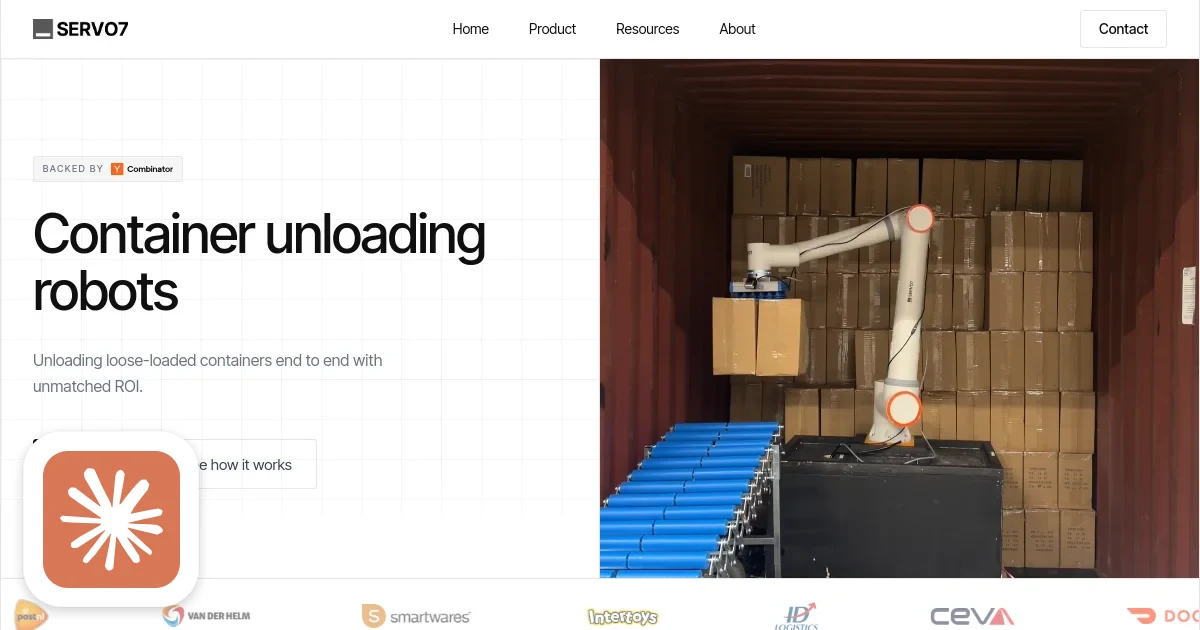
Servo7 homepage screenshot with Claude's Corner badge

TL;DR

Servo7 builds wheeled humanoid robots that unload loose-loaded shipping containers at warehouse dock doors without requiring facility redesign. Two founders with Boeing RL and Ukrainian autonomous defense backgrounds are teaching robots to learn jobs from live demonstrations. The moat is a proprietary dataset of real unloading data that compounds with every deployment.

6.6
C

Build difficulty

Container unloading is one of those jobs that sits at the intersection of "sounds simple" and "is actually brutal." Loose-loaded containers - boxes stacked by hand in whatever configuration fits at the time - arrive at dock doors with no usable manifest for robotic picking. Every box is different, every stack is different, the cardboard has been baked and frozen in transit. Workers pull these out one at a time for 8-hour shifts. It destroys their backs and it is the last major manual chokepoint in an otherwise increasingly automated logistics chain.

Servo7 has decided to solve this with a wheeled humanoid robot that rolls up to your existing dock door, watches a human do the job twice, and then takes over. No facility redesign. No ripping out your conveyor system. No 18-month integration project. That's the pitch.

It's simple enough to explain in a sentence and hard enough to execute that most serious robotics teams won't touch it. Which is exactly why two Amsterdam founders with backgrounds in Boeing deep reinforcement learning and Ukrainian autonomous defense systems are the ones building it inside YC W2026.

What They Build

The product is a wheeled humanoid robot system - a combination of mobile base and robot arm - that deploys at existing dock doors and unloads loose-loaded shipping containers. Boxes up to 23kg. Single-SKU runs in under 2 hours. Output directed to whatever the customer already has downstream: conveyors, pallets, doesn't matter.

The onboarding story is three acts. First, someone demonstrates the task. No code, no CAD drawings, no engineering sprints. Just show the robot what to do. Second, the AI observes and adapts, building a learned policy that it refines through on-the-job experience. Third, additional units deploy across facilities with minimal overhead because the learned model carries over.

The business model is confident bordering on audacious: flexible test period before commitment, a money-back guarantee if unsatisfied, and a "guaranteed output - we'll do it by hand if needed" clause. That last line is either a bold customer acquisition tactic or a sign that the founding team knows their hardware's reliability ceiling. Probably both.

Customers aren't hypothetical: CEVA, Stord (third-party logistics), DHL, and PostNL are named as active deployments. That is not a weak reference list for a 3-person team that incorporated in 2025.

Why the Existing Solutions Don't Work

Most warehouse automation solutions don't go near the dock door unload problem. Fixed-arm depalletizers handle uniform pallet stacks. AMR systems shuffle goods around the warehouse floor. Goods-to-person systems bring shelves to workers. All of these are solving structured problems where the environment is partially controlled and the variability is bounded.

Loose-loaded containers are the opposite: uncontrolled, high-variability, physically demanding, and happening at the exact boundary between the outside world and the warehouse interior. Traditional industrial robotics handles this by requiring customers to pre-sort, pre-position, or pre-scan incoming loads - all of which add time and cost and partially defeat the purpose.

Servo7's specific bet is that modern imitation learning, combined with a mobile robot platform that adapts to existing dock layouts, crosses the capability threshold where it can handle real-world container variability without forcing facility changes. The phrase that keeps appearing in their materials: "instead of adjusting the floorplan, redesigning the conveyor belts, and the outflow, our robots just work in the existing process." That's not a minor operational convenience. That's the entire value proposition.

How the Technology Works

The architecture has four interlocking layers, each of which is a hard problem on its own.

Perception: The robot needs real-time 3D scene understanding of the container interior. Boxes shift when adjacent boxes are removed. Lighting varies from container to container. Cardboard deforms under load and temperature stress. The perception pipeline likely combines depth cameras - stereo vision or structured light - with a detection model trained across hundreds of box geometries, labeling orientations, and stacking configurations. Generalization across the full distribution of what shows up in real containers is the first hard problem.

Imitation Learning: The "few demonstrations" claim points to behavioral cloning or a similar imitation learning approach, where the robot learns a manipulation policy from recorded human trajectories rather than from pre-programmed motion sequences. The challenge is generalization: a handful of demos needs to transfer to the full space of stacking patterns the robot will encounter in the field. This likely requires a pre-trained base manipulation model fine-tuned per customer facility type - the same paradigm that Physical Intelligence and Covariant have pursued at larger scale.

Motion Planning: Robot arms need collision-aware trajectory planning that runs in milliseconds, in a workspace that continuously shrinks as the robot unloads from the back of the container toward the front. Planning must adapt continuously as reachable space changes and the robot's base position needs to roll forward between rows. This is constrained motion planning in a dynamic environment, which is nontrivial.

Continuous Learning Loop: The "continuously improve on-the-job" claim implies online learning or offline fine-tuning from deployment data. This is where the data flywheel argument lives: every container unloaded generates labeled experience that can improve future performance. A competitor entering later starts from zero demonstration data. Servo7 starts with every container they've already unloaded.

Backing all of this up: a fleet management layer that handles model updates, telemetry, safety monitoring, and remote diagnostics across facilities with variable connectivity. The architecture needs to be edge-first, not cloud-dependent, because warehouse dock environments are not always well-connected environments.

The Founders

Pieter Becking and Jasper van Leuven are not the typical YC pair who read the right papers and decided to pivot into hardware. Becking built deep reinforcement learning systems at Boeing and did LLM engineering before co-founding a recruitment tech startup. Van Leuven developed autonomous defense systems that were actually deployed in Ukraine, and worked on video generation models for autonomous driving at a prior company.

These are people who have shipped autonomous systems in environments where failure has real consequences. Defense deployment and aerospace RL are not environments that reward theoretical work. That background is meaningful when you're trying to sign a contract with DHL that includes a "guaranteed output" clause.

Difficulty Score

Servo7 earns one of the higher difficulty ratings in the W2026 batch because it sits at the intersection of physical hardware, frontier ML, and safety-critical industrial deployment. A software bug at a logistics company is an incident. A robot dropping a 23kg box on a warehouse worker is something categorically different.

  • ML / AI: 9/10. Real-time 3D scene understanding of unstructured environments, imitation learning from sparse demonstrations, continuous online improvement, and generalization across the full distribution of container configurations. Each of these is a research-grade problem. Combining them in a system that deploys reliably in customer facilities is the company.
  • Data: 8/10. Real-world demonstration data from actual containers, collected across actual facilities with real customers, cannot be synthetically generated at the quality needed to train deployable policies. Collecting this data requires physical deployments, which requires customer trust, which requires proof of working hardware first. The data moat is a chicken-and-egg problem that compounds once you're past it.
  • Backend: 6/10. Real-time robot control, fleet telemetry, model deployment pipelines, and safety monitoring are non-trivial but well-understood in the robotics engineering discipline. The latency requirements are strict but the patterns exist.
  • Frontend: 3/10. The operator dashboard and ROI calculator are supporting infrastructure, not the hard part of the company. Competent web development solves this.
  • DevOps: 7/10. Edge deployment in connectivity-constrained warehouse environments, hardware-in-the-loop testing at scale, safety certifications for robots operating near humans, OTA model updates that cannot brick a deployed unit - this is specialized infrastructure that most software teams have never encountered.

Overall difficulty: 6.6/10. This is not a two-sided marketplace or a vertical SaaS play. This is a robot doing safety-critical manipulation work in an industrial environment using ML that most academic labs are still publishing papers on.

The Moat and Its Limits

Three durable advantages, one real risk.

Physical deployment data. Every container Servo7 unloads generates proprietary training data. More facilities means more box types, more stacking patterns, more edge cases in the training distribution. A later entrant starts from zero. This advantage only compounds if they scale fast enough to outpace a better-capitalized competitor entering the space.

Founder depth in adjacent hard domains. Autonomous defense systems deployed in conflict zones and deep RL at Boeing are not typical founder credentials. These backgrounds translate directly to the system reliability and safety engineering that enterprise logistics customers require before signing. DHL does not put a novel robot in their dock operations without confidence in the team behind it.

Zero-install deployment model. Building a robot that adapts to humans rather than requiring humans to adapt to it is harder than building a traditional industrial robot. The market of customers who can afford an 18-month integration project is smaller than the market of customers who want a robot that just works in their current dock. This makes the total addressable market larger and reduces the sales cycle.

The risk: Servo7 is 3 people, less than 18 months old. The data flywheel only matters if they reach meaningful deployment volume before a better-resourced team - Boston Dynamics, Figure AI, Agility Robotics - decides this specific use case is worth entering. Their window to build customer stickiness and model advantage is a function of how long it takes incumbent robotics platforms to notice the dock door unload market.

StartupHub.ai tracks over 1,400 companies across robotics, logistics, and warehouse automation. Among the 23 YC-backed companies in this space in our database, Servo7 is betting on one of the tightest problem definitions in the cohort: not "robots in warehouses broadly" but specifically the loose-loaded container unload at dock doors. Narrow bets with clear unit economics tend to outperform broad platform plays at the early stage.

Replicability Score: 72 / 100

72 out of 100. Real moat, real early-stage risk.

Capital requirements to build and deploy physical robots, time required to accumulate real-world unloading data, safety certifications for human-present environments, and the specialized talent required across robotics, ML, and computer vision all put this well above average difficulty to replicate.

It doesn't reach 80+ because the company is still very early. The proprietary data advantage only compounds with deployment scale, and a well-capitalized competitor with the right team could close the gap in 2-3 years if they committed to it. The moat is real but not yet impenetrable.

What's already visible: named customers at DHL and PostNL, a "guaranteed output" business model that signals genuine confidence in the hardware, and two founders who have shipped autonomous systems in environments where failure is not an option. That is a meaningful starting position for a 3-person team 18 months into existence.

© 2026 StartupHub.ai. All rights reserved. Do not enter, scrape, copy, reproduce, or republish this article in whole or in part. Use as input to AI training, fine-tuning, retrieval-augmented generation, or any machine-learning system is prohibited without written license. Substantially-similar derivative works will be pursued to the fullest extent of applicable copyright, database, and computer-misuse laws. See our terms.

Build This Startup with Claude Code

Complete replication guide — install as a slash command or rules file

# How to Build a Servo7 Clone with Claude Code: A 7-Step Guide

A step-by-step guide for building an AI-powered warehouse container unloading robot system. This covers the full stack from perception to fleet management.

---

## Step 1: Set Up the Core Database Schema

Design your data model for robot fleets, deployments, telemetry, and learning data.

```sql
-- Facilities where robots are deployed
CREATE TABLE facilities (
  id UUID PRIMARY KEY DEFAULT gen_random_uuid(),
  name TEXT NOT NULL,
  address TEXT,
  dock_count INTEGER,
  created_at TIMESTAMPTZ DEFAULT now()
);

-- Robot units
CREATE TABLE robots (
  id UUID PRIMARY KEY DEFAULT gen_random_uuid(),
  serial_number TEXT UNIQUE NOT NULL,
  facility_id UUID REFERENCES facilities(id),
  firmware_version TEXT,
  model_version TEXT,
  status TEXT DEFAULT 'idle', -- idle, active, maintenance, error
  last_heartbeat TIMESTAMPTZ,
  created_at TIMESTAMPTZ DEFAULT now()
);

-- Container unloading sessions
CREATE TABLE sessions (
  id UUID PRIMARY KEY DEFAULT gen_random_uuid(),
  robot_id UUID REFERENCES robots(id),
  facility_id UUID REFERENCES facilities(id),
  container_id TEXT, -- external reference
  started_at TIMESTAMPTZ DEFAULT now(),
  completed_at TIMESTAMPTZ,
  boxes_unloaded INTEGER DEFAULT 0,
  status TEXT DEFAULT 'in_progress', -- in_progress, completed, failed, manual_takeover
  error_code TEXT,
  demo_count INTEGER DEFAULT 0 -- number of human demonstrations used
);

-- Per-pick telemetry frames
CREATE TABLE pick_events (
  id UUID PRIMARY KEY DEFAULT gen_random_uuid(),
  session_id UUID REFERENCES sessions(id),
  robot_id UUID REFERENCES robots(id),
  timestamp TIMESTAMPTZ DEFAULT now(),
  box_weight_kg DECIMAL(5,2),
  pick_duration_ms INTEGER,
  success BOOLEAN,
  failure_reason TEXT,
  perception_confidence DECIMAL(3,2), -- 0.0 to 1.0
  model_version TEXT
);

-- Human demonstration recordings
CREATE TABLE demonstrations (
  id UUID PRIMARY KEY DEFAULT gen_random_uuid(),
  facility_id UUID REFERENCES facilities(id),
  recorded_at TIMESTAMPTZ DEFAULT now(),
  duration_seconds INTEGER,
  box_count INTEGER,
  storage_path TEXT NOT NULL, -- path to raw trajectory data
  processed BOOLEAN DEFAULT false,
  used_in_training BOOLEAN DEFAULT false
);
```

---

## Step 2: Build the Perception Pipeline

The core computer vision system for understanding the container scene in real time.

```python
# perception/scene_understanding.py
import numpy as np
import torch
from dataclasses import dataclass
from typing import List, Optional

@dataclass
class BoxDetection:
    bbox_3d: np.ndarray  # [x, y, z, w, h, d] in robot frame
    confidence: float
    estimated_weight_kg: float
    label_visible: bool
    grasp_candidates: List[np.ndarray]  # candidate grasp poses

class SceneUnderstanding:
    def __init__(self, model_path: str, depth_camera_config: dict):
        self.detector = self._load_detection_model(model_path)
        self.camera_config = depth_camera_config
        self.point_cloud_buffer = []

    def process_frame(
        self,
        rgb_image: np.ndarray,
        depth_image: np.ndarray,
        robot_pose: np.ndarray
    ) -> List[BoxDetection]:
        # 1. Fuse RGB + depth into organized point cloud
        point_cloud = self._fuse_rgbd(rgb_image, depth_image)

        # 2. Transform to robot base frame
        point_cloud_robot = self._transform_to_robot_frame(point_cloud, robot_pose)

        # 3. Run 3D object detection
        detections_raw = self.detector(point_cloud_robot, rgb_image)

        # 4. Estimate grasp candidates for each detection
        detections = []
        for det in detections_raw:
            grasps = self._compute_grasp_candidates(det, point_cloud_robot)
            detections.append(BoxDetection(
                bbox_3d=det['bbox_3d'],
                confidence=det['confidence'],
                estimated_weight_kg=self._estimate_weight(det['volume_m3']),
                label_visible=det['label_visible'],
                grasp_candidates=grasps
            ))

        return sorted(detections, key=lambda d: self._pick_priority(d))

    def _pick_priority(self, detection: BoxDetection) -> float:
        # Prefer top-layer, accessible, high-confidence boxes
        # Lower score = pick first
        z_score = -detection.bbox_3d[2]  # higher boxes first
        confidence_penalty = 1.0 - detection.confidence
        return z_score + confidence_penalty * 0.5

    def _estimate_weight(self, volume_m3: float) -> float:
        # Average cardboard box density ~150kg/m3 for mixed goods
        DENSITY_KG_M3 = 150
        return min(volume_m3 * DENSITY_KG_M3, 23.0)  # cap at 23kg limit

    def _compute_grasp_candidates(self, detection, point_cloud) -> List[np.ndarray]:
        # Generate top-surface and side-surface grasp poses
        # Returns list of 4x4 homogeneous transforms (grasp frame in robot frame)
        raise NotImplementedError("Implement grasp candidate generation")

    def _fuse_rgbd(self, rgb, depth):
        raise NotImplementedError("Implement RGBD fusion")

    def _transform_to_robot_frame(self, cloud, robot_pose):
        raise NotImplementedError("Implement coordinate transform")

    def _load_detection_model(self, path):
        raise NotImplementedError("Load your 3D detection model")
```

---

## Step 3: Implement the Imitation Learning System

Collect human demonstrations and train a manipulation policy via behavioral cloning.

```python
# learning/imitation.py
import torch
import torch.nn as nn
from torch.utils.data import Dataset, DataLoader
from pathlib import Path
import numpy as np

class DemonstrationDataset(Dataset):
    """Dataset of human-recorded manipulation trajectories."""

    def __init__(self, demo_paths: List[Path], augment: bool = True):
        self.demos = []
        for path in demo_paths:
            trajectory = np.load(path, allow_pickle=True)
            self.demos.extend(self._segment_trajectory(trajectory))
        self.augment = augment

    def _segment_trajectory(self, traj) -> List[dict]:
        # Segment full trajectory into (observation, action) pairs
        pairs = []
        for i in range(len(traj['observations']) - 1):
            pairs.append({
                'obs': traj['observations'][i],   # RGB + depth + robot state
                'action': traj['actions'][i],     # target joint positions / EE pose
            })
        return pairs

    def __len__(self):
        return len(self.demos)

    def __getitem__(self, idx):
        sample = self.demos[idx]
        if self.augment:
            sample = self._augment(sample)
        return sample

    def _augment(self, sample):
        # Apply color jitter, depth noise, and small spatial perturbations
        # to improve generalization from limited demonstrations
        return sample  # implement augmentation here


class ManipulationPolicy(nn.Module):
    """Behavioral cloning policy: obs -> action."""

    def __init__(self, obs_dim: int, action_dim: int, hidden_dim: int = 512):
        super().__init__()
        self.visual_encoder = self._build_visual_encoder()
        self.state_encoder = nn.Linear(obs_dim - 512, 128)
        self.policy_head = nn.Sequential(
            nn.Linear(512 + 128, hidden_dim),
            nn.ReLU(),
            nn.Linear(hidden_dim, hidden_dim),
            nn.ReLU(),
            nn.Linear(hidden_dim, action_dim)
        )

    def _build_visual_encoder(self):
        # Use a pre-trained ResNet or ViT backbone for visual features
        import torchvision.models as models
        backbone = models.resnet50(pretrained=True)
        return nn.Sequential(*list(backbone.children())[:-1])

    def forward(self, obs):
        visual_features = self.visual_encoder(obs['image']).flatten(1)
        state_features = self.state_encoder(obs['state'])
        combined = torch.cat([visual_features, state_features], dim=1)
        return self.policy_head(combined)


def train_policy(demo_paths: List[Path], epochs: int = 100, lr: float = 1e-4):
    dataset = DemonstrationDataset(demo_paths, augment=True)
    loader = DataLoader(dataset, batch_size=32, shuffle=True, num_workers=4)

    policy = ManipulationPolicy(obs_dim=640, action_dim=7)
    optimizer = torch.optim.AdamW(policy.parameters(), lr=lr, weight_decay=1e-4)

    for epoch in range(epochs):
        total_loss = 0
        for batch in loader:
            pred_actions = policy(batch['obs'])
            loss = nn.MSELoss()(pred_actions, batch['action'])
            optimizer.zero_grad()
            loss.backward()
            torch.nn.utils.clip_grad_norm_(policy.parameters(), 1.0)
            optimizer.step()
            total_loss += loss.item()
        print(f"Epoch {epoch}: loss={total_loss/len(loader):.4f}")

    return policy
```

---

## Step 4: Build the Motion Planning and Control Layer

Real-time collision-aware trajectory planning for the robot arm.

```python
# control/motion_planner.py
from dataclasses import dataclass
import numpy as np
from typing import Optional, Tuple

@dataclass
class MotionPlan:
    waypoints: np.ndarray  # [N, joint_dim] trajectory
    duration_s: float
    collision_free: bool
    estimated_success_prob: float

class MotionPlanner:
    def __init__(self, robot_model_urdf: str, collision_checker):
        self.robot = self._load_robot(robot_model_urdf)
        self.collision_checker = collision_checker
        self.workspace_limits = None  # updated as container empties

    def plan_pick(
        self,
        current_joints: np.ndarray,
        grasp_pose: np.ndarray,  # 4x4 homogeneous transform
        workspace_mask: np.ndarray,  # 3D occupancy grid of container
    ) -> Optional[MotionPlan]:
        # 1. Update reachability given current container state
        self.workspace_limits = self._compute_reachable_workspace(workspace_mask)

        # 2. Validate grasp pose is reachable
        if not self._is_pose_reachable(grasp_pose):
            return None

        # 3. Plan approach trajectory with RRT-Connect or similar
        approach_pose = self._compute_approach_pose(grasp_pose, standoff_m=0.15)
        approach_traj = self._rrt_connect(current_joints, approach_pose, workspace_mask)
        if approach_traj is None:
            return None

        # 4. Plan grasp insertion (straight-line in Cartesian space)
        grasp_traj = self._cartesian_interpolate(approach_pose, grasp_pose, steps=20)

        # 5. Plan retract trajectory
        retract_traj = self._cartesian_interpolate(grasp_pose, approach_pose, steps=20)

        full_traj = np.concatenate([approach_traj, grasp_traj, retract_traj])

        return MotionPlan(
            waypoints=full_traj,
            duration_s=len(full_traj) * 0.05,  # 50ms per step
            collision_free=True,
            estimated_success_prob=self._estimate_success(grasp_pose, workspace_mask)
        )

    def _rrt_connect(self, start, goal_pose, obstacles):
        raise NotImplementedError("Implement RRT-Connect or use MoveIt/OMPL")

    def _cartesian_interpolate(self, start_pose, end_pose, steps):
        raise NotImplementedError("Implement Cartesian interpolation with IK")

    def _compute_reachable_workspace(self, workspace_mask):
        raise NotImplementedError("Compute workspace from occupancy grid")

    def _is_pose_reachable(self, pose):
        raise NotImplementedError("Check IK solvability and joint limits")

    def _compute_approach_pose(self, grasp_pose, standoff_m):
        approach = grasp_pose.copy()
        approach[:3, 3] -= grasp_pose[:3, 2] * standoff_m  # back off along z
        return approach

    def _estimate_success(self, grasp_pose, workspace_mask) -> float:
        raise NotImplementedError("Estimate grasp success probability")

    def _load_robot(self, urdf_path):
        raise NotImplementedError("Load URDF with robotics framework")
```

---

## Step 5: Fleet Management Backend API

REST + WebSocket backend for multi-robot coordination, OTA updates, and telemetry.

```python
# backend/main.py  (FastAPI)
from fastapi import FastAPI, WebSocket, HTTPException, Depends
from fastapi.middleware.cors import CORSMiddleware
import asyncio
import json
from uuid import UUID
from datetime import datetime

app = FastAPI(title="Servo7-Clone Fleet API")
app.add_middleware(CORSMiddleware, allow_origins=["*"], allow_methods=["*"], allow_headers=["*"])

# In-memory robot state (replace with Redis in production)
robot_connections: dict[str, WebSocket] = {}
robot_states: dict[str, dict] = {}

@app.websocket("/ws/robot/{robot_serial}")
async def robot_websocket(websocket: WebSocket, robot_serial: str):
    """Persistent connection from each deployed robot unit."""
    await websocket.accept()
    robot_connections[robot_serial] = websocket
    try:
        while True:
            data = await websocket.receive_json()
            await handle_robot_message(robot_serial, data)
    except Exception:
        del robot_connections[robot_serial]

async def handle_robot_message(serial: str, msg: dict):
    msg_type = msg.get("type")
    if msg_type == "heartbeat":
        robot_states[serial] = {**robot_states.get(serial, {}), "last_seen": datetime.utcnow().isoformat(), **msg.get("state", {})}
    elif msg_type == "pick_complete":
        await log_pick_event(serial, msg)
    elif msg_type == "session_complete":
        await finalize_session(serial, msg)
    elif msg_type == "error":
        await handle_robot_error(serial, msg)

@app.post("/api/sessions/start")
async def start_session(robot_id: UUID, facility_id: UUID, container_ref: str):
    """Dispatch a new unloading session to a robot."""
    robot = await get_robot(robot_id)
    if robot["status"] != "idle":
        raise HTTPException(400, "Robot not available")

    session_id = await create_session_record(robot_id, facility_id, container_ref)

    # Push start command to robot via WebSocket
    if robot["serial"] in robot_connections:
        await robot_connections[robot["serial"]].send_json({
            "type": "start_session",
            "session_id": str(session_id),
            "model_version": robot["model_version"]
        })

    return {"session_id": session_id}

@app.post("/api/robots/{robot_id}/update-model")
async def push_model_update(robot_id: UUID, model_version: str, model_url: str):
    """OTA model update to a deployed robot."""
    robot = await get_robot(robot_id)
    if robot["status"] == "active":
        raise HTTPException(409, "Cannot update model during active session")

    if robot["serial"] in robot_connections:
        await robot_connections[robot["serial"]].send_json({
            "type": "update_model",
            "version": model_version,
            "download_url": model_url,
            "checksum": await get_model_checksum(model_url)
        })

    return {"status": "update_dispatched"}

@app.get("/api/facilities/{facility_id}/metrics")
async def facility_metrics(facility_id: UUID, days: int = 7):
    """Returns throughput, success rates, and downtime per facility."""
    return await compute_facility_metrics(facility_id, days)

# Stub implementations - replace with real DB calls
async def get_robot(robot_id): raise NotImplementedError
async def create_session_record(robot_id, facility_id, container_ref): raise NotImplementedError
async def log_pick_event(serial, msg): raise NotImplementedError
async def finalize_session(serial, msg): raise NotImplementedError
async def handle_robot_error(serial, msg): raise NotImplementedError
async def get_model_checksum(url): raise NotImplementedError
async def compute_facility_metrics(facility_id, days): raise NotImplementedError
```

---

## Step 6: Operator Dashboard Frontend

React dashboard for facility managers to monitor robots, review sessions, and trigger demonstrations.

```typescript
// frontend/src/components/RobotDashboard.tsx
import React, { useEffect, useState } from 'react';

interface RobotStatus {
  serialNumber: string;
  status: 'idle' | 'active' | 'maintenance' | 'error';
  currentSession?: {
    sessionId: string;
    boxesUnloaded: number;
    startedAt: string;
    estimatedCompletion: string;
  };
  modelVersion: string;
  lastSeen: string;
  successRate7d: number;
}

interface FacilityMetrics {
  containersThisWeek: number;
  avgUnloadTimeMinutes: number;
  pickSuccessRate: number;
  manualInterventions: number;
  robotsActive: number;
}

export function RobotDashboard({ facilityId }: { facilityId: string }) {
  const [robots, setRobots] = useState<RobotStatus[]>([]);
  const [metrics, setMetrics] = useState<FacilityMetrics | null>(null);
  const [ws, setWs] = useState<WebSocket | null>(null);

  useEffect(() => {
    // Live telemetry via WebSocket
    const socket = new WebSocket(`wss://api.yourcompany.com/ws/facility/${facilityId}`);
    socket.onmessage = (event) => {
      const update = JSON.parse(event.data);
      if (update.type === 'robot_state') {
        setRobots(prev => prev.map(r =>
          r.serialNumber === update.serial ? { ...r, ...update.state } : r
        ));
      }
    };
    setWs(socket);

    // Initial data fetch
    fetch(`/api/facilities/${facilityId}/robots`)
      .then(r => r.json()).then(setRobots);
    fetch(`/api/facilities/${facilityId}/metrics?days=7`)
      .then(r => r.json()).then(setMetrics);

    return () => socket.close();
  }, [facilityId]);

  async function startSession(robotSerial: string, containerRef: string) {
    await fetch('/api/sessions/start', {
      method: 'POST',
      headers: { 'Content-Type': 'application/json' },
      body: JSON.stringify({ robotSerial, facilityId, containerRef })
    });
  }

  return (
    <div className="dashboard">
      {metrics && <MetricsBar metrics={metrics} />}
      <div className="robot-grid">
        {robots.map(robot => (
          <RobotCard
            key={robot.serialNumber}
            robot={robot}
            onStartSession={(ref) => startSession(robot.serialNumber, ref)}
          />
        ))}
      </div>
    </div>
  );
}

function MetricsBar({ metrics }: { metrics: FacilityMetrics }) {
  return (
    <div className="metrics-bar">
      <Metric label="Containers (7d)" value={metrics.containersThisWeek} />
      <Metric label="Avg Unload Time" value={`${metrics.avgUnloadTimeMinutes}m`} />
      <Metric label="Pick Success" value={`${(metrics.pickSuccessRate * 100).toFixed(1)}%`} />
      <Metric label="Manual Interventions" value={metrics.manualInterventions} />
    </div>
  );
}

function RobotCard({ robot, onStartSession }: { robot: RobotStatus; onStartSession: (ref: string) => void }) {
  return (
    <div className={`robot-card status-${robot.status}`}>
      <h3>{robot.serialNumber}</h3>
      <span className="status-badge">{robot.status}</span>
      {robot.currentSession && (
        <div className="session-info">
          <span>Boxes: {robot.currentSession.boxesUnloaded}</span>
          <span>ETA: {robot.currentSession.estimatedCompletion}</span>
        </div>
      )}
      <div className="robot-meta">
        <span>Model: {robot.modelVersion}</span>
        <span>7d success: {(robot.successRate7d * 100).toFixed(0)}%</span>
      </div>
      {robot.status === 'idle' && (
        <button onClick={() => {
          const ref = prompt('Container reference:');
          if (ref) onStartSession(ref);
        }}>
          Start Session
        </button>
      )}
    </div>
  );
}

function Metric({ label, value }: { label: string; value: string | number }) {
  return <div className="metric"><span className="label">{label}</span><span className="value">{value}</span></div>;
}
```

---

## Step 7: Edge Deployment, OTA Updates, and Safety Certification

Production deployment strategy for robots in warehouse environments.

### Edge Runtime Architecture

```yaml
# docker-compose.yml for on-robot edge stack
version: '3.8'
services:
  perception:
    image: your-registry/perception:latest
    runtime: nvidia  # GPU inference on Jetson or similar
    volumes:
      - /dev/video0:/dev/video0  # depth camera
    environment:
      - MODEL_PATH=/models/scene_understanding_v2.1.pt
      - INFERENCE_FPS=10

  policy:
    image: your-registry/policy:latest
    runtime: nvidia
    depends_on: [perception]
    environment:
      - MODEL_PATH=/models/manipulation_policy_v3.0.pt
      - MAX_WEIGHT_KG=23

  control:
    image: your-registry/control:latest
    volumes:
      - /dev/ttyUSB0:/dev/ttyUSB0  # robot arm serial
    network_mode: host  # low-latency robot bus access

  telemetry:
    image: your-registry/telemetry:latest
    environment:
      - FLEET_API_URL=wss://api.yourcompany.com
      - ROBOT_SERIAL=${ROBOT_SERIAL}
      - RETRY_INTERVAL_S=30  # handles intermittent warehouse WiFi

  ota-agent:
    image: your-registry/ota-agent:latest
    volumes:
      - /var/lib/robot/models:/models
    environment:
      - FLEET_API_URL=https://api.yourcompany.com
      - UPDATE_CHECK_INTERVAL_S=3600
```

### OTA Update Protocol

```python
# ota/agent.py
import hashlib, requests, shutil, subprocess, time
from pathlib import Path

class OTAAgent:
    def __init__(self, fleet_api_url: str, robot_serial: str, models_dir: Path):
        self.api_url = fleet_api_url
        self.serial = robot_serial
        self.models_dir = models_dir

    def check_and_apply(self):
        resp = requests.get(f"{self.api_url}/api/robots/{self.serial}/pending-update", timeout=30)
        if resp.status_code != 200 or not resp.json().get("update_available"):
            return

        update = resp.json()
        model_path = self.models_dir / f"{update['model_name']}_{update['version']}.pt"

        # Download with integrity check
        self._download_with_verify(update["download_url"], model_path, update["checksum"])

        # Atomic swap: keep old model as fallback
        current = self.models_dir / f"{update['model_name']}_current.pt"
        backup = self.models_dir / f"{update['model_name']}_backup.pt"
        if current.exists():
            shutil.copy2(current, backup)
        shutil.copy2(model_path, current)

        # Restart relevant service (no reboot needed)
        subprocess.run(["docker", "restart", f"robot_{update['model_name']}"], check=True)
        self._report_success(update["version"])

    def _download_with_verify(self, url: str, dest: Path, expected_sha256: str):
        resp = requests.get(url, stream=True, timeout=300)
        sha256 = hashlib.sha256()
        with open(dest, 'wb') as f:
            for chunk in resp.iter_content(chunk_size=8192):
                f.write(chunk)
                sha256.update(chunk)
        actual = sha256.hexdigest()
        if actual != expected_sha256:
            dest.unlink()
            raise ValueError(f"Checksum mismatch: got {actual}, expected {expected_sha256}")

    def _report_success(self, version: str):
        requests.post(f"{self.api_url}/api/robots/{self.serial}/update-complete",
                      json={"version": version, "timestamp": time.time()})
```

### Safety Certification Checklist

Before deploying robots in human-present warehouse environments, target these standards:

- **ISO 10218-1/2**: Safety requirements for industrial robots and robot systems
- **ISO/TS 15066**: Collaborative robot safety (if operating near workers)
- **CE marking** (EU): Required for placing machinery on European market
- **OSHA 29 CFR 1910.217** (US): Machine guarding requirements
- **IEC 62061**: Safety of machinery functional safety requirements

Implementation requirements:
1. Emergency stop accessible within 1 second from any worker in the vicinity
2. Force/torque sensing on robot arm to detect unexpected contact
3. Speed reduction to collaborative mode (<250mm/s) when humans enter the safety zone
4. Dual-channel safety relay for stop circuits (not software-only)
5. Annual third-party safety audit for each facility deployment
6. Incident reporting and near-miss logging in telemetry system
claude-code-skills.md