
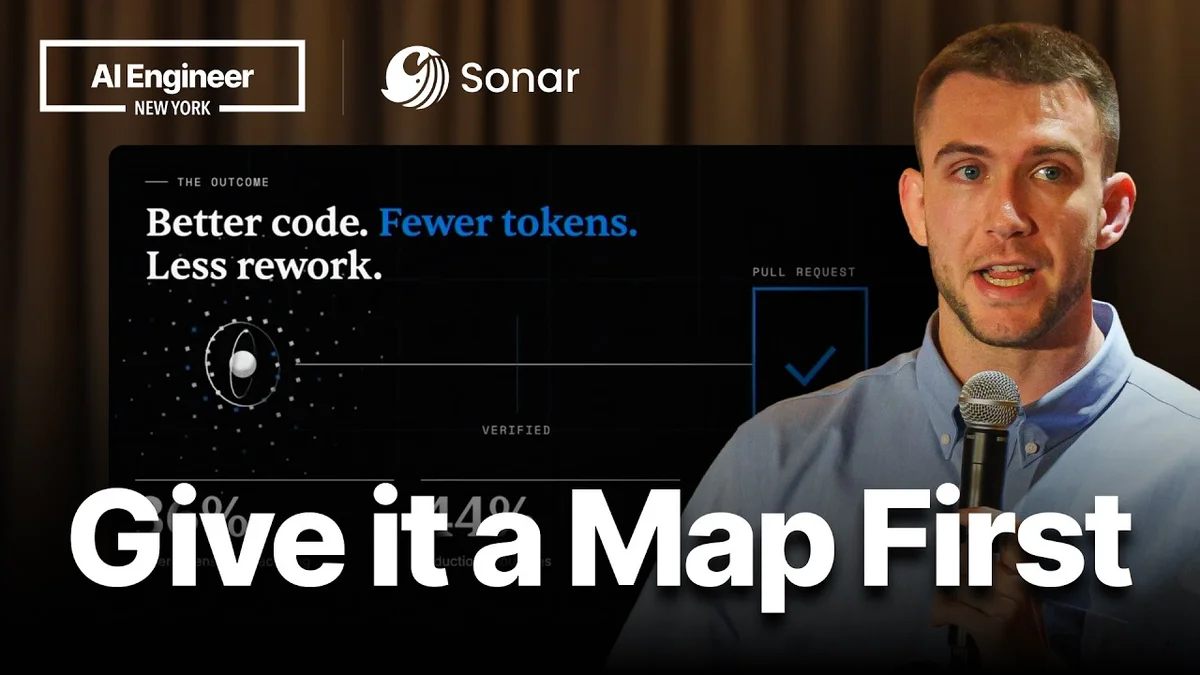
Killian Carlsen-Phelan demoed AI Engineer how Sonar’s new Vortex plugin pulls SonarQube rules into the coding agent before it writes a line. The demo centered on a Java task, unzipping a log file into a temp file in the default shared temp directory without explicit permissions, a flaw that requires only local access on a shared server but leaks sensitive logs to any other user or process on that host.
Every new session is a new hire.
Carlsen-Phelan argued that agents start cold every time, without your architecture rules, approved libraries or coding guidelines, so they grep the repo at random. That hunt burns tokens and time, and it replicates existing flaws, Carlsen-Phelan said, citing a Sonar survey of over 1,100 developers in which 96% said they do not fully trust AI-generated code yet only 48% said they fully verified it before pushing.
The fix, in Sonar’s pitch, is to guide then verify deterministically. Vortex loads project context up front, language guidelines for Java and a map of parent and child architecture, so the agent goes straight to the right files. Every file edit triggers a quick SonarQube check, and before the agent ends its turn it runs a deeper cross-file data flow analysis, Carlsen-Phelan said. In the recorded run with Claude, the agent wrote the feature and its own tests in under two minutes, flagged six findings, two on new lines and four pre-existing, and was forced to iterate when its first patch relied on the Java default temp permission. On macOS and Linux that default is owner-only, but Vortex enforces explicit permissions and rejected the fix, Carlsen-Phelan said. He put the efficiency gain at 36% fewer tokens on average, especially on refactoring, and a 44% reduction in production outages among users, with a very low false positive rate.
That pre-write steering is the contrast to Sonar’s other agent work. The Gitar Risk Triage system labels every pull request Low, Medium or High risk with a one-line reason and lets a repository rule raise risk for sensitive paths like lib/payments/, per Sonar, while the Gitar code change verification agent shown with daily.dev sits at the PR to catch what human review misses. Vortex moves that deterministic layer left, into the IDE loop, and works across Claude Code, Codex, Antigravity and custom agents via CLI and configurable MCP clients, plus secrets detection to keep keys out of GitHub and agent memory, Carlsen-Phelan said.
The daily brief
Get the free daily brief with the day's AI news, new AI startups and funding rounds every morning.
Join 12,008 subscribers.
You still have to set the bar yourself. Vortex reuses what your CI’s SonarQube scan already knows, so it is only as good as the rules you codify, and Carlsen-Phelan was blunt that AI checking AI, even a second model reviewing the first, hallucinates and misses, which is why Sonar insists on the same result every run. For shared /tmp bugs like this one, the exploit is not remote, it needs a co-tenant on the box, and the noisy alternative is catching it at PR and pinging a senior engineer for rework.
If it sticks, the payoff is less back-and-forth, not more review. Carlsen-Phelan framed context at the start as the single biggest lever for agent performance, more than model choice, because front-loaded guidance avoids the loop of review, rework, re-push. The team is staffing a booth to onboard both new and existing SonarQube users, but the practical test will be whether teams actually codify those permissions and architecture rules or let Vortex run on defaults.



