

Uber's Agentic SDLC: Building the Future of Software

Uber engineers Uday Kiran Medisetty and Adam Huda unveil the six building blocks of their agentic software factory, transforming development from idea to production with AI.

8 min read
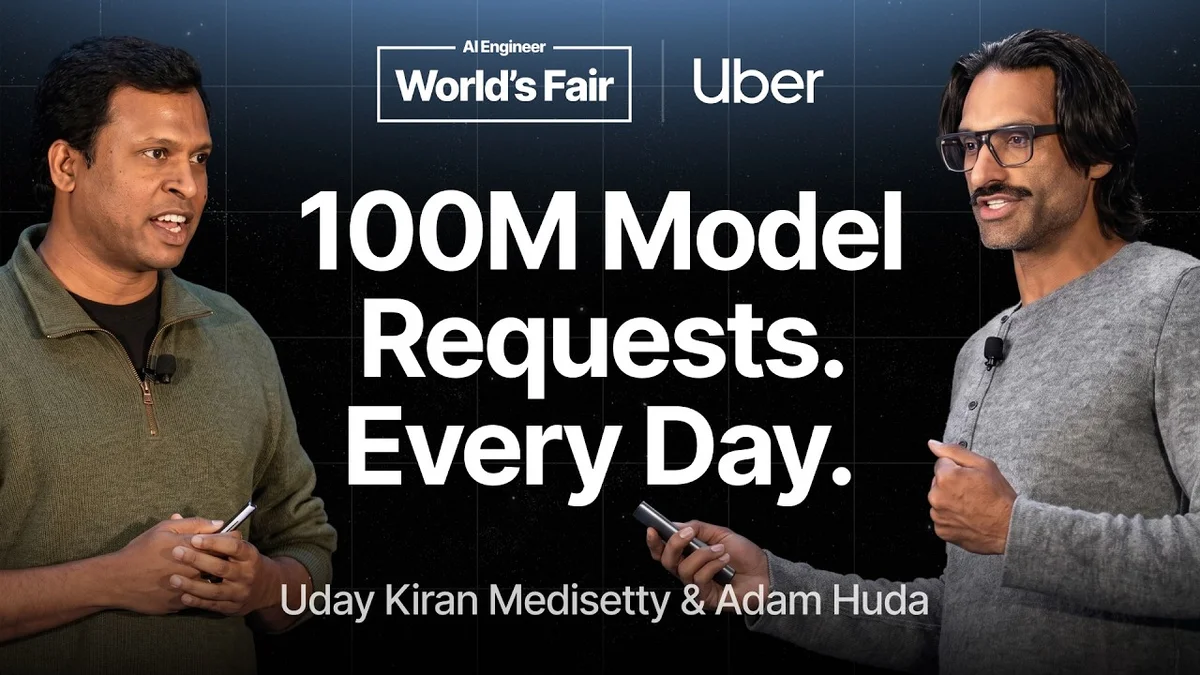
Uday Kiran Medisetty and Adam Huda presenting at AI Engineer World's Fair
AI Engineer

Visual TL;DR. Uber's SDLC Vision drives AI Agent Investment. AI Agent Investment leads to PRs by Agents. PRs by Agents results in Doubled Code Output. AI Agent Investment enables Toil Reduction. Uber's SDLC Vision is built on Agentic Software Factory.

  1. Uber's SDLC Vision: transforming software development lifecycle using agentic AI for a managed software factory
  2. AI Agent Investment: heavy investment in agentic AI over the past year across 12 global tech sites
  3. PRs by Agents: over 70% of Pull Requests now generated by local or cloud AI agents
  4. Doubled Code Output: remarkable doubling of code output per engineer year-over-year, impacting all facets
  5. Toil Reduction: accelerated efforts, automating over 250 manual tasks and processes
  6. Agentic Software Factory: six building blocks unveiled by engineers Medisetty and Huda at AI Engineer World's Fair
Visual TL;DR
Visual TL;DR, startuphub.ai Uber's SDLC Vision drives AI Agent Investment. Uber's SDLC Vision is built on Agentic Software Factory drives is built on Uber's SDLC Vision AI Agent Investment Doubled Code Output Agentic Software Factory From startuphub.ai · The publishers behind this format
Visual TL;DR, startuphub.ai Uber's SDLC Vision drives AI Agent Investment. Uber's SDLC Vision is built on Agentic Software Factory drives is built on Uber's SDLCVision AI AgentInvestment Doubled CodeOutput Agentic SoftwareFactory From startuphub.ai · The publishers behind this format
Visual TL;DR, startuphub.ai Uber's SDLC Vision drives AI Agent Investment. Uber's SDLC Vision is built on Agentic Software Factory drives is built on Uber's SDLC Vision transforming software developmentlifecycle using agentic AI for a managedsoftware factory AI Agent Investment heavy investment in agentic AI over thepast year across 12 global tech sites Doubled Code Output remarkable doubling of code output perengineer year-over-year, impacting allfacets Agentic Software Factory six building blocks unveiled by engineersMedisetty and Huda at AI Engineer World'sFair From startuphub.ai · The publishers behind this format
Visual TL;DR, startuphub.ai Uber's SDLC Vision drives AI Agent Investment. Uber's SDLC Vision is built on Agentic Software Factory drives is built on Uber's SDLCVision transformingsoftwaredevelopment… AI AgentInvestment heavy investment inagentic AI over thepast year across 12… Doubled CodeOutput remarkable doublingof code output perengineer… Agentic SoftwareFactory six building blocksunveiled byengineers Medisetty… From startuphub.ai · The publishers behind this format
Visual TL;DR, startuphub.ai Uber's SDLC Vision drives AI Agent Investment. AI Agent Investment leads to PRs by Agents. PRs by Agents results in Doubled Code Output. AI Agent Investment enables Toil Reduction. Uber's SDLC Vision is built on Agentic Software Factory drives leads to results in enables is built on Uber's SDLC Vision transforming software developmentlifecycle using agentic AI for a managedsoftware factory AI Agent Investment heavy investment in agentic AI over thepast year across 12 global tech sites PRs by Agents over 70% of Pull Requests now generated bylocal or cloud AI agents Doubled Code Output remarkable doubling of code output perengineer year-over-year, impacting allfacets Toil Reduction accelerated efforts, automating over 250manual tasks and processes Agentic Software Factory six building blocks unveiled by engineersMedisetty and Huda at AI Engineer World'sFair From startuphub.ai · The publishers behind this format
Visual TL;DR, startuphub.ai Uber's SDLC Vision drives AI Agent Investment. AI Agent Investment leads to PRs by Agents. PRs by Agents results in Doubled Code Output. AI Agent Investment enables Toil Reduction. Uber's SDLC Vision is built on Agentic Software Factory drives leads to results in enables is built on Uber's SDLCVision transformingsoftwaredevelopment… AI AgentInvestment heavy investment inagentic AI over thepast year across 12… PRs by Agents over 70% of PullRequests nowgenerated by local… Doubled CodeOutput remarkable doublingof code output perengineer… Toil Reduction acceleratedefforts, automatingover 250 manual… Agentic SoftwareFactory six building blocksunveiled byengineers Medisetty… From startuphub.ai · The publishers behind this format

At the AI Engineer World's Fair, Uber's Uday Kiran Medisetty and Adam Huda shared insights into their ambitious journey of transforming their software development lifecycle (SDLC) through agentic AI. They detailed the creation of a "managed software factory" that leverages AI agents to streamline and automate processes across the entire engineering workflow, from initial idea generation to final production deployment.

Uber's Agentic SDLC: Building the Future of Software - AI Engineer
Uber's Agentic SDLC: Building the Future of Software — from AI Engineer

Uber's Vision for an Agentic SDLC

With thousands of engineers spread across 12 global tech sites, Uber has been investing heavily in agentic AI over the past year. This strategic focus has yielded impressive results, with over 70% of their Pull Requests (PRs) now being generated by either local or cloud agents. This has translated into a remarkable doubling of code output per engineer year-over-year, extending beyond just coding to impact every facet of the engineering lifecycle. Furthermore, the company has accelerated its toil reduction efforts, automating over 250 migrations and handling nine million lines of code automatically.
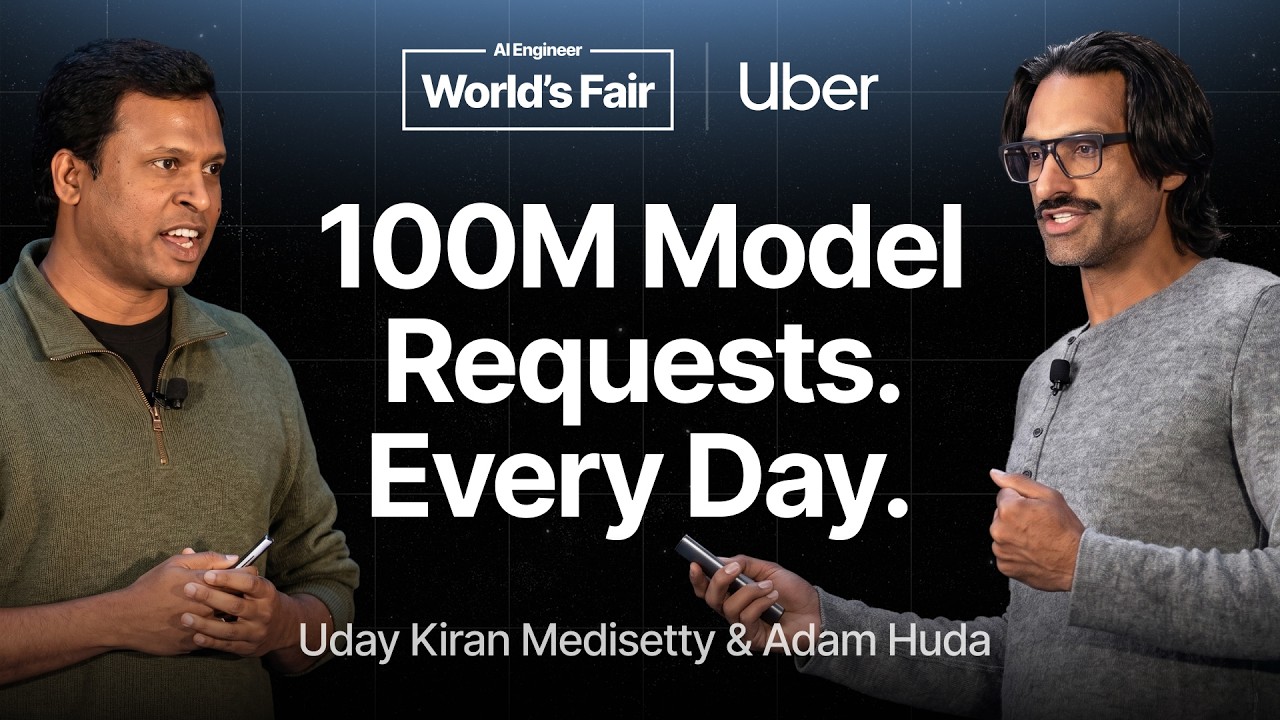
Medisetty and Huda outlined the six core building blocks essential for this agentic transformation:

  • Model Gateway: Ensuring data privacy by keeping PII within the perimeter, bounding guardrail latency, and attributing requests per user, project, and team.
  • MCP Gateway: Providing a unified interface for accessing and managing thousands of internal APIs and SaaS tools, simplifying integration and reducing token overhead.
  • DevPods: Offering agent-friendly, isolated, and globally available Kubernetes pods that are pre-provisioned with repositories and search indexes, enabling agents to start work in seconds.
  • Agent Skills: A managed marketplace for reusable skills, ensuring baseline quality through automated reviews and simplifying discovery and installation.
  • Context Graphs: A unified graph consolidating information from scattered systems to provide agents with essential context about services, dependencies, and ownership, thereby reducing latency and improving outcome predictability.
  • AI Assistant (Cortana): The central hub that integrates all these building blocks, accessible across various surfaces like Slack and CLI, enabling users to query, invoke skills, and analyze code.

From Ideation to Production: A Feature's Journey

To illustrate the practical application of these building blocks, Adam Huda walked through the end-to-end process of developing a new feature. The scenario involved creating a "smart pickup" location feature for event venues, aimed at improving rider experience during peak congestion.

The process began with an idea brainstormed on Slack, where the AI assistant, Cortana, was used to analyze business potential by referencing the context graph. This led to defining product requirements and even generating Figma mockups for A/B testing different button variants. Cortana then assisted in identifying the necessary code changes for both frontend and backend components. This entire ideation and design phase, which previously could take weeks, is now compressed into a significantly shorter timeframe.

The development handoff then moved to the Minion agent, Uber's cloud coding agent solution, which leveraged the DevPods building block. Minion autonomously worked on creating draft PRs, performing tasks like code validation and visual checks before submitting to CI. This proactive validation in the "inner loop" aims to catch errors early, reducing load on the CI system. The presentation highlighted how the system shifts checks from the outer loop (CI) to the inner loop, incorporating visual validation and even self-healing CI capabilities.

Automating Maintenance and Continuous Improvement

The discussion also touched upon the crucial aspect of maintenance, showcasing how features or services can be enrolled into maintenance skills. This includes tasks like feature flag cleanup, where unused variants are automatically removed. These maintenance loops are managed centrally to avoid overwhelming engineers and to optimize CI capacity. The data generated from these automated diffs and their acceptance or rejection is fed back into a continuous evaluation loop to further refine the skills.

The session concluded by emphasizing that while the agentic transformation is still in its early stages, the learning process is rapid. The focus is shifting from simply building features to determining "should we build it," highlighting the strategic importance of these AI-driven advancements in shaping the future of software development at Uber.

© 2026 StartupHub.ai. All rights reserved. Do not enter, scrape, copy, reproduce, or republish this article in whole or in part. Use as input to AI training, fine-tuning, retrieval-augmented generation, or any machine-learning system is prohibited without written license. Substantially-similar derivative works will be pursued to the fullest extent of applicable copyright, database, and computer-misuse laws. See our terms.