


Neo4j CEO on AI Agents and Ontology-based Data

Neo4j CEO Emil Eifrem proposes an ontology-based semantic layer to streamline data management for AI agents, enabling 'thin agents on a smarter substrate'.

7 min read
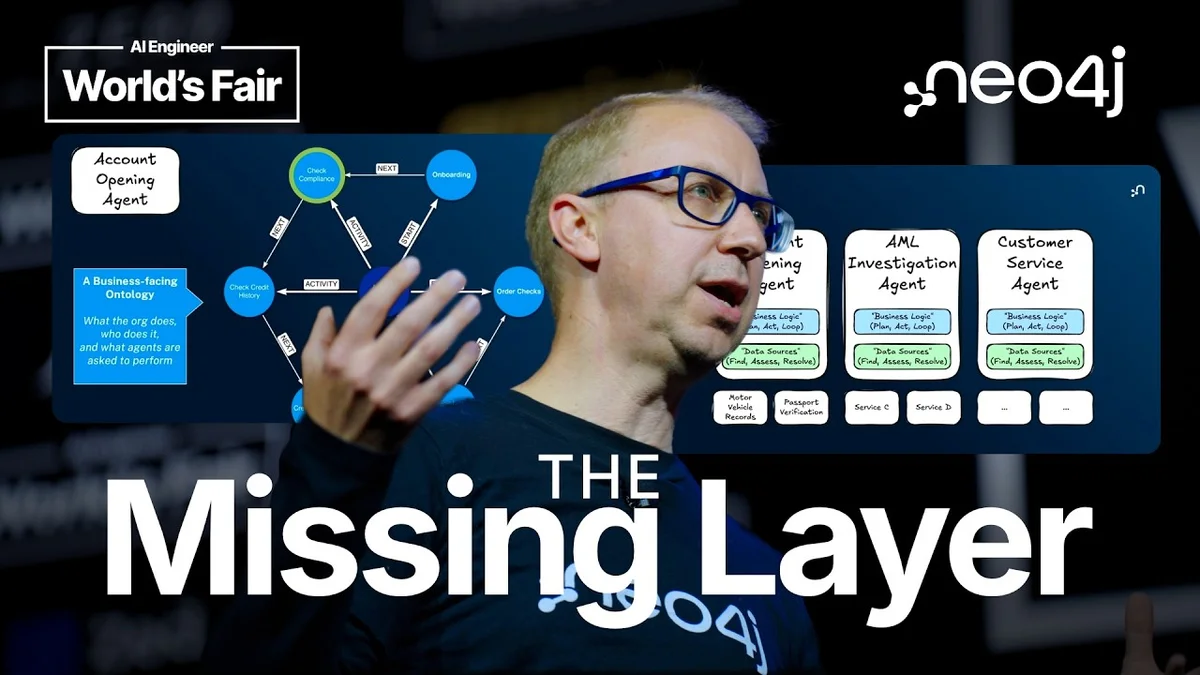
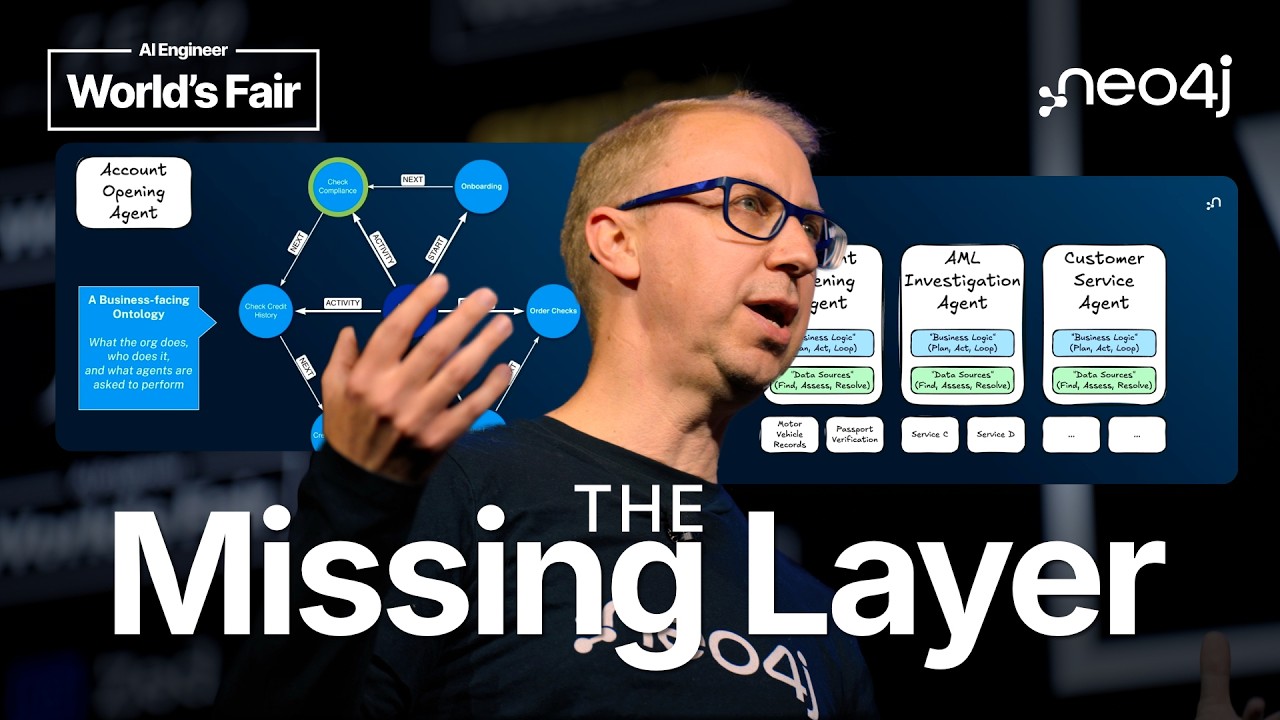
Emil Eifrem, CEO of Neo4j, presenting on stage at AI Engineer World's Fair.
AI Engineer

Visual TL;DR. Thick AI Agents due to Data Fragmentation. Thick AI Agents solved by Ontology-based Layer. Data Fragmentation causes Thick AI Agents. Ontology-based Layer enables Thin Agents. Ontology-based Layer provides Semantic Understanding. Thin Agents leads to Efficient Data Prep. Semantic Understanding facilitates Efficient Data Prep. Efficient Data Prep achieves Scalable AI.

  1. Thick AI Agents: manual, repetitive process connecting agents to fragmented enterprise data sources
  2. Data Fragmentation: hundreds of databases, cloud storage, and data platforms across organizations
  3. Ontology-based Layer: proposed semantic layer to streamline data management for AI agents
  4. Thin Agents: agents operate on a smarter substrate, reducing individual agent complexity
  5. Semantic Understanding: provides agents with a unified, contextual view of enterprise data
  6. Efficient Data Prep: automates locating, validating, and connecting to necessary data sources
  7. Scalable AI: enables building and deploying many AI agents across the enterprise
Visual TL;DR
Visual TL;DR, startuphub.ai Thick AI Agents solved by Ontology-based Layer. Ontology-based Layer enables Thin Agents. Thin Agents leads to Efficient Data Prep solved by enables leads to Thick AI Agents Ontology-based Layer Thin Agents Efficient Data Prep From startuphub.ai · The publishers behind this format
Visual TL;DR, startuphub.ai Thick AI Agents solved by Ontology-based Layer. Ontology-based Layer enables Thin Agents. Thin Agents leads to Efficient Data Prep solved by enables leads to Thick AI Agents Ontology-basedLayer Thin Agents Efficient DataPrep From startuphub.ai · The publishers behind this format
Visual TL;DR, startuphub.ai Thick AI Agents solved by Ontology-based Layer. Ontology-based Layer enables Thin Agents. Thin Agents leads to Efficient Data Prep solved by enables leads to Thick AI Agents manual, repetitive process connectingagents to fragmented enterprise datasources Ontology-based Layer proposed semantic layer to streamline datamanagement for AI agents Thin Agents agents operate on a smarter substrate,reducing individual agent complexity Efficient Data Prep automates locating, validating, andconnecting to necessary data sources From startuphub.ai · The publishers behind this format
Visual TL;DR, startuphub.ai Thick AI Agents solved by Ontology-based Layer. Ontology-based Layer enables Thin Agents. Thin Agents leads to Efficient Data Prep solved by enables leads to Thick AI Agents manual, repetitiveprocess connectingagents to… Ontology-basedLayer proposed semanticlayer to streamlinedata management for… Thin Agents agents operate on asmarter substrate,reducing individual… Efficient DataPrep automates locating,validating, andconnecting to… From startuphub.ai · The publishers behind this format
Visual TL;DR, startuphub.ai Thick AI Agents due to Data Fragmentation. Thick AI Agents solved by Ontology-based Layer. Data Fragmentation causes Thick AI Agents. Ontology-based Layer enables Thin Agents. Ontology-based Layer provides Semantic Understanding. Thin Agents leads to Efficient Data Prep. Semantic Understanding facilitates Efficient Data Prep. Efficient Data Prep achieves Scalable AI due to solved by causes enables provides leads to facilitates achieves Thick AI Agents manual, repetitive process connectingagents to fragmented enterprise datasources Data Fragmentation hundreds of databases, cloud storage, anddata platforms across organizations Ontology-based Layer proposed semantic layer to streamline datamanagement for AI agents Thin Agents agents operate on a smarter substrate,reducing individual agent complexity Semantic Understanding provides agents with a unified, contextualview of enterprise data Efficient Data Prep automates locating, validating, andconnecting to necessary data sources Scalable AI enables building and deploying many AIagents across the enterprise From startuphub.ai · The publishers behind this format
Visual TL;DR, startuphub.ai Thick AI Agents due to Data Fragmentation. Thick AI Agents solved by Ontology-based Layer. Data Fragmentation causes Thick AI Agents. Ontology-based Layer enables Thin Agents. Ontology-based Layer provides Semantic Understanding. Thin Agents leads to Efficient Data Prep. Semantic Understanding facilitates Efficient Data Prep. Efficient Data Prep achieves Scalable AI due to solved by causes enables provides leads to facilitates achieves Thick AI Agents manual, repetitiveprocess connectingagents to… DataFragmentation hundreds ofdatabases, cloudstorage, and data… Ontology-basedLayer proposed semanticlayer to streamlinedata management for… Thin Agents agents operate on asmarter substrate,reducing individual… SemanticUnderstanding provides agentswith a unified,contextual view of… Efficient DataPrep automates locating,validating, andconnecting to… Scalable AI enables buildingand deploying manyAI agents across… From startuphub.ai · The publishers behind this format

Emil Eifrem, Founder and CEO of Neo4j, addressed the challenges of preparing data for AI agents at the AI Engineer World's Fair. He outlined a critical problem emerging in the last six to nine months: the manual, repetitive, and inefficient process of connecting AI agents to the vast and complex data sources within large organizations.

Neo4j CEO on AI Agents and Ontology-based Data - AI Engineer
Neo4j CEO on AI Agents and Ontology-based Data — from AI Engineer

The Problem with 'Thick Agents'

Eifrem illustrated the issue using the example of an 'account opening agent' for a bank. Such agents typically consist of 'business logic' (interpreting intent, planning, acting) and 'data sources' (identifying, assessing, and resolving necessary data). While this setup works for individual agents, scaling it across an enterprise presents significant hurdles. In large organizations, data is fragmented across hundreds of databases, cloud storage, and data platforms. Each time a new agent is built, developers must manually locate, validate, and connect to these data sources. This process is not only time-consuming but also violates the 'Don't Repeat Yourself' (DRY) principle of software engineering, as changes to data sources require manual updates across multiple agents. Furthermore, this approach lacks a mechanism for learning or improvement, meaning agents do not become smarter over time.

Proposed Solution: The Ontology-based Semantic Layer

Neo4j proposes a solution centered around an 'ontology-based semantic layer' to address these challenges. Eifrem described this as needing 'thin agents on a smarter shared substrate.' This approach is built on three core pillars:

  • Business-facing Ontology: This pillar defines the key concepts within an organization (e.g., customers, accounts, transactions) in a human-readable format, ensuring common understanding across teams.
  • Technical Ontology: This layer captures the metadata of all data assets and sources within the enterprise, detailing their location, schemas, attributes, and physical locations.
  • Execution Traces: This pillar involves collecting runtime signals from agent executions, including decisions, paths taken, outcomes, and errors. These traces provide data on what worked and what didn't, enabling learning.

Eifrem emphasized that these three pillars, when combined, solve the critical problems of data discovery, trust, 'don't repeat yourself,' and agent learning. The ontology provides a single, governed place to map business intent to data sources, informed by both human curation and observed execution performance.

Addressing the 'Markdown Files' Approach

While acknowledging that simple solutions like markdown files might seem appealing for defining agent logic, Eifrem cited insights from Swyx on the Latent Space podcast, stating, "Learn your databases. You can't vibe code with just markdown files." He indicated that these simpler methods are only part of the solution and not sufficient for complex enterprise needs.

Real-World Application and Future Directions

Neo4j has been implementing this solution with major organizations, including a Fortune 20 global bank, a large tech platform company, and a leading fintech company. Eifrem showcased how the ontology can represent a business process, like account opening, and map specific steps, such as 'Check Compliance,' to underlying data sources like 'Motor Vehicle Records' or 'Passport Verification' through the technical ontology.

Eifrem concluded by highlighting the broader application of graphs in AI, mentioning an upcoming 'Amazing Graph Track' at the conference featuring talks on various graph-based AI patterns. He also encouraged startups to explore the Neo4j startup program, which offers credits and dedicated solution engineering support.

© 2026 StartupHub.ai. All rights reserved. Do not enter, scrape, copy, reproduce, or republish this article in whole or in part. Use as input to AI training, fine-tuning, retrieval-augmented generation, or any machine-learning system is prohibited without written license. Substantially-similar derivative works will be pursued to the fullest extent of applicable copyright, database, and computer-misuse laws. See our terms.