

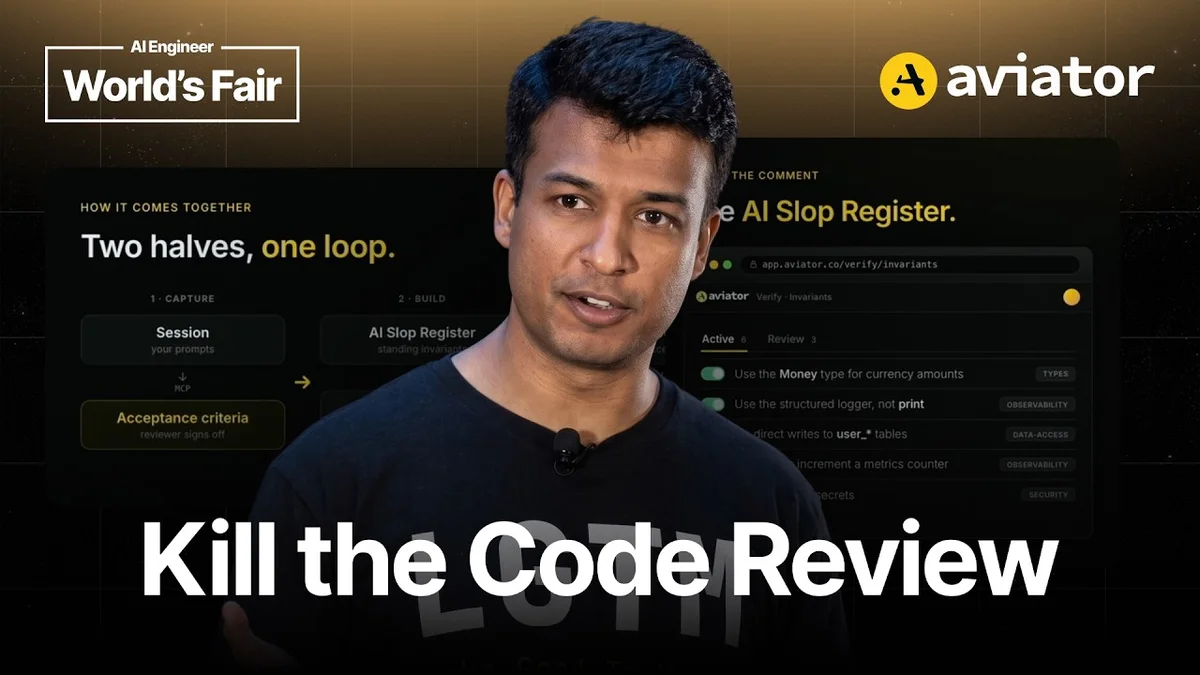
Ankit Jain: Rethinking Code Reviews with AI

Ankit Jain of Aviator argues for a shift in code reviews, focusing on 'intent' and 'alignment' with AI-assisted development, proposing an 'AI Slop Register' and integrated verification system.

9 min read
Ankit Jain presenting on stage with a slide titled 'How to Kill the Code Review'
AI Engineer

Visual TL;DR. Modern Code Review Fails exacerbated by AI Writes/Reviews Code. Modern Code Review Fails requires Focus on Intent/Alignment. AI Writes/Reviews Code leads to Modern Code Review Fails. Focus on Intent/Alignment enabled by AI Slop Register. AI Slop Register part of Unified Verification System. Unified Verification System achieves Improved Code Quality. Focus on Intent/Alignment drives Rethink Code Reviews. Rethink Code Reviews aims for Improved Code Quality.

  1. Modern Code Review Fails: 861% code churn, rising incidents, 4x wait time, 30% unreviewed changes
  2. AI Writes/Reviews Code: AI agents generate and review code, humans merely skim before merging
  3. Focus on Intent/Alignment: shift code reviews to 'intent' and 'alignment' with AI-assisted development
  4. AI Slop Register: new system to track and manage AI-generated code that needs human attention
  5. Unified Verification System: integrated platform for alignment and accuracy, leveraging LLMs and deterministic checks
  6. Rethink Code Reviews: Ankit Jain of Aviator proposes a fundamental shift in how code reviews are done
  7. Improved Code Quality: reduce incidents and improve effectiveness by focusing on core development goals
Visual TL;DR
Visual TL;DR, startuphub.ai Modern Code Review Fails requires Focus on Intent/Alignment. Focus on Intent/Alignment enabled by AI Slop Register. AI Slop Register part of Unified Verification System requires enabled by part of Modern Code Review Fails Focus on Intent/Alignment AI Slop Register Unified Verification System From startuphub.ai · The publishers behind this format
Visual TL;DR, startuphub.ai Modern Code Review Fails requires Focus on Intent/Alignment. Focus on Intent/Alignment enabled by AI Slop Register. AI Slop Register part of Unified Verification System requires enabled by part of Modern CodeReview Fails Focus onIntent/Alignment AI Slop Register UnifiedVerification… From startuphub.ai · The publishers behind this format
Visual TL;DR, startuphub.ai Modern Code Review Fails requires Focus on Intent/Alignment. Focus on Intent/Alignment enabled by AI Slop Register. AI Slop Register part of Unified Verification System requires enabled by part of Modern Code Review Fails 861% code churn, rising incidents, 4x waittime, 30% unreviewed changes Focus on Intent/Alignment shift code reviews to 'intent' and'alignment' with AI-assisted development AI Slop Register new system to track and manageAI-generated code that needs humanattention Unified Verification System integrated platform for alignment andaccuracy, leveraging LLMs anddeterministic checks From startuphub.ai · The publishers behind this format
Visual TL;DR, startuphub.ai Modern Code Review Fails requires Focus on Intent/Alignment. Focus on Intent/Alignment enabled by AI Slop Register. AI Slop Register part of Unified Verification System requires enabled by part of Modern CodeReview Fails 861% code churn,rising incidents,4x wait time, 30%… Focus onIntent/Alignment shift code reviewsto 'intent' and'alignment' with… AI Slop Register new system to trackand manageAI-generated code… UnifiedVerification… integrated platformfor alignment andaccuracy,… From startuphub.ai · The publishers behind this format
Visual TL;DR, startuphub.ai Modern Code Review Fails exacerbated by AI Writes/Reviews Code. Modern Code Review Fails requires Focus on Intent/Alignment. AI Writes/Reviews Code leads to Modern Code Review Fails. Focus on Intent/Alignment enabled by AI Slop Register. AI Slop Register part of Unified Verification System. Unified Verification System achieves Improved Code Quality. Focus on Intent/Alignment drives Rethink Code Reviews. Rethink Code Reviews aims for Improved Code Quality exacerbated by requires leads to enabled by part of achieves drives aims for Modern Code Review Fails 861% code churn, rising incidents, 4x waittime, 30% unreviewed changes AI Writes/Reviews Code AI agents generate and review code, humansmerely skim before merging Focus on Intent/Alignment shift code reviews to 'intent' and'alignment' with AI-assisted development AI Slop Register new system to track and manageAI-generated code that needs humanattention Unified Verification System integrated platform for alignment andaccuracy, leveraging LLMs anddeterministic checks Rethink Code Reviews Ankit Jain of Aviator proposes afundamental shift in how code reviews aredone Improved Code Quality reduce incidents and improve effectivenessby focusing on core development goals From startuphub.ai · The publishers behind this format
Visual TL;DR, startuphub.ai Modern Code Review Fails exacerbated by AI Writes/Reviews Code. Modern Code Review Fails requires Focus on Intent/Alignment. AI Writes/Reviews Code leads to Modern Code Review Fails. Focus on Intent/Alignment enabled by AI Slop Register. AI Slop Register part of Unified Verification System. Unified Verification System achieves Improved Code Quality. Focus on Intent/Alignment drives Rethink Code Reviews. Rethink Code Reviews aims for Improved Code Quality exacerbated by requires leads to enabled by part of achieves drives aims for Modern CodeReview Fails 861% code churn,rising incidents,4x wait time, 30%… AI Writes/ReviewsCode AI agents generateand review code,humans merely skim… Focus onIntent/Alignment shift code reviewsto 'intent' and'alignment' with… AI Slop Register new system to trackand manageAI-generated code… UnifiedVerification… integrated platformfor alignment andaccuracy,… Rethink CodeReviews Ankit Jain ofAviator proposes afundamental shift… Improved CodeQuality reduce incidentsand improveeffectiveness by… From startuphub.ai · The publishers behind this format

In a presentation titled "How to Kill the Code Review," Ankit Jain, co-founder of Aviator, a company building an AI code verification platform, discussed the evolving challenges and potential solutions for code review processes in the age of AI-assisted development. Jain, drawing from his previous work on a five-layer trust model, argued that the current methods of code review are failing to keep pace with the rapid increase in code volume and the rise of AI coding agents.

Ankit Jain: Rethinking Code Reviews with AI - AI Engineer
Ankit Jain: Rethinking Code Reviews with AI — from AI Engineer

The Problem with Modern Code Reviews

Jain highlighted several concerning trends: an 861% increase in code churn, a rising incidents-to-PR ratio indicating diminishing review effectiveness, and a 4x increase in time spent waiting for reviews. Alarmingly, over 30% of changes are merged without any review at all. He pointed to the common scenario where AI agents write and review code, leading to a situation where humans merely skim the output before merging. "When AI reviews and nobody reads, we have configured the wrong thing," Jain stated, questioning the purpose of a UI in this automated workflow.

Code Review: Beyond Semantic Accuracy

While acknowledging that code reviews have historically focused on catching bugs, conventions, and security issues, Jain emphasized that a critical, often overlooked, aspect is 'alignment.' This includes knowledge sharing, mentorship, architectural feedback, and onboarding. He stressed that for teams, this alignment is paramount, and while tools can improve semantic accuracy, the collaborative aspect of code review must be preserved.

Intent-Driven Development and AI's Role

Jain critiqued the "spec-driven development" model, comparing it to the limitations of the 1970s waterfall model due to its lack of feedback loops. He argued that true intent doesn't solely reside in specifications but also in Jira tickets and, crucially, in the prompts used to interact with AI coding agents. "Most importantly, intent lives in your prompts today," he said, lamenting that this valuable information is often discarded after a pull request is created.

Introducing the AI Slop Register

To address the issue of recurring review findings, Jain introduced the concept of an "AI Slop Register." This system would codify common issues identified during reviews, essentially turning repetitive comments into automated guardrails. "Every recurring comment is now a guardrail that you don't have to review again," he explained. This approach allows the system to learn from human review experiences, leading to better overall code quality.
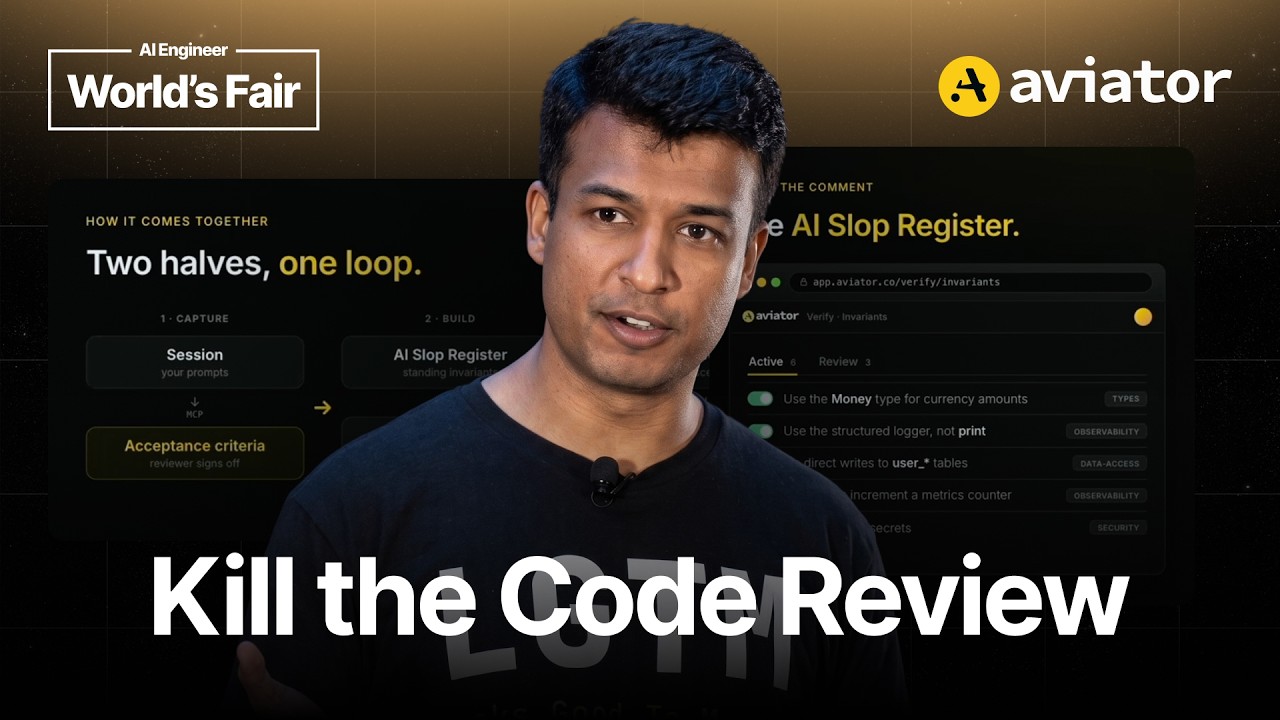
Building a Unified System: Alignment and Accuracy

Jain proposed a system that integrates both alignment and semantic accuracy. The process involves capturing user responses from AI sessions to form acceptance criteria, which are then combined with the AI Slop Register to create a test plan. This test plan is then used in a verification system that spins up previews to ensure the code functions end-to-end. The review surface shifts from examining code line-by-line to reviewing the evidence of intent, capability implementation, and adherence to requirements.

He elaborated on the practical application: capturing decisions made during AI coding sessions converts them into acceptance criteria. LLMs can assist in generating test plans from these criteria, streamlining the process. The value of human input remains in the governance and review of these test plans, rather than the code itself. This approach, he noted, aligns with behavior-driven development, making test plans shareable and understandable across different roles like product managers and designers.

Leveraging LLMs and Deterministic Checks

Jain advocated for a balanced approach: "Deterministic where you can. LLM where you must." While deterministic checks ensure reproducibility, LLMs can handle fuzzy behavior and subjective judgments. He used an example of verifying a new payment form, where AI agents could browse the application, capture screenshots, and compare them with database snapshots to confirm criteria fulfillment. This provides more robust evidence for reviewers.

The Future of Code Review: Intent over Diffs

The core message was a paradigm shift: "Reviewers review intent. Not diffs." By capturing and leveraging the intent and architectural decisions made during AI interactions, teams can move beyond superficial code checks to more meaningful architectural discussions. Jain encouraged attendees to mine their past review comments to build their own AI Slop Registers, noting that while this process requires initial investment, it compounds over time, reducing future review efforts.

Aviator is currently piloting its "Verify" product, which aims to integrate these concepts. "If you remember one thing from today," Jain concluded, "remember code review is not about code review, it is about getting the alignment."

© 2026 StartupHub.ai. All rights reserved. Do not enter, scrape, copy, reproduce, or republish this article in whole or in part. Use as input to AI training, fine-tuning, retrieval-augmented generation, or any machine-learning system is prohibited without written license. Substantially-similar derivative works will be pursued to the fullest extent of applicable copyright, database, and computer-misuse laws. See our terms.