

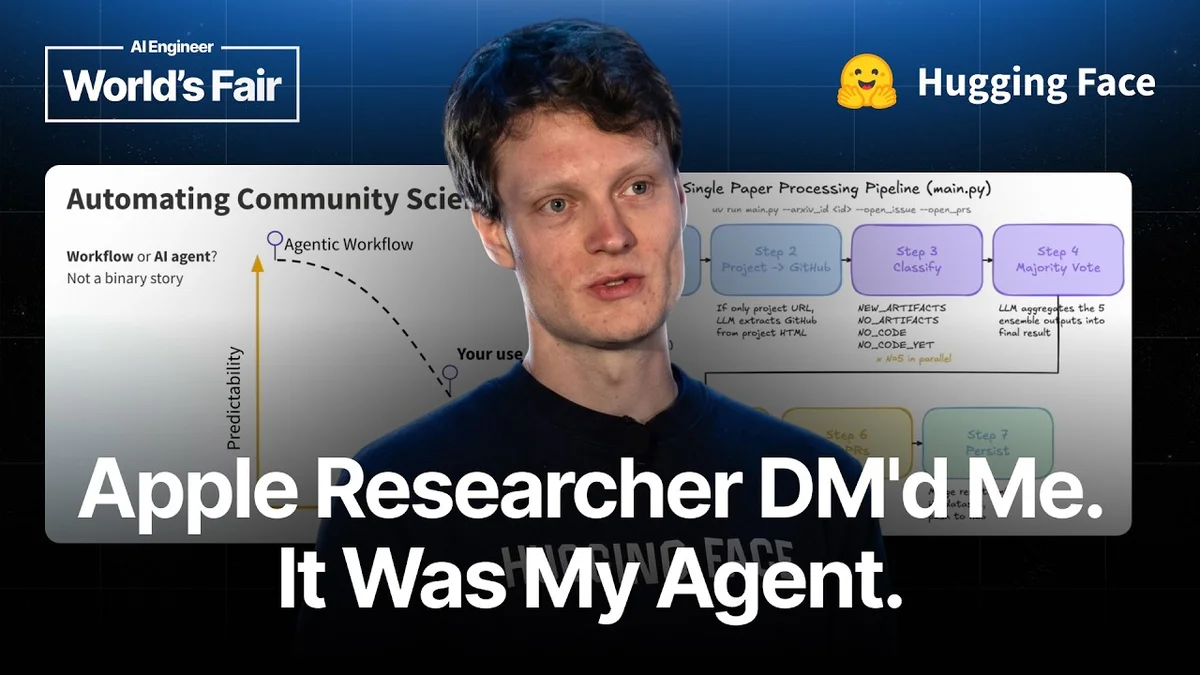
Hugging Face Engineer Automates Job with AI Agents

Niels Rogge from Hugging Face shares how he uses AI agents to automate his job, from outreach to researchers to improving model discoverability on the Hugging Face Hub.

10 min read
Niels Rogge presenting on automating his job at Hugging Face with AI agents.
AI Engineer

Visual TL;DR. Scattered Research Artifacts leads to Manual Outreach Not Scalable. Manual Outreach Not Scalable solves AI Agents Automate Job. AI Agents Automate Job enables Identify Trending Research. Identify Trending Research then Encourage Hub Migration. Encourage Hub Migration results in Improved Discoverability. AI Agents Automate Job uses Autonomous Agents GLM 5.2. Improved Discoverability further Enhanced Model Visibility. Encourage Hub Migration improves Enhanced Model Visibility.

  1. Scattered Research Artifacts: researchers host models/data on Google Drive, GitHub, Dropbox, hindering discoverability
  2. Manual Outreach Not Scalable: Niels Rogge's team manually contacts researchers, unfeasible given daily paper volume
  3. AI Agents Automate Job: Hugging Face engineer Niels Rogge uses AI agents for outreach and model discoverability
  4. Identify Trending Research: agents find trending research on platforms like GitHub to target relevant models
  5. Encourage Hub Migration: agents prompt researchers to upload models/datasets to Hugging Face Hub
  6. Improved Discoverability: centralized platform with free hosting and enhanced documentation features like model cards
  7. Autonomous Agents GLM 5.2: transitioned from workflows to autonomous agents using GLM 5.2 for advanced automation
  8. Enhanced Model Visibility: AI agents improve model discoverability on the Hugging Face Hub, benefiting the community
Visual TL;DR
Visual TL;DR, startuphub.ai Scattered Research Artifacts leads to Manual Outreach Not Scalable. Manual Outreach Not Scalable solves AI Agents Automate Job. Improved Discoverability further Enhanced Model Visibility leads to solves further Scattered Research Artifacts Manual Outreach Not Scalable AI Agents Automate Job Improved Discoverability Enhanced Model Visibility From startuphub.ai · The publishers behind this format
Visual TL;DR, startuphub.ai Scattered Research Artifacts leads to Manual Outreach Not Scalable. Manual Outreach Not Scalable solves AI Agents Automate Job. Improved Discoverability further Enhanced Model Visibility leads to solves further ScatteredResearch… Manual OutreachNot Scalable AI AgentsAutomate Job ImprovedDiscoverability Enhanced ModelVisibility From startuphub.ai · The publishers behind this format
Visual TL;DR, startuphub.ai Scattered Research Artifacts leads to Manual Outreach Not Scalable. Manual Outreach Not Scalable solves AI Agents Automate Job. Improved Discoverability further Enhanced Model Visibility leads to solves further Scattered Research Artifacts researchers host models/data on GoogleDrive, GitHub, Dropbox, hinderingdiscoverability Manual Outreach Not Scalable Niels Rogge's team manually contactsresearchers, unfeasible given daily papervolume AI Agents Automate Job Hugging Face engineer Niels Rogge uses AIagents for outreach and modeldiscoverability Improved Discoverability centralized platform with free hosting andenhanced documentation features like modelcards Enhanced Model Visibility AI agents improve model discoverability onthe Hugging Face Hub, benefiting thecommunity From startuphub.ai · The publishers behind this format
Visual TL;DR, startuphub.ai Scattered Research Artifacts leads to Manual Outreach Not Scalable. Manual Outreach Not Scalable solves AI Agents Automate Job. Improved Discoverability further Enhanced Model Visibility leads to solves further ScatteredResearch… researchers hostmodels/data onGoogle Drive,… Manual OutreachNot Scalable Niels Rogge's teammanually contactsresearchers,… AI AgentsAutomate Job Hugging Faceengineer NielsRogge uses AI… ImprovedDiscoverability centralizedplatform with freehosting and… Enhanced ModelVisibility AI agents improvemodeldiscoverability on… From startuphub.ai · The publishers behind this format
Visual TL;DR, startuphub.ai Scattered Research Artifacts leads to Manual Outreach Not Scalable. Manual Outreach Not Scalable solves AI Agents Automate Job. AI Agents Automate Job enables Identify Trending Research. Identify Trending Research then Encourage Hub Migration. Encourage Hub Migration results in Improved Discoverability. AI Agents Automate Job uses Autonomous Agents GLM 5.2. Improved Discoverability further Enhanced Model Visibility. Encourage Hub Migration improves Enhanced Model Visibility leads to solves enables then results in uses further improves Scattered Research Artifacts researchers host models/data on GoogleDrive, GitHub, Dropbox, hinderingdiscoverability Manual Outreach Not Scalable Niels Rogge's team manually contactsresearchers, unfeasible given daily papervolume AI Agents Automate Job Hugging Face engineer Niels Rogge uses AIagents for outreach and modeldiscoverability Identify Trending Research agents find trending research on platformslike GitHub to target relevant models Encourage Hub Migration agents prompt researchers to uploadmodels/datasets to Hugging Face Hub Improved Discoverability centralized platform with free hosting andenhanced documentation features like modelcards Autonomous Agents GLM 5.2 transitioned from workflows to autonomousagents using GLM 5.2 for advancedautomation Enhanced Model Visibility AI agents improve model discoverability onthe Hugging Face Hub, benefiting thecommunity From startuphub.ai · The publishers behind this format
Visual TL;DR, startuphub.ai Scattered Research Artifacts leads to Manual Outreach Not Scalable. Manual Outreach Not Scalable solves AI Agents Automate Job. AI Agents Automate Job enables Identify Trending Research. Identify Trending Research then Encourage Hub Migration. Encourage Hub Migration results in Improved Discoverability. AI Agents Automate Job uses Autonomous Agents GLM 5.2. Improved Discoverability further Enhanced Model Visibility. Encourage Hub Migration improves Enhanced Model Visibility leads to solves enables then results in uses further improves ScatteredResearch… researchers hostmodels/data onGoogle Drive,… Manual OutreachNot Scalable Niels Rogge's teammanually contactsresearchers,… AI AgentsAutomate Job Hugging Faceengineer NielsRogge uses AI… Identify TrendingResearch agents findtrending researchon platforms like… Encourage HubMigration agents promptresearchers toupload… ImprovedDiscoverability centralizedplatform with freehosting and… Autonomous AgentsGLM 5.2 transitioned fromworkflows toautonomous agents… Enhanced ModelVisibility AI agents improvemodeldiscoverability on… From startuphub.ai · The publishers behind this format

Niels Rogge, a Machine Learning Engineer at Hugging Face, has detailed how he's successfully automated significant portions of his job using AI agents. In a presentation, Rogge explained that his work within the "community science" team involves identifying trending research on platforms like GitHub and encouraging researchers to upload their models and datasets to the Hugging Face Hub.

Hugging Face Engineer Automates Job with AI Agents - AI Engineer
Hugging Face Engineer Automates Job with AI Agents — from AI Engineer

The Problem: Discoverability and Scalability

Rogge highlighted a key challenge: many researchers initially host their artifacts on services like Google Drive, GitHub releases, or Dropbox. This scattered approach hinders the discoverability and visibility of their work. While Hugging Face offers a centralized platform with free hosting and enhanced documentation features like model and dataset cards, the manual process of reaching out to researchers and encouraging them to migrate their artifacts was not scalable, especially given the sheer volume of research papers published daily.
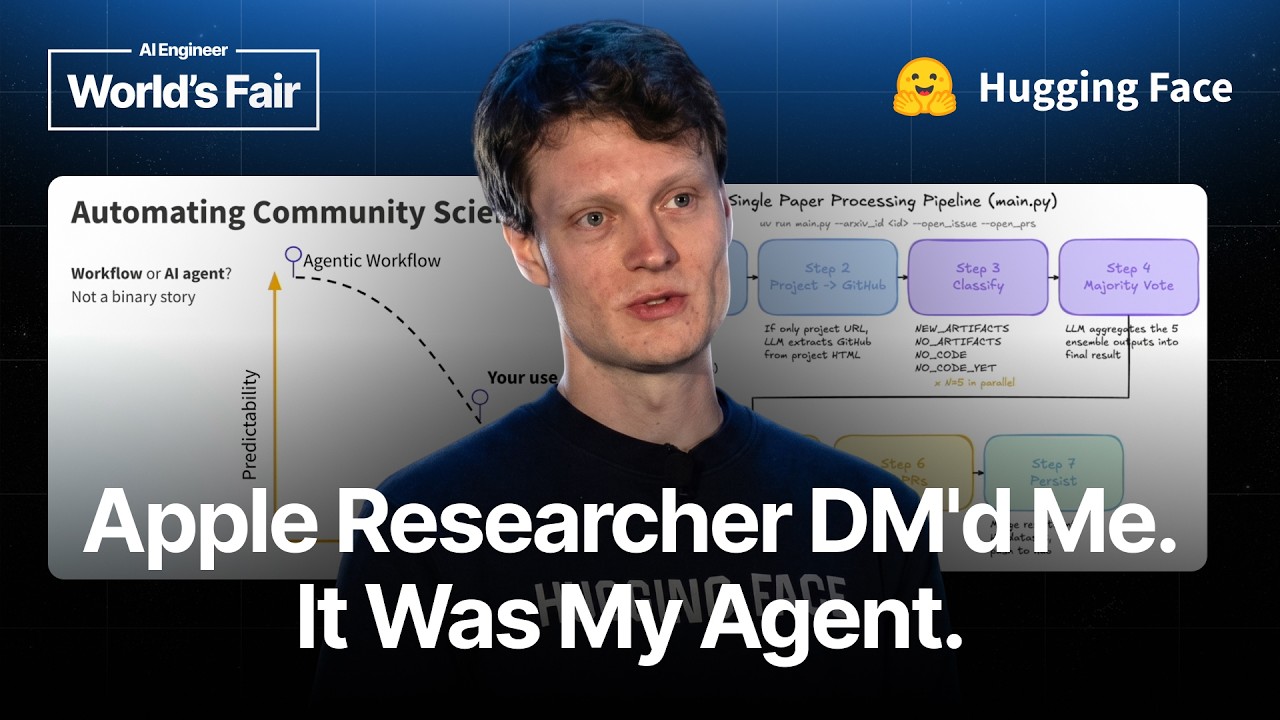
"Lots of researchers make their artifacts available on services like Google Drive, Zenodo, Dropbox... This hurts the discoverability and visibility of their work," Rogge explained. He would often open GitHub issues or pull requests to prompt researchers, but the sheer volume of new papers made this approach unsustainable.

Automating the Outreach with Agents

To address this, Rogge developed an AI agent to automate the outreach process. The workflow involves identifying research papers, finding their GitHub URLs, reading the README files, checking for new artifacts, and then either opening a pull request on Hugging Face if artifacts are missing or suggesting improvements to existing documentation. The agent also handles follow-ups with authors.

Rogge discussed two primary approaches for building such agents: a deterministic workflow versus a fully autonomous agent. He opted for a more deterministic workflow initially, aligning with advice to "start simple" and avoid complex agent frameworks. However, he later transitioned to a more autonomous agent model, particularly for handling the follow-up tasks.

Choosing the Right Approach: Workflows vs. Agents

Rogge presented a useful comparison: workflows offer more predictability and control, making them simpler to manage. Autonomous agents, on the other hand, provide greater flexibility but can be less predictable. He noted that the choice depends on the specific use case, and a hybrid approach is also possible.

For the initial outreach, Rogge built a workflow that replicated his manual process. This workflow was deployed as a simple cron job, running nightly to parse hundreds of arXiv papers and create GitHub issues or pull requests. For tracing and observability, he uses LangFuse to monitor the agent's inputs, outputs, prompts, and costs.

From Workflows to Autonomous Agents and GLM 5.2

The second phase of his automation involved automating the follow-up to GitHub issues. For this, Rogge adopted a more autonomous agent approach, citing a workshop by Anthropic that suggested models have become capable enough for such agents to outperform workflows. He specifically uses the Claude agent SDK for this, noting that he has recently switched from Claude models to the GLM 5.2 model via Hugging Face inference providers.

Rogge highlighted the advantages of GLM 5.2, stating that it shows great performance, often beating models like Opus 4.8, and is also more cost-effective, making it a logical choice given his work at Hugging Face.

Deployment and Results

The agent is deployed on Modal, utilizing its batch processing feature to run thousands of containers in parallel, with each container handling a single GitHub issue. Rogge also created a custom skill within Cursor, called "process_unreads_modal," which allows him to manually trigger the agent for follow-up tasks.

The results have been impressive. The automated system generates numerous GitHub issues and pull requests, leading to many researchers making their artifacts available on Hugging Face. Rogge shared examples of how the agent has successfully prompted researchers from companies like Apple and Google DeepMind, and even facilitated the migration of an entire OCR model suite from a Chinese company, Paddle Paddle.

He also noted a particularly successful instance where an issue created by his agent for a paper titled "Tiny Recursive Models" received over 60 upvotes, leading to the model's release on Hugging Face. Rogge humorously admitted he doesn't disclose to users that an agent is handling these interactions, as he believes knowing it's a bot might lead to issues being closed prematurely, and the agent's output is indistinguishable from his own manual efforts.

Beyond Automation: Other Hugging Face Efforts

Rogge also touched upon other related efforts, including a Twitter account called "Daily Papers," which uses a similar automation workflow to share popular research papers and artifacts. This account has garnered over 90,000 followers organically.

Additionally, he is involved in reviving "Papers With Code," a website that aims to make research and state-of-the-art findings more accessible, currently living at paperswithcode.co. This initiative includes providing benchmarks and educational resources on technical terms.

Conclusion: The Power of Open Models and Agents

Rogge concluded by emphasizing the rapid advancements in open models like GLM 5.2, which are now competitive with closed-source alternatives. He reiterated that for his use case, agents offer a distinct advantage over traditional workflows, requiring only a CLI, a skill, and a sandbox to operate effectively. He also stressed the importance of continuous evaluation for these AI systems.

© 2026 StartupHub.ai. All rights reserved. Do not enter, scrape, copy, reproduce, or republish this article in whole or in part. Use as input to AI training, fine-tuning, retrieval-augmented generation, or any machine-learning system is prohibited without written license. Substantially-similar derivative works will be pursued to the fullest extent of applicable copyright, database, and computer-misuse laws. See our terms.