


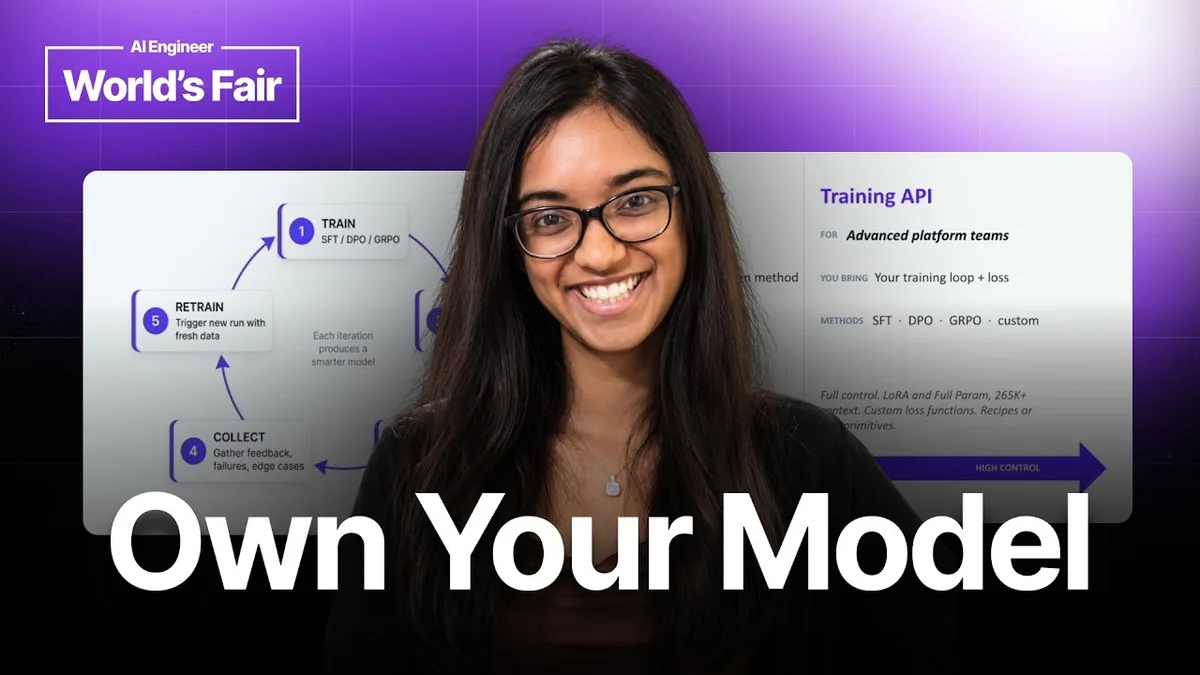
AI Engineer host Jatashri, who leads applied machine learning at Fireworks AI and goes by Jet, pitched a train-to-deploy loop that moves teams off rented closed models and onto tuned open models that stay on Fireworks for both training and inference.
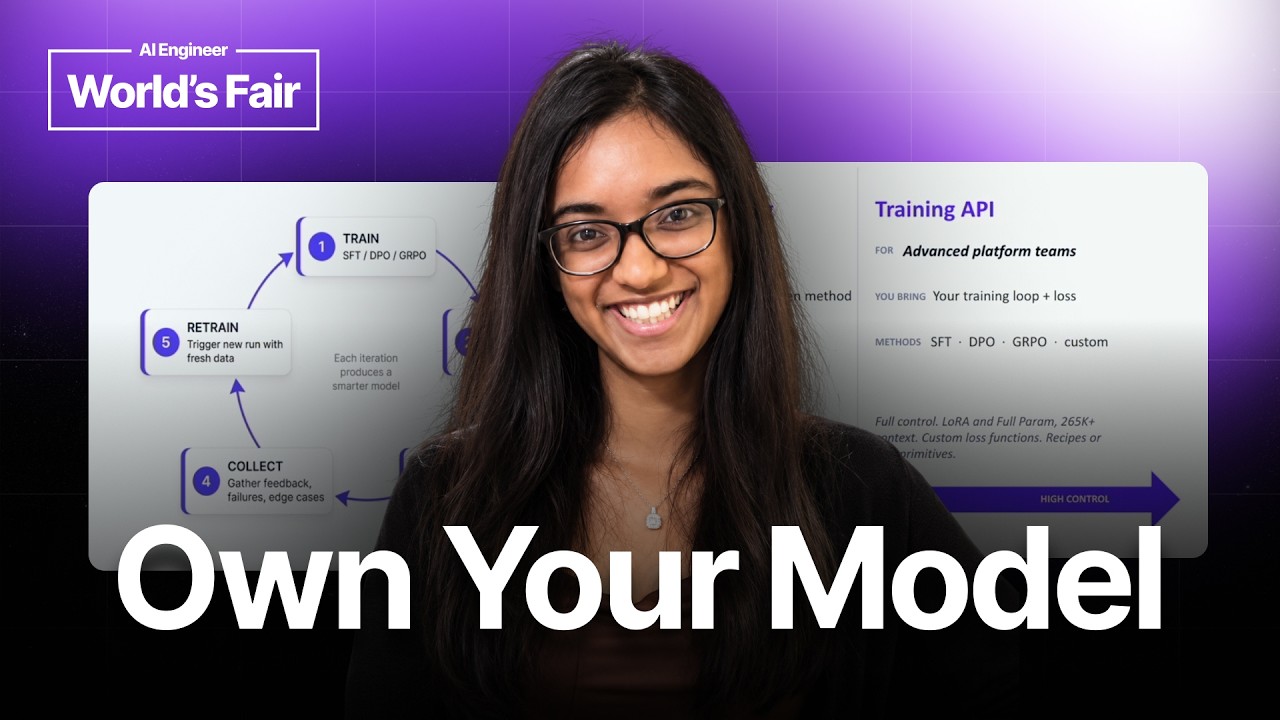
Stop renting intelligence was the hook.
Jet framed three claims as current reality: open models are production ready, citing GLM 5.2 for coding; closing the quality gap depends on customization; and teams now want a continuous train, host, retrain flywheel instead of one-off serving. Fireworks says it serves about 30 trillion tokens and, pre-GLM 5.2, expected that to rise by about 5 trillion tokens per day, with more than 10,000 companies and about 200,000 requests per second in production. The talk cited Cursor's Composer 2 trained and hosted on Fireworks with 13x faster inference via its Fire Attention engine, Vercel with a 40x latency improvement, and GenSpark with a 12% quality gain after RFT plus dataset cleaning and evaluator work. None of those figures came with datasets, baselines, or costs.
Fire Attention is presented as a custom CUDA kernel layer between model and GPUs, tuned per workload on input tokens, output tokens, and prompt cache hit rate, plus techniques like speculative decoding, disaggregation, and quantization. Jet said customers can train draft models for speculative decoding on the platform the same way they submit fine-tuning data. That helps latency and throughput if the draft model is good, but it ties speed gains to workload-specific kernel work that Fireworks controls.
Training comes in three flavors. The Training Agent in the UI takes linked datasets and a task description, picks a base model, cleans data, and selects hyperparameters, then reports steps, accuracy and F1 and recommended next steps. Managed training via API or UI requires you to choose model, datasets and hyperparameters and click Create, with a dashboard for loss by epoch and an export to Weights & Biases. The Training API lets ML engineers define their own loop and loss. All three support supervised fine-tuning, reinforcement fine-tuning and DPO, except the agent does not support RFT today, including its data cleaning and hyperparameter help. Jet acknowledged teams often need help writing evaluator functions for RFT.