Frontier guardrails refused to analyze live malware logs and exploit payloads, blocking defenders during a July 2026 incident at Hugging Face, and the response team had to rerun the work on an open-weight model running locally with no remote API call.
The case study anchors a broader argument from Databricks field engineers Jay Palaniappan, Elise Gonzales, Tanner Waggoner, Toby Messinger and Will Middlebrook, who said in a Nov. 4 post that enterprises are moving from single-provider frontier stacks to managed portfolios.
The authors, who work inside enterprise AI deployments, listed seven pressures they see in the field. Spend has outpaced returns according to MIT Project NANDA data they cite, model leadership has changed hands more than 20 times since May 2023 according to BenchLM, Anthropic introduced a 30-day minimum retention on its frontier tier that breaks zero-data-retention assumptions, and harness choice alone swung the same model from 38.4% bare to 61.7% in Databricks’ harness in their benchmark.
The intelligence is now a commodity.
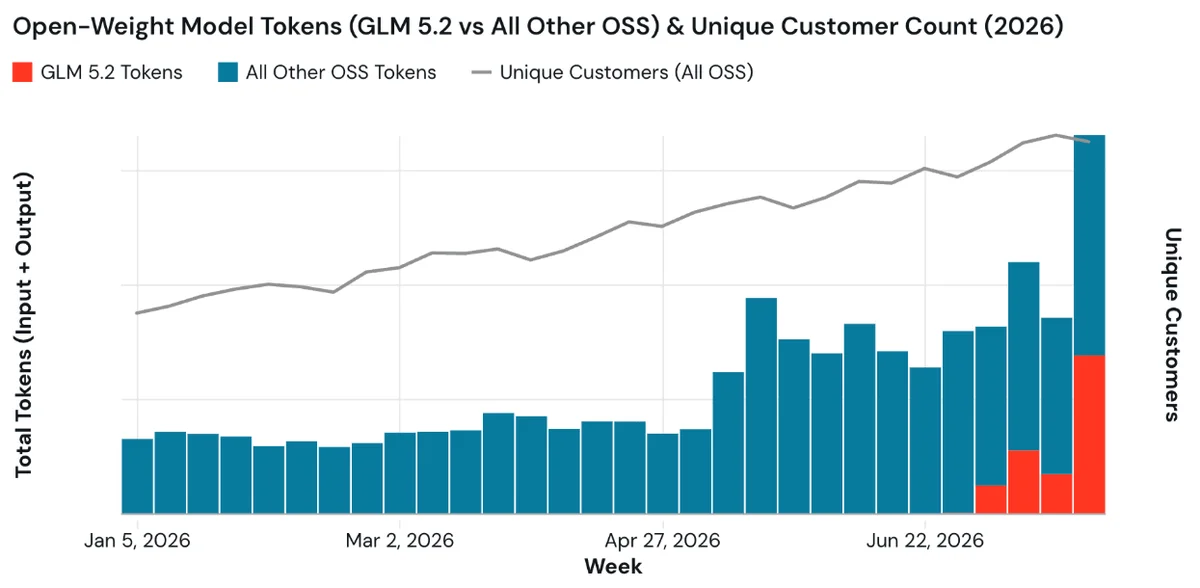
Databricks says that is why open-weight models matter in its stack, with parity at lower cost, data sovereignty on customer-controlled infrastructure, and operational autonomy for work that frontier policies block. The company points to Unity AI Gateway as the control plane, serving open-weight, frontier and external providers through one governed API with smart routing, fallback chains, budget caps and centralized audit for tools and skills. Internal data for the weeks ending Jan. 5 to shows the average unique models per customer rose from 4.2 to 7.1, with roughly 40% open-weight, and GLM 5.2, available in mid-July, already accounted for about 40% of open-weight tokens a month later, mostly incremental growth, according to the company. Independent testing cited by Databricks from Artificial Analysis put GLM 5.3 (max) at 9.1 seconds end-to-end on Databricks.
The daily brief
Get the free daily brief with the day's AI news, new AI startups and funding rounds every morning.
Join 64,000 other subscribers.
Databricks Chief Executive Ali Ghodsi tied that demand to infrastructure, telling CNBC in July around a $3 billion fundraising round that the company is running out of GPUs everywhere and needed capacity to host open models, according to the post.
The comparison point the post invites is the GLM family versus the Kimi family. Databricks cites Kimi K3 alongside GLM 5.3 as frontier-comparable open options, but Kimi K3 is a 2.8 trillion parameter model built on Kimi Delta Attention, a hybrid linear attention mechanism with Attention Residuals and native 1M-token context, and its successor Kimi K3.1 Pro is pitched as a 3T-class open-weight model with the same 1M context, according to Kimi’s platform docs. Databricks did not publish a head-to-head cost per million tokens for those models on Unity Gateway, nor did it detail how its smart routing decides cost versus reasoning quality for a given session.
That gap matters because harness effects cut both ways. If a harness can lift a model by more than 20 points, then any parity claim between open and frontier weights is a harness-plus-model claim, not a model-only claim, and customers comparing leaderboards without fixing the harness will misread price and performance.
The post also leans on centralized governance for tool use, including managed proxies and audit for external MCP servers and governed skills to improve determinism, but it declined to say how data residency is proved to auditors when an open-weight model runs on shared GPU pools versus dedicated deployments.
No one in the post answered who owns liability when a guardrail-free open-weight model is used to reproduce an exploit and that reproduction later leaks.