

AI Traffic Needs New Homepage Strategy

AI traffic is soaring, but homepages are failing to capture it. Learn why and how to adapt.

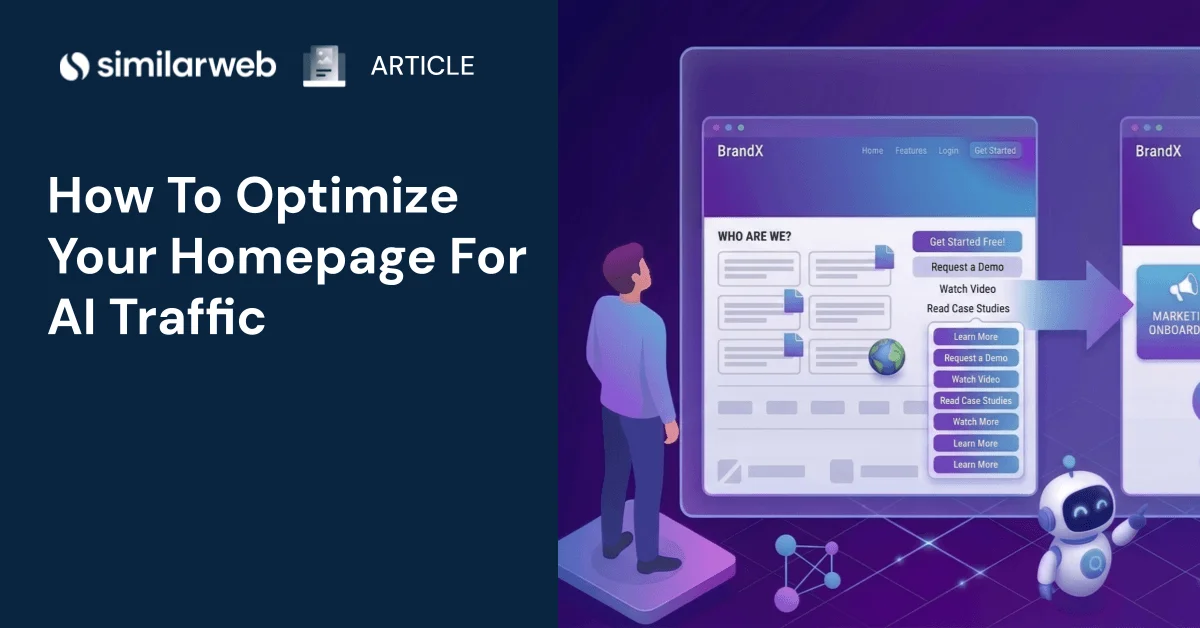
Illustration of a website homepage with AI chatbot icon and data analytics graphs.
Similarweb
Visual TL;DR
AI Traffic SoaringDriver
generative AI platforms globally reached 9.5 billion monthly visits, a 70% increase
From the article 8 mentionsThe surge in AI-driven web traffic demands a fundamental rethink of website homepages.
Old Homepages FailDriver
designed for first-time visitors, ill-equipped for already-informed AI referrals
AI Referrals EngagedContext
ChatGPT referrals spend 15 minutes, view 12 pages, convert at 7%
From the article 6 mentionsThis AI traffic is not just more engaged; it's directed differently.
Dark Library EffectContext
AI tools directly answer questions, bypassing traditional brand discovery paths
From the articleThis pattern, dubbed the 'Dark Library Effect' by Orbit Media based on their analysis of 74 Cloudflare accounts, means AI systems digest granular content, but users land on the main page.
New Homepage StrategyEffect
adapt homepages to capture and convert already-informed AI-driven visitors
From the article 9+ mentionsFor years, homepages have served as the digital front door for first-time visitors, tasked with introducing a brand and its offerings.
AI Referral AuditCore
framework to assess and optimize website architecture for AI-referred traffic
From the article 6 mentionsTo address this, a new framework called the AI Referral Architecture Audit has been developed.
Rethink Digital Front DoorOutcome
fundamental shift needed for startups and enterprises to leverage AI traffic
From the articleFor years, homepages have served as the digital front door for first-time visitors, tasked with introducing a brand and its offerings.
Contents(4)

The surge in AI-driven web traffic demands a fundamental rethink of website homepages. For years, homepages have served as the digital front door for first-time visitors, tasked with introducing a brand and its offerings. However, the way AI tools like ChatGPT direct users is fundamentally altering this dynamic, sending traffic to homepages that are ill-equipped to handle already-informed visitors.

This shift is not gradual. Between June 2025 and May 2026, average monthly web visits across generative AI platforms globally reached 9.5 billion, a 70% year-over-year increase, according to Similarweb's 2026 Generative AI Landscape report. More strikingly, visitors referred from ChatGPT spend an average of 15 minutes on site and view 12 pages, outperforming Google referrals (8 minutes, 9 pages) and converting at a higher rate (7% vs. 5%). This AI traffic is not just more engaged; it's directed differently.

The mechanism changed abruptly on May 7, 2026, when ChatGPT began turning brand names within its answers into clickable links, rather than just citations. This led to a 157.7% week-over-week surge in total ChatGPT referrals, with homepage referrals exploding by 354.7%. This happened because AI systems often summarize information from deep pages, articles, documentation, or FAQs, but the link provided to the user directs them to the homepage.

The 'Dark Library Effect' and AI Referrals

This pattern, dubbed the 'Dark Library Effect' by Orbit Media based on their analysis of 74 Cloudflare accounts, means AI systems digest granular content, but users land on the main page. Homepages receive approximately 15 times more AI attention than other page types. Compounding this, Similarweb's research shows users recommended by ChatGPT are 2.5 times more likely to visit that brand's site within seven days, even without a direct link. When these users then search for the brand, they are typically directed to the homepage.

Why Old Homepages Fail Informed Visitors

The traditional homepage, designed for a visitor who knows nothing about the brand, is now an outdated model for AI-referred traffic. These users arrive with context already provided by the AI. They don't need an introduction to 'who we are, what we do.' Instead, they need immediate access to information relevant to their query. This requires a homepage that prioritizes speed to decision and clear routing for an already-briefed audience, not a generic overview.

The AI Referral Architecture Audit Framework

To address this, a new framework called the AI Referral Architecture Audit has been developed. It assesses how well a homepage serves visitors who already possess brand knowledge. The audit examines seven criteria grouped into five core functions: Speed to Decision (CTA consistency, Context fit), Routing for Different Visitors (Intent routing), Trust and Credibility (Visible trust signals, Reputation fit), Recovery (Search and navigation prominence), and Technical prerequisites (Mobile load speed).

Each criterion is scored on a 0-2 scale, with a maximum of 14 points. A score of 10 or above indicates a homepage is optimized for AI-referred traffic. For instance, ClickUp scored a 0/2 for CTA consistency due to multiple competing calls to action, while monday.com scored a 2/2 by repeating a single 'Get Started' button. In terms of context fit, ClickUp's headline scored a 1/2 for vagueness, whereas monday.com's headline scored a 2/2 for assuming full context.

This audit highlights a critical gap: most homepages are still built for a stranger, not the informed visitor AI is increasingly sending. Companies like Similarweb, which itself has a StartupHub score of 64/100 and verified financials including a $27.5M secondary transaction in 2024, are analyzing these shifts to guide businesses. Competitors such as Varos (56/100) and Usearch (53/100) also operate in the competitive market intelligence space, but the specific challenge of AI referral traffic optimization is a new frontier.

Why This Matters for Startups and Enterprises

For startups and established companies alike, failing to adapt homepages for AI traffic means losing valuable, high-intent visitors. This new traffic source is not a substitute for search but a distinct, engaged channel. Optimizing homepages is no longer just about SEO; it's about understanding user journeys shaped by AI. The companies that quickly adjust their digital storefronts to meet these informed visitors will gain a significant competitive advantage.

© 2026 StartupHub.ai. All rights reserved. You may not republish this article in full without a license. Search engines and AI research tools may crawl and summarize for reference. Bulk reproduction or model training requires a license. See our terms.
Daniel Singer

Written by

Daniel Singer

Editor, StartupHub.ai

Daniel Singer is the editor of StartupHub.ai, a technology expert and thought leader on AI and its applications across sectors, from fintech and healthcare to developer tooling and consumer software. He writes and tests the tools covered here thoroughly and regularly, and built StartupHub.ai to give founders, operators and buyers a clearer read on what they are actually being sold.