

TypeSafe Jev: the frontier model built to kill chat

On 15 September 2026 TypeSafe AI left stealth with Jev, a System One model that returns typed decisions instead of chat. Seed was $40 million, led by DCVC. Early access is waitlisted at typesafe.ai.

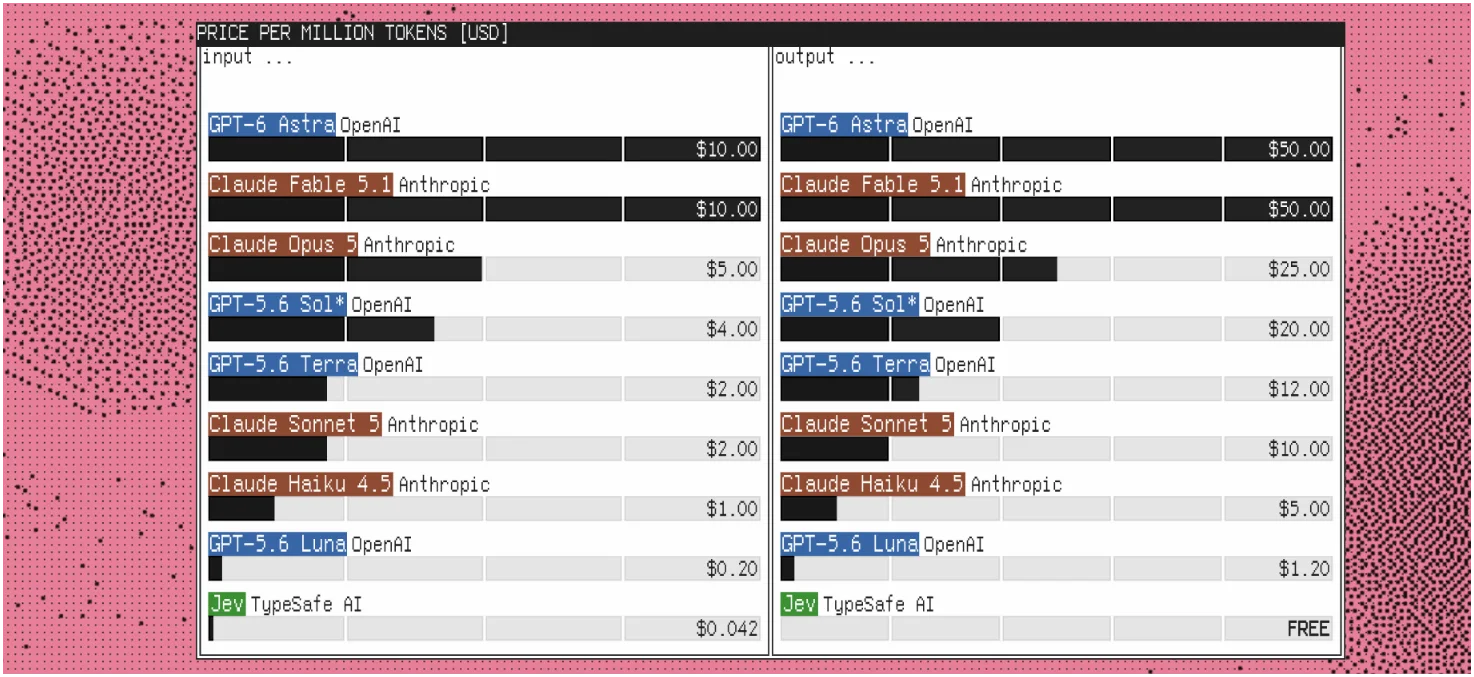
TypeSafe Jev price per million tokens compared with frontier chat models
TypeSafe homepage comparison: input and output price per million tokens.
Key Takeaways
  • 1
    TypeSafe AI left stealth on 15 September 2026 with Jev, a System One model that returns typed decisions instead of chat.

  • 2
    Business Wire reported an approximately $40 million seed led by DCVC. Founders are Diogo Almeida, Erik Gafni and Sasha Sheng.

  • 3
    Jev is priced at $0.042 per million input tokens, with output tokens listed as free. Vendor workflows claim up to 193.6x faster and 444.6x cheaper.

  • 4
    Zero hallucinations means guaranteed schema match, not a zero error rate. There are no independent evals at launch.
Contents(3)

The big labs are still racing to make chat better. TypeSafe AI came out of stealth yesterday to kill chat entirely.

On 15 September 2026 the San Francisco company announced System One Models and its first model, Jev, and opened early access off a waitlist at typesafe.ai. The homepage line is not subtle: "We took the opposite research direction - not chat."

StartupHub already had TypeSafe in the directory as a thin stub. This is the first day the company has a public product, a Business Wire seed announcement, and a reason to sit next to the other frontier labs we track.

Diogo Almeida, TypeSafe's CEO, spent years at OpenAI on the instruction-following work that became InstructGPT, ChatGPT and GPT-4. In the launch note he asks the question that started the company: "Models have been superhuman at chat for years, so where is all the automation?"

His argument is that RLHF made models superhuman at talking to people, and also baked in mode dropping, overconfidence, and unreliability. Those flaws keep a human in the loop. TypeSafe says it built a new stack from scratch: new architecture, new sampler, and a training method it calls Reinforcement Learning for Calibrated Decisions (RLCD). It named the class System One Models, after Kahneman's fast System 1 thinking.

The seed is about $40 million, led by DCVC, according to that same wire. Almeida founded the company in 2024 with Erik Gafni, previously of genomics startup Ravel, Invitae and Freenome, and Sasha Sheng, a former Meta and FAIR research engineer. The team works in person near Embarcadero.

Jev does not write. It chooses.

Jev is named after Jevons Paradox: make a resource cheaper and people use more of it. It does not produce words for people. It produces typed decisions that software can act on.

Developers send a block of state and a set of typed questions. Jev returns choices, scores or probabilities the application can use to classify, route, approve or escalate. It does not generate prose, code or open-ended strings. TypeSafe says it evaluates those questions in parallel and returns the probability distributions in one response, so adding questions barely moves latency. Every decision carries a confidence estimate. Software acts when confidence is high and escalates when it is not.

In TypeSafe's wording: "Think of Jev as a frontier-intelligence function call: unstructured state in, typed probabilistic decisions out." That is not JSON mode. JSON mode still generates strings that happen to look like JSON. TypeSafe says Jev's architecture guarantees schema matching. It can still pick the wrong answer. It should not invent a field or an invalid type.

The demos are the part that will travel. A Doom bot making about 10 calls a second on structured text state, not pixels, for about $7 an hour. A Wikiracing run picking among large sets of Wikipedia links. Cardinality today tops out at 255 choices.

The price TypeSafe wants you to see

The company is not shy about the chart. Frontier intelligence at under 100 milliseconds. Often 100x faster and cheaper than other frontier models, it says. End-to-end response time of 70ms to 500ms, against 3 to 329 seconds for the chat labs. Input priced at $42 per billion tokens, which is $0.042 per million. Output tokens: free, "too cheap to meter." The homepage also claims 193.6x faster and 444.6x cheaper on System One workflows, and 238x lower input price than Claude Fable 5.1.

If those numbers hold in other people's code, the interesting consequence is not a cheaper chatbot. It is model calls inside hot loops, data pipelines and real-time UI, places today's token bills make no sense. Almeida's electric-motor analogy: early factories swapped the steam engine for an electric motor and left the floor plan alone. The gain showed up decades later, when the motor was small enough to put at every workstation. TypeSafe wants AI to be that small motor, not the big assistant in the middle.

Three caveats, then the bet

The 193.6x and 444.6x figures sit near the high end of what TypeSafe says customers should expect. The published workflow evals cover security incidents, agent-trace monitoring, invoice processing and customer service. The reference answers are the average output of GPT-6 Astra and Claude Fable 5.1, not an independently established ground truth. The company says staff-made workflows can introduce bias. Speed numbers were generally run from West Coast laptops, where the service currently lives.

"Zero hallucinations" here means schema match, not "never wrong." TypeSafe is explicit: the 0% is not an empirical error rate. Schema matching is guaranteed, so they plot zero. Jev can still choose the incorrect class.

There is also no independent eval at launch, and no weights or paper with enough detail for an outside lab to reproduce the stack. That is a product announcement, not a result you can rerun.

Even with those asterisks, the critique is coherent. DCVC general partner James Hardiman, in the seed release, called it one of the biggest remaining challenges in AI: turning increasingly capable models into technology developers can actually build into products at scale. Almeida is not arguing that chat was a mistake. He is arguing that chat is the horseless carriage: a human interface glued onto a technology that needs a machine-native one.

The if is still large. A waitlisted model with vendor-run workflows is not a new stack until other people's production traffic says so. It is still the most pointed product-shaped argument against chat-centric AI since RLHF itself.

San Francisco frontier lab shipping System One models. First public model is Jev, waitlisted at typesafe.ai.

Founded
2024
HQ
San Francisco
Seed
$40M, DCVC-led
© 2026 StartupHub.ai. All rights reserved. You may not republish this article in full without a license. Search engines and AI research tools may crawl and summarize for reference. Bulk reproduction or model training requires a license. See our terms.
Daniel Singer

Written by

Daniel Singer

Editor, StartupHub.ai

Daniel Singer is the editor of StartupHub.ai, a technology expert and thought leader on AI and its applications across sectors, from fintech and healthcare to developer tooling and consumer software. He writes and tests the tools covered here thoroughly and regularly, and built StartupHub.ai to give founders, operators and buyers a clearer read on what they are actually being sold.