Live Agent Run: Test Your Site With AI Coding Agents

Live Agent Run points five real AI coding agent harnesses and a control at a site and scores whether they can answer the seven questions a buyer's agent would ask.

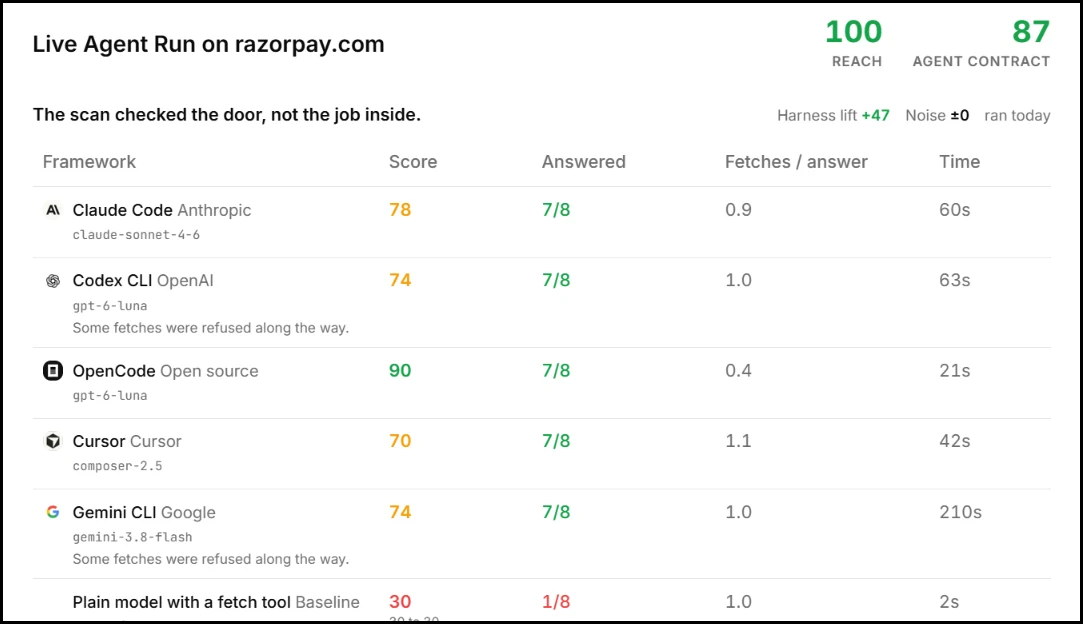
Live Agent Run on razorpay.com showing six rows scored by AI coding agents
Contents(6)

AI agents now open sites, compare products and take actions on behalf of people, and that traffic is already real. Most readiness checks stay static, and they inspect files and headers to see if an agent is allowed in and can find what it needs. Live Agent Run asks a harder question, and it tests whether agents can actually complete the job on your site.

It does this by pointing five real agent harnesses and a control at the site and scoring what they bring back. It sits inside the existing agent readiness scanner.

What's new

The scanner already gave a 0 to 100 score, a grade from A+ to F, and six category scores for Discoverability, Content, Access Control, Capabilities, Commerce and Quality. About 40 checks make up the scan, and each returns pass, warn, fail or skip, with a warn counting at 40 percent of its weight. Every failure ships with a paste-ready fix prompt for a coding agent, and a single call returns the full result as JSON over REST and MCP so it fits in CI or inside an agent. You can call it through the agent readiness API.

Before any agent runs, the scan also reports two numbers. Reach shows the share of 12 AI answer and search clients that get readable text from the homepage, and training-only crawlers do not count toward it. Agent contract is a weighted check for llms.txt, AGENTS.md, an OpenAPI document, an MCP server card and CLAUDE.md.

Live Agent Run puts five real agent harnesses on our own hardware to work against a site, its MCP server and its APIs.
Each harness tries to answer the same seven questions using only what the site itself publishes: what the company does, the cheapest paid monthly price, a named customer or a review score, founders or funders or location, the privacy or security page, the public API address, and up to three product names.

If the site exposes a payment surface, the harness also has to find where an agent could pay without a human.

Each harness can earn 80 points for the share of questions it answers, and 20 more if it completes the whole job in three fetches or fewer in total.

The results table then breaks out each harness by score, answers, fetches per answer, time, and the model it ran on.

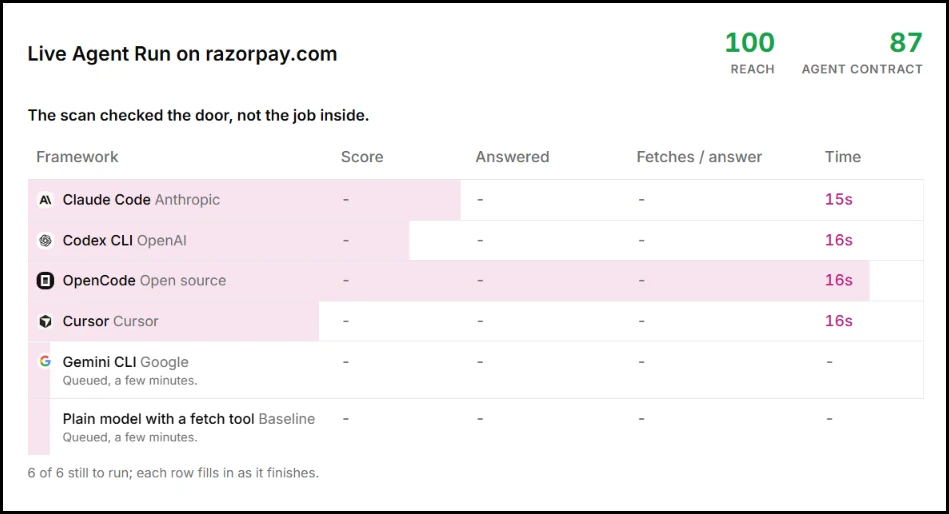
Every click starts a fresh run, and nothing is served from a cached result. Rows stream in as each harness finishes, and each row fills as its own progress bar, while a finished result survives a reload.

Starting a run needs a signed-in account, and a free account includes three Live Agent Runs a month while every paid plan is unlimited. Results are also readable per domain through the API at GET /api/agent-readiness/agent-task?domain=example.com.

Live Agent Run on razorpay.com while four harnesses are still running, each row a progress bar
Rows fill in as each harness finishes; the tint across a row is its progress.

Why six rows, not one

A single harness can tell you as much about the harness as about the site, because harnesses differ in how they fetch, follow links and decide to stop. To make differences readable, the run uses five harnesses with deliberate overlap. OpenCode runs the same model as Codex CLI, so between those two the harness is the only variable, and Cursor runs on its own model while only Claude Code runs on a Claude model.

The sixth row is a control, a plain model with one fetch tool and no harness, run three times on the same input. The spread across its three runs is published as the noise floor, and a gap between harnesses that is smaller than that spread is not a finding. Harness lift is the average score of the real agents minus the control, and it shows what the harness adds on that site. See how the noise floor and harness lift work for the details.

RowModelRole
Claude Codeclaude-sonnet-4-6Agent harness
Codex CLIgpt-6-lunaAgent harness
OpenCodegpt-6-lunaAgent harness, same model as Codex CLI
CursorComposer 2.5Agent harness on Cursor's own model
Gemini CLIgemini-3.8-flashAgent harness
Controlgemini-2.5-flash-litePlain model, one fetch tool, run three times

The six categories and what they probe

As of 14 October 2026 the scanner has scored 93,152 distinct sites, and the average latest score is 37.1 out of 100. Only 423 of those sites, about 0.5 percent, score 70 or more, so most sites are not yet built for agents.

The six categories below are what the scan checks.

  • Discoverability: looks for robots.txt, a discoverable sitemap, a Link response header, a reference to llms.txt, AGENTS.md or CLAUDE.md, and an on-site search URL exposed as a JSON-LD SearchAction.
  • Content: verifies at least 150 words of real text in the raw HTML, negotiates for markdown where offered, and confirms an llms.txt guide with working links alongside llms-full.txt.
  • Access Control: tests whether browse bots can fetch the site at all, and inspects AI bot rules in robots.txt, Content Signals, and Web Bot Auth signing keys.
  • Capabilities: probes for an MCP server card at /.well-known/mcp/server-card.json, an OpenAPI document at /openapi.json, an API catalog, an A2A agent card, an Agent Skills index, and OAuth discovery.
  • Commerce: checks x402 payment support at /x402 and /.well-known/x402, AP2 and ACP discovery at /.well-known/ap2 and /.well-known/acp, MPP discovery, Offer or Product structured data, and a payment link an agent can reach.
  • Quality: validates complete OpenGraph metadata, a single H1, image alt text, a meta description, a canonical URL, JSON-LD structured data, RateLimit headers, security.txt, and JSON content negotiation.

The Stripe example: what a homepage costs an agent

On 14 October 2026 stripe.com scored 54 out of 100, grade D. In our scan of 27 August 2026 the homepage cost an agent roughly 163,000 tokens as HTML against about 3,200 as markdown, about 50 times fewer, and that figure is a snapshot not a current measurement.

An agent pays for every token it reads, so a site that returns markdown on request is cheaper and faster to read, and an agent with a fixed budget gets further on it. The point is token economics rather than a criticism of Stripe.

How Live Agent Run stacks up against Cloudflare and Lighthouse

Cloudflare's checker at isitagentready.com is free with no account, and it returns a 0 to 100 score with a level from Bot-Unaware to Agent-Native. It spans five categories from discoverability to commerce and covers surfaces such as x402, MPP, UCP and ACP, though Cloudflare notes commerce checks do not yet influence the score, and all checks are static. Lighthouse 13.3 added an experimental agentic browsing category in May 2026 that reports a passed audit ratio with no single score, and neither tool starts a live agent.

StartupHub.ai Agent ReadinessCloudflare Agent Readiness ScoreLighthouse 13.3 agentic browsing
Score model0 to 100 score, grade A+ to F, six categories0 to 100 score plus a level from Bot-Unaware to Agent-Native, five categoriesRatio of passed audits, no 0 to 100 score (experimental)
Live agent testFive real agent harnesses plus a control, scored per harnessNo, static checks onlyNo
Monitoring and alertsDaily rescan, alert names the check that broke (paid plans)No daily rescan alertNo, run manually
Commerce readinessScored category: x402, AP2, ACP and MPP discovery, plus a payment question for agentsChecks x402, MPP, UCP and ACP, not counted toward the scoreNo commerce checks
Machine interfaces checkedllms.txt, AGENTS.md, CLAUDE.md, OpenAPI, MCP server card, markdown negotiation, plus a live run against the MCP server and APIsStatic checks across five categories, discoverability to commerceAccessibility tree, layout shift, llms.txt, WebMCP

Beyond that difference, the StartupHub.ai scanner makes a real request as each of 17 named AI clients, and it shows the status and word count each received. It runs real agent frameworks on our own hardware, and it rescans watched sites daily while naming the exact check that failed. It also publishes a public leaderboard, and every failed check includes a paste-ready fix prompt, while the report is transparent about which clients it cannot probe. See the full comparison with Cloudflare for detail.

Why this matters for the next 12 months

Publishing llms.txt or an MCP server card shows a site is present for agents, but it does not prove an agent can actually extract an answer or a price. Over the next 12 months, success will be measured by that outcome, not by presence.

Harnesses and the models behind them change often, so a site that worked last month can fail without any change on the site itself. For that reason a watched site is rescanned daily. An alert goes out when a passing check breaks, the score falls 5 points or more, a category falls 10 or more, or the site becomes blocked. Alerts arrive in the app and in an email digest. They can also go to an https webhook set through the API. Monitoring is part of paid plans.

Agents do not stop at the homepage, so the run points them at the MCP server and the APIs as well, and at the payment surface when a site has one.

The whole result returns as JSON over REST and over MCP so the scan can run in CI or inside an agent, and every failed check includes a fix prompt that can be pasted into an AI coding agent.

Run the agent readiness scanner on your site, and start a Live Agent Run from the report when you are signed in. A free account includes three runs a month, and every paid plan is unlimited.

© 2026 StartupHub.ai. All rights reserved. You may not republish this article in full without a license. Search engines and AI research tools may crawl and summarize for reference. Bulk reproduction or model training requires a license. See our terms.

Watch

The videos behind the news, one flip at a time

The feed mixes the videos from our articles with startup demos and you flip through them like TV channels for free with no signup.

Daniel Singer

Written by

Daniel Singer

Editor, StartupHub.ai

Daniel Singer is the editor of StartupHub.ai, a technology expert and thought leader on AI and its applications across sectors, from fintech and healthcare to developer tooling and consumer software. He writes and tests the tools covered here thoroughly and regularly, and built StartupHub.ai to give founders, operators and buyers a clearer read on what they are actually being sold.