

Microsoft's Echoverse trains AI agents

Microsoft Research's Echoverse system creates deep, evolving training environments to significantly improve AI agent capabilities in complex software applications.

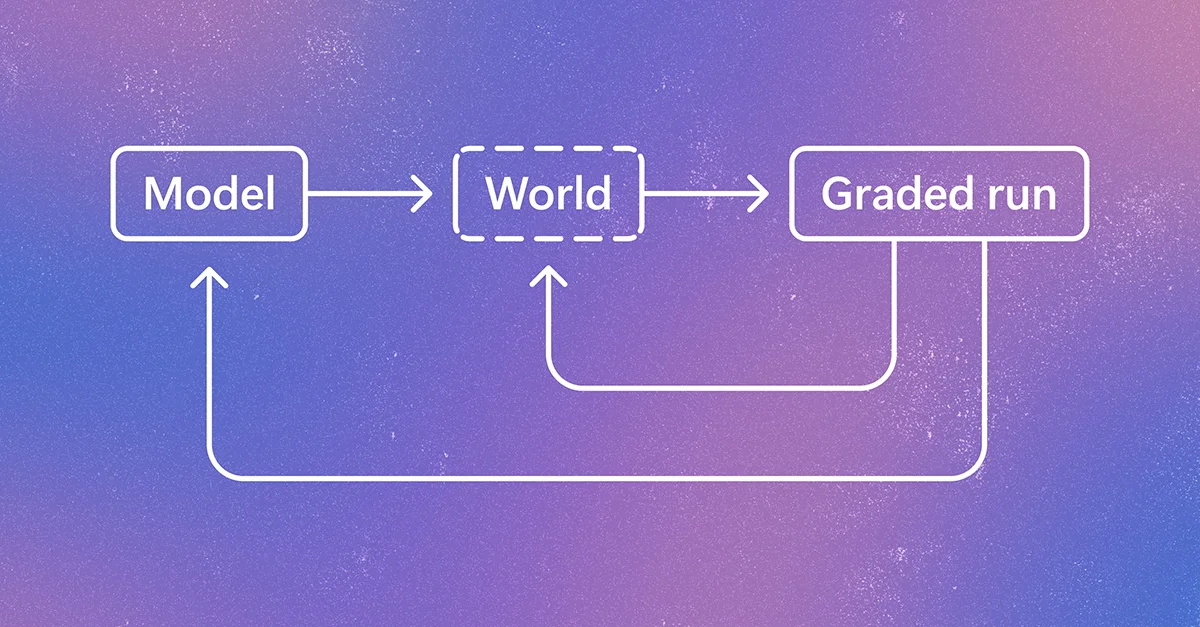
Diagram illustrating the Echoverse learning loop with arrows showing model training and world refinement.
The Echoverse learning loop shows how agent failures improve the training world.· Microsoft Reesarch
Visual TL;DR
Complex Software AppsDriver
AI agents struggle with deep, stateful interactions in proprietary systems
From the articleMicrosoft Research has unveiled Echoverse, a novel training framework designed to equip AI agents with the ability to navigate and operate within complex, real-world software applications.
Microsoft EchoverseCore
novel training framework for AI agents in complex, real-world software applications
From the article 9+ mentionsMicrosoft Research's experiments with Echoverse demonstrated substantial gains.
Depth Over QuantityContext
prioritizes highly faithful, evolving training environments over shallow, numerous ones
Realistic EnvironmentsEffect
From the article 9+ mentionsThe core idea behind Echoverse is to build highly faithful, evolving training environments that mimic the actual behavior of applications, complete with realistic data and persistent state.
Improved AI AgentsEffect
equips agents to navigate and operate within complex software applications
From the article 9 mentionsThis leap brings the agent's capabilities within fourteen points of GPT-5.4, according to the research.
Performance Nearly DoubledOutcome
From the articleA 9B parameter model trained on twelve Echoverse worlds saw its performance nearly double, improving from 36.5% to 67.1%.
Close to GPT-5.4Outcome
agent capabilities within fourteen points of GPT-5.4 after Echoverse training
From the article 2 mentionsTraining data is generated by having GPT-5.4 solve tasks within these worlds.
Contents(3)

Microsoft Research has unveiled Echoverse, a novel training framework designed to equip AI agents with the ability to navigate and operate within complex, real-world software applications. The system prioritizes simulating the deep, stateful interactions found in proprietary systems, moving beyond simple web scraping or basic UI interactions.

The core idea behind Echoverse is to build highly faithful, evolving training environments that mimic the actual behavior of applications, complete with realistic data and persistent state. This approach contrasts with methods that rely on a vast quantity of shallow, easily replicated environments.

Microsoft Research's experiments with Echoverse demonstrated substantial gains. A 9B parameter model trained on twelve Echoverse worlds saw its performance nearly double, improving from 36.5% to 67.1%. This leap brings the agent's capabilities within fourteen points of GPT-5.4, according to the research.

Depth Over Quantity

Echoverse emphasizes 'depth', meaning environments that accurately reproduce application logic, maintain coherent state across user sessions and screens, and handle complex workflows. This is crucial because AI agents often struggle with common, challenging UI elements like date pickers and nested filters. By creating specific 'capability worlds' that drill down into these difficult interactions, Echoverse trains agents to generalize these skills to unseen domains.

The system also employs a 'co-evolution' strategy. Instead of treating environment creation and model training as separate stages, Echoverse refines the training worlds, tasks, and verification methods based on where the AI agent fails. This iterative process sharpens the training signal for both the agent and the environment simultaneously.

Why Synthetic Worlds Matter

The researchers argue that live applications are unsuitable for agent training due to their dynamic nature and the risk of real-world consequences. Synthetic environments, like those in Echoverse, offer stability and control. StartupHub.ai data shows that while platforms like Hugging Face score well (76/100) for facilitating AI development, truly deep and controlled environments for agent interaction remain a critical need.

Echoverse builds these environments by first defining a specification and then compiling it into machine-checkable claims about application behavior. This is followed by generating the application itself, often a FastAPI and SQLite backend with a React interface. The system then rigorously tests every claim against the running environment, repairing and iterating until the world is sufficiently faithful.

Training data is generated by having GPT-5.4 solve tasks within these worlds. Only trajectories that pass ground truth verification are used for supervised fine-tuning, ensuring high-quality data.

The Echoverse Suite

The Echoverse project includes ten 'domain worlds' that model complex applications like email, calendars, banking, and health records. These mimic proprietary systems by focusing on permissions, shared state, and audit histories. Four additional 'capability worlds' target specific challenging UI elements.

These environments are designed to be self-contained, interactive clones of the applications they model. The goal is to create worlds where an agent's actions have tangible, stateful consequences, mirroring real-world utility.

Microsoft Research is releasing four of these worlds, along with their code, data, and grading systems, to foster further research in high-fidelity training environments.

© 2026 StartupHub.ai. All rights reserved. You may not republish this article in full without a license. Search engines and AI research tools may crawl and summarize for reference. Bulk reproduction or model training requires a license. See our terms.
Daniel Singer

Written by

Daniel Singer

Editor, StartupHub.ai

Daniel Singer is the editor of StartupHub.ai, a technology expert and thought leader on AI and its applications across sectors, from fintech and healthcare to developer tooling and consumer software. He writes and tests the tools covered here thoroughly and regularly, and built StartupHub.ai to give founders, operators and buyers a clearer read on what they are actually being sold.