

Skala 1.1 Boosts AI for Chemistry Simulations

Microsoft Research's Skala 1.1 deep-learning DFT model offers higher accuracy and broader integration into scientific software, accelerating computational chemistry.

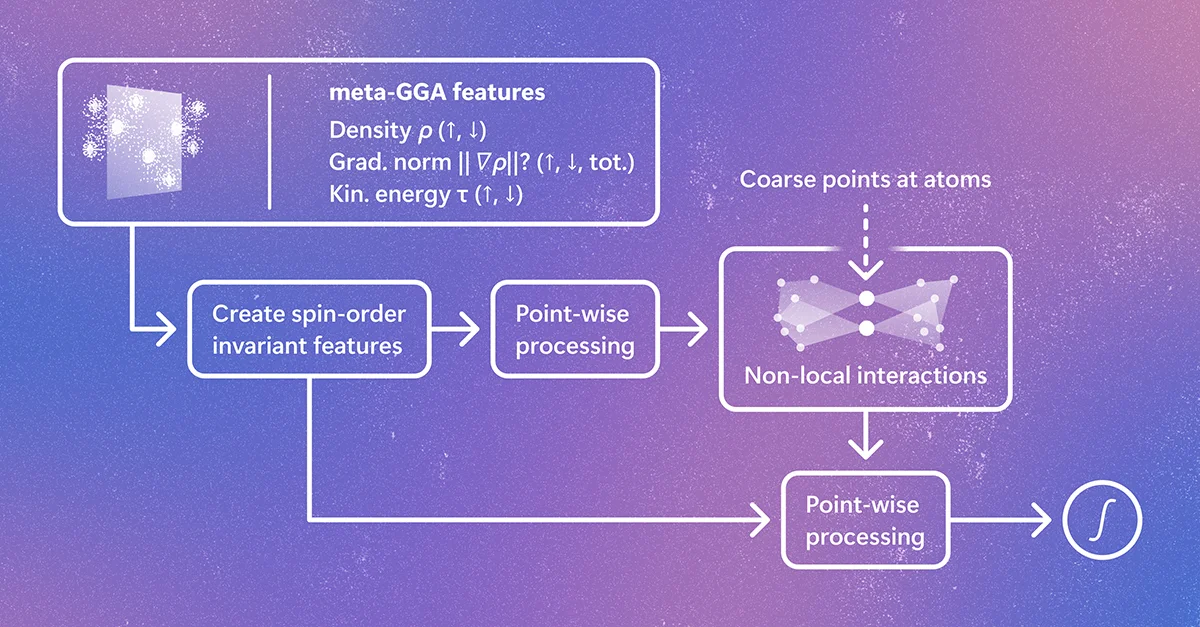
Diagram showing Skala 1.1 accuracy across thermochemistry, kinetics, and non-covalent interactions.
Microsoft Reesarch
Visual TL;DR
Predictive DFT challengesDriver
traditional methods trade accuracy for computational cost in molecular simulations
From the articleFor years, achieving truly predictive accuracy in DFT has been a major challenge.
Microsoft Skala 1.1Core
deep-learning DFT model for higher accuracy and broader scientific software integration
From the article 9+ mentionsMicrosoft Research is pushing the boundaries of computational chemistry with the release of Skala 1.1, an updated version of its deep-learning density functional theory (DFT) approach.
More training dataContext
trained on 2.5 times more data than its predecessor for improved accuracy
From the article 3 mentionsInstead, Microsoft Research aims for each Skala release to supersede the last, building on new data, model architectures, and training strategies.
Supersedes old methodsContext
each Skala release aims to supersede the last, avoiding a 'functional zoo'
Improved accuracyEffect
From the article 4 mentionsAccording to the announcement on Microsoft Research, Skala 1.1 has been trained on 2.5 times more data than its predecessor, resulting in substantially improved accuracy across critical areas like thermochemistry, reaction kinetics, and molecular structure prediction.
Accessible simulationsEffect
From the article 4 mentionsThis new iteration promises to significantly accelerate scientific discovery by making highly accurate molecular simulations more accessible and efficient.
Accelerate discoveryOutcome
From the article 4 mentionsThis new iteration promises to significantly accelerate scientific discovery by making highly accurate molecular simulations more accessible and efficient.
Contents(3)

Microsoft Research is pushing the boundaries of computational chemistry with the release of Skala 1.1, an updated version of its deep-learning density functional theory (DFT) approach. This new iteration promises to significantly accelerate scientific discovery by making highly accurate molecular simulations more accessible and efficient. According to the announcement on Microsoft Research, Skala 1.1 has been trained on 2.5 times more data than its predecessor, resulting in substantially improved accuracy across critical areas like thermochemistry, reaction kinetics, and molecular structure prediction.

For years, achieving truly predictive accuracy in DFT has been a major challenge. Traditional methods often involve a trade-off between accuracy and computational cost. Skala, however, represents a departure from the typical "functional zoo" approach where new methods are added without replacing older ones. Instead, Microsoft Research aims for each Skala release to supersede the last, building on new data, model architectures, and training strategies. Skala 1.1, for instance, achieves a weighted average error of just 2.8 kcal/mol on the GMTKN55 benchmark, a widely respected suite for evaluating DFT functionals. This performance rivals expensive global hybrid functionals but at the computational cost of a simpler meta-GGA functional.

Expanding the Reach of AI in Science

Accuracy is only one piece of the puzzle. The real impact of advanced computational tools like Skala comes from their integration into the workflows scientists already use. DFT is the backbone for research and development across chemistry, materials science, drug discovery, and energy technologies. To ensure Skala benefits a broad community, Microsoft Research has focused on expanding its accessibility. The tool is now available within CP2K, a powerful DFT simulation package, and is being integrated into other leading codes such as Psi4, FHI-aims, ORCA, and VASP. This widespread adoption is key to bringing next-generation DFT accuracy directly to researchers in their daily work.

This push for integration is a significant development for the computational chemistry field. While Skala itself is a product of Microsoft Research's AI for Science initiative, its success hinges on its adoption by the wider scientific software community. The collaboration with developers of established tools like CP2K and Psi4 is crucial. Skala's ability to run efficiently on both CPUs and GPUs, with performance comparable to semi-local meta-GGAs, makes it a practical choice for large-scale simulations.

A Commitment to Continuous Improvement

Microsoft Research is also introducing a "living benchmark" for Skala. This initiative will continuously track the computational performance of successive Skala releases across different software packages and hardware platforms. The goal is to provide a transparent and up-to-date reference that helps the community measure progress and accelerate the development of ever more accurate and efficient DFT methods. This data-driven, iterative improvement cycle is a hallmark of modern AI development and promises to keep Skala at the forefront of computational chemistry.

In the competitive space of AI for scientific discovery, where various research groups and companies are developing specialized tools, Skala's approach is noteworthy. While StartupHub.ai data shows Skala with a score of 41/100 and verified financials of $1.2M raised in a Seed round in 2022, it faces competition from platforms like Carta (score 61/100), LawPath (score 63/100), and LegalZoom (score 60/100) in broader AI applications, though direct comparisons in computational chemistry are more nuanced. Skala's focus on deep-learning DFT and its open integration strategy differentiate it. The success of such tools could significantly reduce the time and cost associated with scientific R&D, potentially leading to faster breakthroughs in areas ranging from new pharmaceuticals to advanced materials.

Why This Matters

The broad availability of Skala 1.1 means that more researchers can access state-of-the-art predictive capabilities without needing specialized hardware or extensive expertise in AI model deployment. This democratizes access to high-fidelity simulations, enabling smaller labs and academic groups to tackle complex problems previously out of reach. For enterprises, this translates to faster development cycles, more accurate predictions, and ultimately, a quicker path to market for new products and technologies. The continuous improvement model, coupled with the living benchmark, ensures that the field will see ongoing advancements, pushing the frontier of what is computationally possible in chemistry and materials science.

© 2026 StartupHub.ai. All rights reserved. You may not republish this article in full without a license. Search engines and AI research tools may crawl and summarize for reference. Bulk reproduction or model training requires a license. See our terms.
Daniel Singer

Written by

Daniel Singer

Editor, StartupHub.ai

Daniel Singer is the editor of StartupHub.ai, a technology expert and thought leader on AI and its applications across sectors, from fintech and healthcare to developer tooling and consumer software. He writes and tests the tools covered here thoroughly and regularly, and built StartupHub.ai to give founders, operators and buyers a clearer read on what they are actually being sold.