

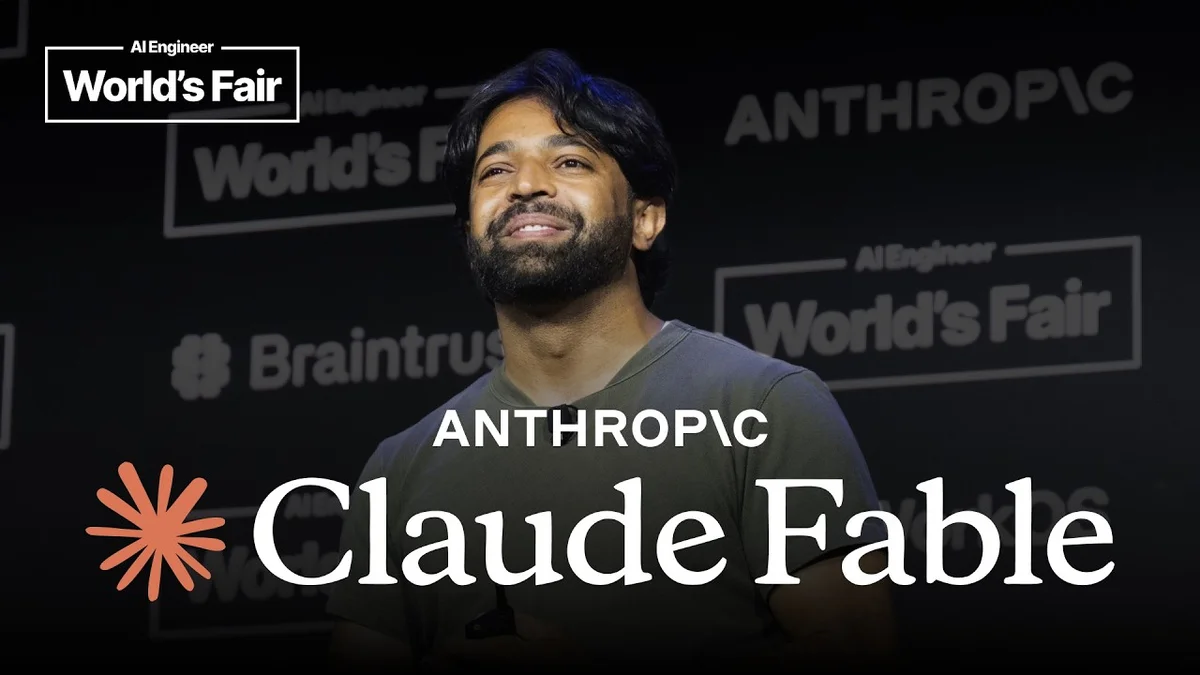
Anthropic's Thariq Shihipar on Fable: A Field Guide

Anthropic's Thariq Shihipar presents a 'Field Guide to Fable,' detailing its 'grown' nature, the evolution of AI agents, and how to leverage it to discover 'unknown unknowns.'

Thariq Shihipar on stage presenting at AI Engineer World's Fair
Thariq Shihipar, Member of Technical Staff at Anthropic, presents at the AI Engineer World's Fair.· AI Engineer
Visual TL;DR
Anthropic's Fable ModelCore
a 'grown, not designed' AI model
From the article 4 mentionsIn his talk, Shihipar provided insights into Anthropic's Fable model, its development, and how to effectively work with it.
Iterative DevelopmentContext
continuous learning and refinement process
From the article 2 mentionsShihipar described Fable as a model that is "grown, not designed." This metaphor emphasizes the iterative and adaptive nature of its development, contrasting it with traditional software engineering.
Evolving AI AgentsContext
progression through distinct functional stages
From the article 5 mentionsHe highlighted the evolving nature of AI agents and the importance of understanding their capabilities and limitations.
Discover Unknown UnknownsEffect
leveraging Fable's capabilities to find unexpected insights
From the article 3 mentionsA significant portion of Shihipar's talk focused on the concept of "unknown unknowns" and how to leverage Fable to uncover them.
Rethink TradeoffsContext
moving beyond 'good, fast, cheap' paradigms
Embrace FutureOutcome
implementing Fable and its emergent capabilities
Contents(6)

Thariq Shihipar, a member of technical staff at Anthropic, recently presented a "Field Guide to Fable" at the AI Engineer World's Fair. In his talk, Shihipar provided insights into Anthropic's Fable model, its development, and how to effectively work with it. He highlighted the evolving nature of AI agents and the importance of understanding their capabilities and limitations.

Anthropic's Thariq Shihipar on Fable: A Field Guide - AI Engineer
Anthropic's Thariq Shihipar on Fable: A Field Guide, from AI Engineer

Understanding Fable: A Growing Model

Shihipar described Fable as a model that is "grown, not designed." This metaphor emphasizes the iterative and adaptive nature of its development, contrasting it with traditional software engineering. He explained that working with Fable involves a continuous process of learning and refinement, akin to nurturing a biological organism. This approach allows for emergent capabilities and a more intuitive interaction model.

The Evolution of AI Agents

The presentation traced the progression of AI agents through distinct stages. Initially, agents primarily functioned through chat interfaces, requiring explicit context for every task. This evolved to agents with "given arms to execute," capable of performing actions through code. The latest stage, exemplified by Fable, is an agent that "acts proactively." Shihipar noted that this advancement was driven by the need to better manage context, as early models struggled with the sheer volume of information required for complex tasks.

A significant portion of Shihipar's talk focused on the concept of "unknown unknowns" and how to leverage Fable to uncover them. He proposed using a framework, akin to an "Unknown Matrix," to categorize different types of knowledge gaps: known-knowns, known-unknowns, unknown-knowns, and unknown-unknowns. Shihipar suggested that Fable can be used as a tool to identify these unknowns by prompting it with specific questions or scenarios. For instance, asking Fable to identify coding challenges or to generate multiple design directions for a dashboard can reveal aspects that the user might not have considered.

Rethinking Tradeoffs: Beyond "Good, Fast, Cheap"

Shihipar presented a compelling argument that in the age of advanced AI, the traditional "Good, Fast, Cheap: Pick Three" mantra is becoming obsolete. He stated, "We believe that tradeoffs are not real." This provocative claim suggests that AI models like Fable can help achieve multiple desirable qualities simultaneously, such as being both "good" and "fast," or "good" and "cheap." He illustrated this with the example of using Fable to generate code and documentation in hours that would previously take weeks, thus challenging conventional project management constraints.

Implementation Notes and Future Directions

Shihipar shared practical advice for developers working with Fable, emphasizing the importance of "implementation notes." He recommended keeping a log of deviations from the plan and choosing conservative options when encountering edge cases. This practice, he explained, helps in understanding the model's behavior and refining prompts effectively. He also touched upon the concept of "blindspot passes," where users can ask Fable to identify potential blind spots in their understanding or work, thereby improving prompt engineering and uncovering hidden complexities.

Conclusion: Embrace the Future

Shihipar concluded by reiterating that "the only way to prove that agents work is to do the best work of our lives, faster than ever before." He encouraged the audience to embrace the capabilities of models like Fable, to "go explore" and "make it real." His message conveyed a sense of optimism about the future of AI development, highlighting the potential for these advanced tools to unlock unprecedented levels of productivity and creativity.

© 2026 StartupHub.ai. All rights reserved. You may not republish this article in full without a license. Search engines and AI research tools may crawl and summarize for reference. Bulk reproduction or model training requires a license. See our terms.
Daniel Singer

Written by

Daniel Singer

Editor, StartupHub.ai

Daniel Singer is the editor of StartupHub.ai, a technology expert and thought leader on AI and its applications across sectors, from fintech and healthcare to developer tooling and consumer software. He writes and tests the tools covered here thoroughly and regularly, and built StartupHub.ai to give founders, operators and buyers a clearer read on what they are actually being sold.

More from Daniel Singer