AI Model Wars: GPT 5.6 Undercuts Fable, Open Source Gains

ARK Invest's 'The Brainstorm' panel discusses the latest AI model releases, with GPT 5.6 undercutting Fable on cost and the growing competition from open source.

9 min read
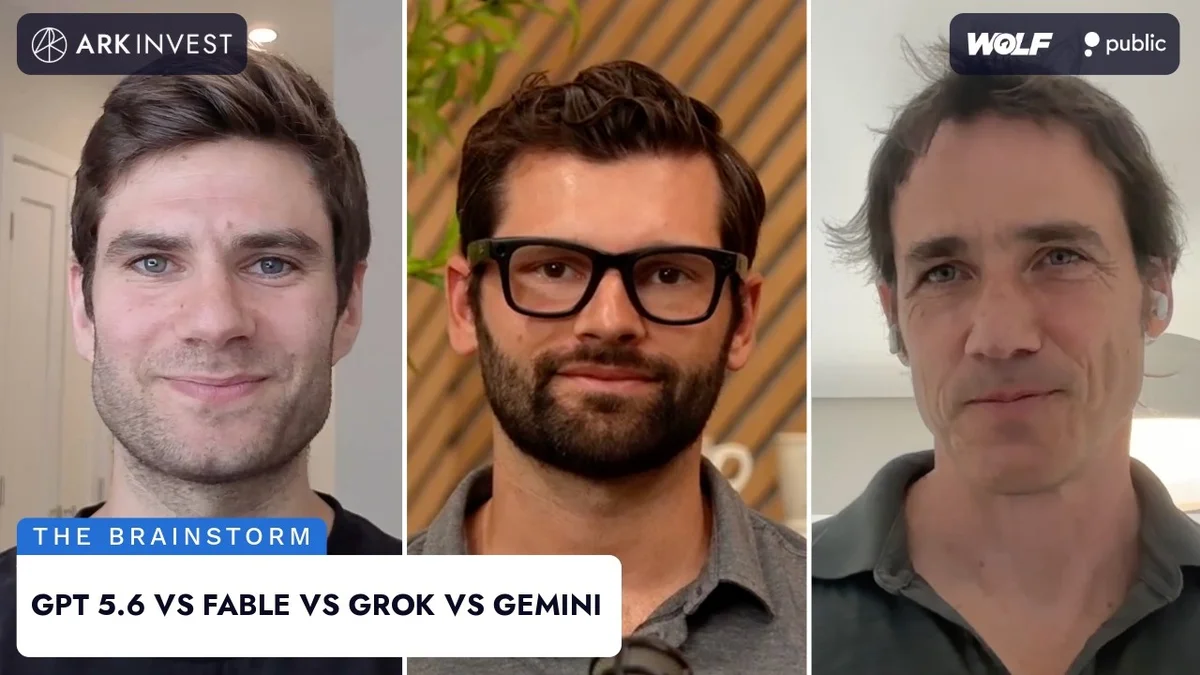
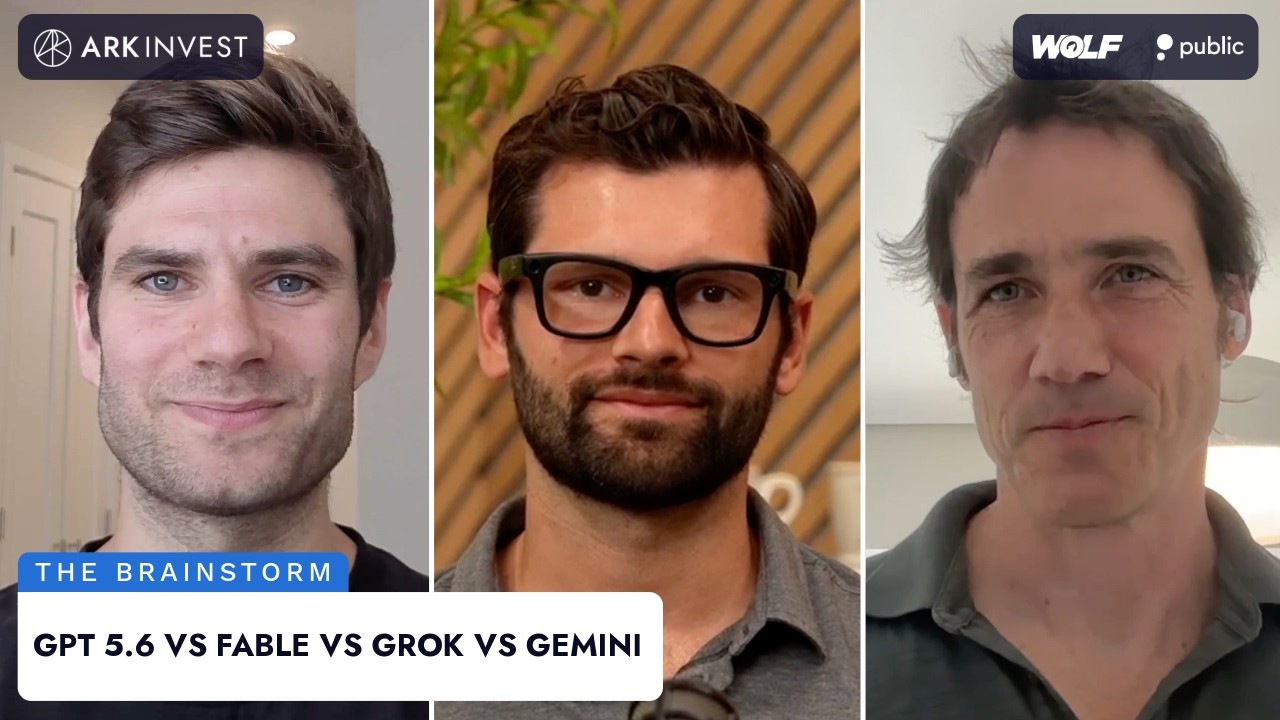
Four panelists appear on screen in a grid format for ARK Invest's 'The Brainstorm' discussion on AI models.
ARK Invest

Visual TL;DR. GPT 5.6 Released drives Cost-Performance Edge. Cost-Performance Edge leads to Market Disruption. New Models Flood contributes to Market Disruption. Open Source Rise increases Market Disruption. Gemini 3.5 Delay impacts New Models Flood. Agentic AI Evolving informs Frontier AI Need. Frontier AI Need shapes Market Disruption.

  1. GPT 5.6 Released: OpenAI's new model offers half the cost for same performance as GPT 5.5 and Fable
  2. Cost-Performance Edge: GPT 5.6 provides higher performance on many benchmarks, making economic sense for users
  3. New Models Flood: a surge of new AI models focusing on efficiency and cost-cutting measures
  4. Open Source Rise: open source models are gaining traction, offering 'good enough' performance for many tasks
  5. Gemini 3.5 Delay: Google's Gemini 3.5 Pro faces delays, impacting its competitive position in the market
  6. Agentic AI Evolving: advances in agentic products and voice capabilities are shaping future AI applications
  7. Frontier AI Need: true need for frontier AI is for 'CEO' level tasks, not just 'line worker' automation
  8. Market Disruption: aggressive cost-cutting and performance improvements are rapidly evolving the AI landscape
Visual TL;DR
Visual TL;DR, startuphub.ai GPT 5.6 Released drives Cost-Performance Edge. Cost-Performance Edge leads to Market Disruption. Open Source Rise increases Market Disruption drives leads to increases GPT 5.6 Released Cost-Performance Edge Open Source Rise Market Disruption From startuphub.ai · The publishers behind this format
Visual TL;DR, startuphub.ai GPT 5.6 Released drives Cost-Performance Edge. Cost-Performance Edge leads to Market Disruption. Open Source Rise increases Market Disruption drives leads to increases GPT 5.6 Released Cost-PerformanceEdge Open Source Rise Market Disruption From startuphub.ai · The publishers behind this format
Visual TL;DR, startuphub.ai GPT 5.6 Released drives Cost-Performance Edge. Cost-Performance Edge leads to Market Disruption. Open Source Rise increases Market Disruption drives leads to increases GPT 5.6 Released OpenAI's new model offers half the costfor same performance as GPT 5.5 and Fable Cost-Performance Edge GPT 5.6 provides higher performance onmany benchmarks, making economic sense forusers Open Source Rise open source models are gaining traction,offering 'good enough' performance formany tasks Market Disruption aggressive cost-cutting and performanceimprovements are rapidly evolving the AIlandscape From startuphub.ai · The publishers behind this format
Visual TL;DR, startuphub.ai GPT 5.6 Released drives Cost-Performance Edge. Cost-Performance Edge leads to Market Disruption. Open Source Rise increases Market Disruption drives leads to increases GPT 5.6 Released OpenAI's new modeloffers half thecost for same… Cost-PerformanceEdge GPT 5.6 provideshigher performanceon many benchmarks,… Open Source Rise open source modelsare gainingtraction, offering… Market Disruption aggressivecost-cutting andperformance… From startuphub.ai · The publishers behind this format
Visual TL;DR, startuphub.ai GPT 5.6 Released drives Cost-Performance Edge. Cost-Performance Edge leads to Market Disruption. New Models Flood contributes to Market Disruption. Open Source Rise increases Market Disruption. Gemini 3.5 Delay impacts New Models Flood. Agentic AI Evolving informs Frontier AI Need. Frontier AI Need shapes Market Disruption drives leads to contributes to increases impacts informs shapes GPT 5.6 Released OpenAI's new model offers half the costfor same performance as GPT 5.5 and Fable Cost-Performance Edge GPT 5.6 provides higher performance onmany benchmarks, making economic sense forusers New Models Flood a surge of new AI models focusing onefficiency and cost-cutting measures Open Source Rise open source models are gaining traction,offering 'good enough' performance formany tasks Gemini 3.5 Delay Google's Gemini 3.5 Pro faces delays,impacting its competitive position in themarket Agentic AI Evolving advances in agentic products and voicecapabilities are shaping future AIapplications Frontier AI Need true need for frontier AI is for 'CEO'level tasks, not just 'line worker'automation Market Disruption aggressive cost-cutting and performanceimprovements are rapidly evolving the AIlandscape From startuphub.ai · The publishers behind this format
Visual TL;DR, startuphub.ai GPT 5.6 Released drives Cost-Performance Edge. Cost-Performance Edge leads to Market Disruption. New Models Flood contributes to Market Disruption. Open Source Rise increases Market Disruption. Gemini 3.5 Delay impacts New Models Flood. Agentic AI Evolving informs Frontier AI Need. Frontier AI Need shapes Market Disruption drives leads to contributes to increases impacts informs shapes GPT 5.6 Released OpenAI's new modeloffers half thecost for same… Cost-PerformanceEdge GPT 5.6 provideshigher performanceon many benchmarks,… New Models Flood a surge of new AImodels focusing onefficiency and… Open Source Rise open source modelsare gainingtraction, offering… Gemini 3.5 Delay Google's Gemini 3.5Pro faces delays,impacting its… Agentic AIEvolving advances in agenticproducts and voicecapabilities are… Frontier AI Need true need forfrontier AI is for'CEO' level tasks,… Market Disruption aggressivecost-cutting andperformance… From startuphub.ai · The publishers behind this format

The AI race is heating up, and the latest "Brainstorm" session from ARK Invest dives deep into the rapidly evolving landscape of large language models. The discussion highlights the aggressive cost-cutting measures and performance improvements being rolled out by major AI players, with a particular focus on OpenAI's latest GPT 5.6 release.

AI Model Wars: GPT 5.6 Undercuts Fable, Open Source Gains - ARK Invest
AI Model Wars: GPT 5.6 Undercuts Fable, Open Source Gains — from ARK Invest

GPT 5.6's Competitive Edge

Brett Winton kicks off the analysis by pointing out that OpenAI's GPT 5.6 is positioned to disrupt the market by offering a significant cost advantage. "GPT 5.6 is um kind of one it's half the cost for the same performance of GPT 5.5 and two it offers I mean at least also half the cost for the same performance as as Fable the Anthropics reputed best-in-class model," Winton states. He adds that GPT 5.6 also offers higher performance on many benchmarks, signaling a clear catch-up and surpassing move by OpenAI, especially as economic considerations become paramount for users.
A Flood of New Models and the Focus on Efficiency

Frank Downing elaborates on the recent surge of model releases, noting that "all the major uh like five top US AI companies have all released models in the last month and a half." He mentions Google's Gemini 3.5 Flash, Meta's improved and lower-cost model, and xAI's Grok 4.5. Downing emphasizes the current market's focus on efficiency, suggesting that companies are strategically optimizing for cost-effectiveness. He also raises questions about Anthropic's pricing strategy, wondering if their higher costs are due to a premium for superior performance or simply a higher margin.

Evolving Agentic Products and Voice Capabilities

The conversation shifts to the evolution of AI products beyond raw language models. Downing highlights Anthropic's Claude Co-work for web and mobile, making it more accessible for enterprise users, and OpenAI's launch of ChatGPT Work, which integrates a Codex-powered agent into its services. He also praises the new ChatGPT voice capability, noting its full-duplex nature and ability to delegate thinking to underlying models, resulting in more coherent and less fabricated responses. "It sounds and acts now like a frontier intelligence," Downing remarks.

The Gemini 3.5 Pro Delay and Benchmark Comparisons

Downing then presents a chart comparing the performance and cost of various frontier models. He notes that Google's Gemini 3.5 Pro, expected to compete with models like Fable and GPT 5.6, has been delayed. He speculates that Google is refining the model based on recent competitor launches. The chart reveals that while OpenAI and Anthropic still lead in overall intelligence, other players like Meta are closing the gap, even surpassing Google on certain benchmarks. However, Downing cautions that these benchmarks are "relatively one-dimensional and don't represent the real-world utility of these models in as compelling of a way as you'd want them to."

The Rise of Open Source and the "Good Enough" Question

Nick Groux introduces a critical counterpoint, questioning the necessity of frontier models for many tasks and highlighting the growing influence of open-source AI. He points to the dominance of Chinese models in open-source usage statistics, with companies like Tencent, Xiaomi, and Deepseek leading the charge. Groux also brings up the "reverse information paradox," where users pay for intelligence not just through token consumption but also by potentially giving up proprietary knowledge to frontier labs. He suggests that hyperscalers might offer a solution by providing privacy protections and abstracting away the underlying models.

The "CEO vs. Line Worker" Analogy and the True Need for Frontier AI

The discussion delves into the economic implications, with Groux drawing an analogy between CEOs and line workers to explain the market positioning of frontier models versus open-source alternatives. He argues that frontier models are positioning themselves as the highly compensated CEOs, while open-source models fill the role of interchangeable line workers. The panel then debates the actual need for frontier models in today's knowledge work, with a general consensus that many tasks do not yet require the absolute peak performance, but the competitive landscape is pushing for it.

Agentic Capabilities and Future Directions

The conversation circles back to agentic capabilities, with the consensus that while AI agents can assist, they are still in their infancy and not yet capable of fully autonomous task completion. The risk of a "70% success rate" is highlighted, as the 30% failure rate can be detrimental. The panel concludes by discussing OpenAI's strategy of offering a broad spectrum of models at various price points, suggesting a future where users can intelligently route tasks based on speed and performance needs. The race for market share and investment opportunity is clearly on, with efficiency and product differentiation being key drivers.

© 2026 StartupHub.ai. All rights reserved. Do not enter, scrape, copy, reproduce, or republish this article in whole or in part. Use as input to AI training, fine-tuning, retrieval-augmented generation, or any machine-learning system is prohibited without written license. Substantially-similar derivative works will be pursued to the fullest extent of applicable copyright, database, and computer-misuse laws. See our terms.