

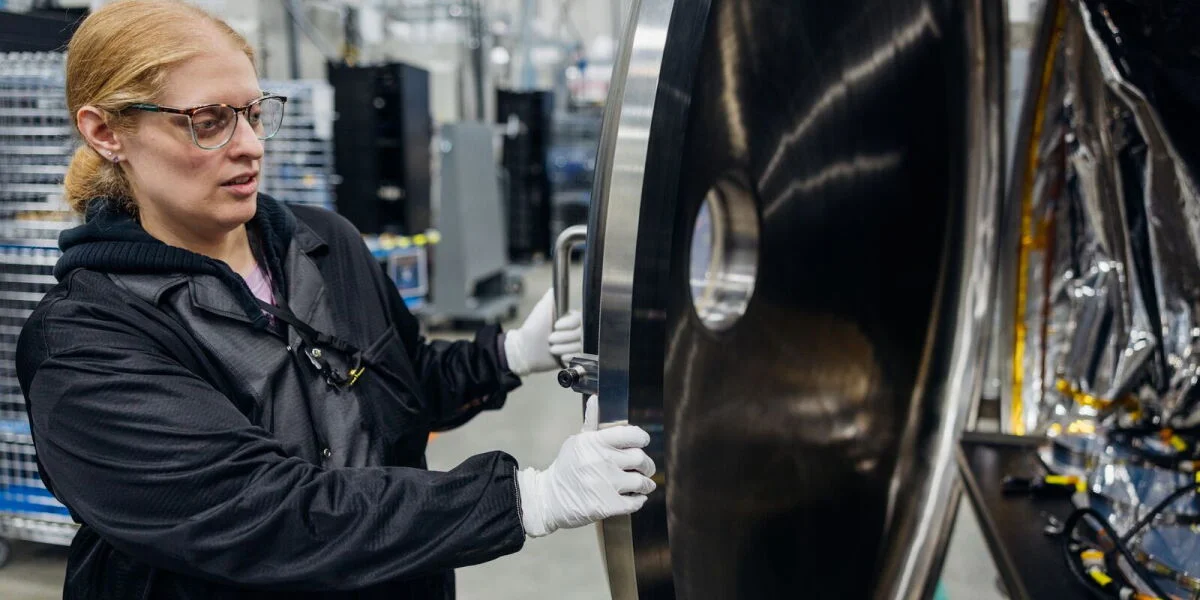
Amazon's Career Choice Builds Space Technicians

Amazon's Career Choice program transforms hourly workers into satellite technicians, fueling the company's ambitious Amazon Leo internet constellation.

7 min read
Amazon employees Nadine Finegold and Jessica Hubbell watch a rocket launch from Cape Canaveral.
Amazon News
Visual TL;DR
Amazon Career ChoiceCore
prepaid tuition benefit supports 300,000+ employees globally in new career paths
From the article 6 mentionsAmazon (NASDAQ:AMZN) is cultivating its own pipeline of aerospace talent through its Career Choice program, transforming fulfillment center workers into satellite technicians.
Hourly Workers TrainedEffect
transforms fulfillment center workers into skilled satellite technicians for aerospace roles
Build Satellite ConstellationEffect
employees like Finegold and Hubbell assemble solar panels for Amazon Leo satellites
From the article 3 mentionsThe initiative, detailed by Amazon News, showcases how the e-commerce giant is investing in workforce development to meet the burgeoning demands of its Amazon Leo satellite internet constellation.
Amazon Leo LaunchedOutcome
satellites built by these technicians launched into low Earth orbit from Cape Canaveral
From the article 6 mentionsFinegold, who started at Amazon in 2018 stowing packages, now assembles solar panels for Amazon Leo satellites.
Bridge Skills GapDriver
cultivates Amazon's own pipeline of aerospace talent to meet industry demands
From the article 2 mentionsKarin Hoffman, founder and CEO of Key Innovative Solutions, which partners with employers to connect them with training programs, highlighted that the real workforce gap lies in hands-on skills.
Amazon Career ChoiceCore
prepaid tuition benefit supports 300,000+ employees globally in new career paths
From the article 6 mentionsAmazon (NASDAQ:AMZN) is cultivating its own pipeline of aerospace talent through its Career Choice program, transforming fulfillment center workers into satellite technicians.
Hourly Workers TrainedEffect
transforms fulfillment center workers into skilled satellite technicians for aerospace roles
Workforce DevelopmentContext
e-commerce giant invests in workforce development to meet burgeoning demands
From the article 7 mentionsThe development of satellite internet, a sector that has seen significant investment and competition, is directly tied to the availability of this specialized workforce.
Build Satellite ConstellationEffect
employees like Finegold and Hubbell assemble solar panels for Amazon Leo satellites
From the article 3 mentionsThe initiative, detailed by Amazon News, showcases how the e-commerce giant is investing in workforce development to meet the burgeoning demands of its Amazon Leo satellite internet constellation.
Amazon Leo LaunchedOutcome
satellites built by these technicians launched into low Earth orbit from Cape Canaveral
From the article 6 mentionsFinegold, who started at Amazon in 2018 stowing packages, now assembles solar panels for Amazon Leo satellites.
Internet for UnderservedOutcome
From the article 4 mentionsFor Finegold and Hubbell, this meant moving from packing boxes to precision assembly for a project aiming to bring internet access to underserved areas.
Contents(3)

Amazon (NASDAQ:AMZN) is cultivating its own pipeline of aerospace talent through its Career Choice program, transforming fulfillment center workers into satellite technicians. Two employees, Nadine Finegold and Jessica Hubbell, recently witnessed the fruits of their labor firsthand as satellites they helped build launched into low Earth orbit from Cape Canaveral.

The initiative, detailed by Amazon News, showcases how the e-commerce giant is investing in workforce development to meet the burgeoning demands of its Amazon Leo satellite internet constellation. Career Choice, a prepaid tuition benefit, has supported over 300,000 employees globally in pursuing new educational and career paths. For Finegold and Hubbell, this meant moving from packing boxes to precision assembly for a project aiming to bring internet access to underserved areas.

From Warehouses to Orbit

Finegold, who started at Amazon in 2018 stowing packages, now assembles solar panels for Amazon Leo satellites. Hubbell, initially a box packer in Colorado, now tests critical satellite components in a space simulation lab. Both women credit Career Choice and a specialized partnership with Lake Washington Institute of Technology (LWTech) for their career pivot.

The six-month LWTech program covers aerospace assembly, electronics manufacturing, and avionics wiring. Amazon fully funded their tuition and provided necessary resources. "Amazon paid for all of it and gave me a leg up," Finegold stated. "Career Choice was my golden ticket." Hubbell added, "Amazon covered my courses and paid the school directly. I didn't even have to worry about any of that." StartupHub.ai data shows Amazon with a score of 81/100, indicating strong market presence, while Hubbell's individual score is 20/100, reflecting her personal career growth trajectory.

Bridging the Space Industry Skills Gap

Amazon's investment in its space division, Amazon Leo, extends beyond employee training. The company has poured over $200 million into infrastructure at Cape Canaveral. However, the rapid expansion of the commercial space sector, including projects like Amazon Leo's goal of connecting billions globally, faces a significant bottleneck: a shortage of skilled technicians. Brian Huseman, Amazon's vice president of public policy and community engagement, noted that the biggest needs are in technical roles, not just theoretical engineering. "The reality is that our biggest workforce needs are in skilled technical roles, precision assembly, testing, electrical, logistics," Huseman said.

This approach is becoming a model for the broader industry. Karin Hoffman, founder and CEO of Key Innovative Solutions, which partners with employers to connect them with training programs, highlighted that the real workforce gap lies in hands-on skills. Companies like Amazon are instrumental in identifying these needs and collaborating with educational institutions to create relevant certification programs. LWTech, for instance, tailors its curriculum to industry demands, ensuring graduates are job-ready. While Amazon itself is a dominant player with verified financials showing it raised $10 billion in 2025, its efforts in workforce development also position it favorably against competitors like Walmart (score 41/100) and Coupang (score 49/100) in attracting and retaining specialized talent.

Why This Matters

The successful launch and the stories of Finegold and Hubbell underscore a critical trend: the democratization of high-tech careers, particularly within the rapidly growing space sector. Amazon Leo's mission to provide global internet access relies on a physical infrastructure built by skilled hands, not just brilliant minds. Programs like Career Choice are essential for companies seeking to scale quickly, especially in industries with specialized labor demands. This model offers a blueprint for other enterprises looking to build internal talent pools for emerging technologies, moving beyond traditional hiring and focusing on upskilling existing workforces. It also signifies a shift in the perception of space jobs, broadening the definition beyond astronauts and engineers to include the vital technicians who make space missions a reality. The development of satellite internet, a sector that has seen significant investment and competition, is directly tied to the availability of this specialized workforce.

For the AI and startup industry, this highlights the increasing intersection of physical infrastructure and digital services. As AI becomes more integrated into complex systems, the need for technicians who can build, maintain, and operate that infrastructure, from data centers to satellite manufacturing facilities, will only grow. Companies that can effectively bridge this gap through innovative workforce development programs will likely gain a significant competitive advantage.

Finegold and Hubbell's journey from Amazon fulfillment associates to satellite builders is more than a personal success story; it's a glimpse into the future of work in high-growth industries. As Amazon Leo's constellation expands, so too will the opportunities for individuals to transition into these vital roles, building the infrastructure that connects the world.

© 2026 StartupHub.ai. All rights reserved. Do not enter, scrape, copy, reproduce, or republish this article in whole or in part. Use as input to AI training, fine-tuning, retrieval-augmented generation, or any machine-learning system is prohibited without written license. Substantially-similar derivative works will be pursued to the fullest extent of applicable copyright, database, and computer-misuse laws. See our terms.