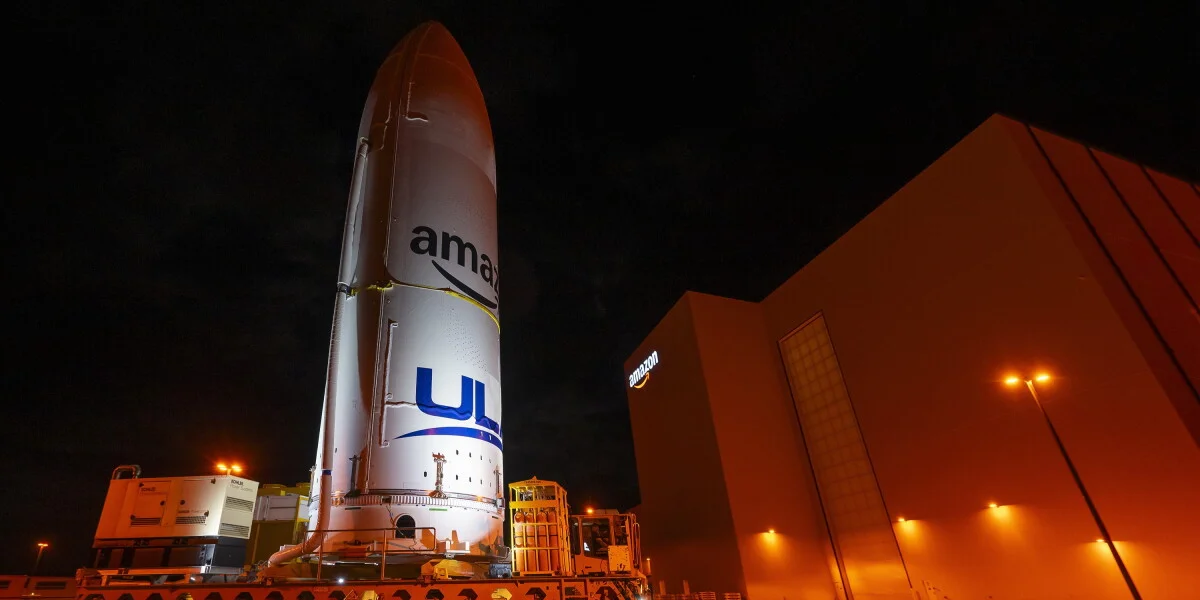
Amazon Leo is done trickling satellites into orbit. Amazon Leo says its first Vulcan mission, LV-01, will carry 40 satellites to low Earth orbit, targeting liftoff November 13 from SLC-41 at Cape Canaveral, according to the company.
I read that as the real start of the constellation race.
Vulcan will launch more than 1,500 first-generation Leo satellites across 38 missions, more than any other rocket in the program, the company said. Melissa Wuerl, director of launch systems for Amazon Leo, said larger rockets and more frequent launches are critical to scaling the constellation and getting service to customers. She called Vulcan the primary workhorse for the next several years, set to launch close to half the first-generation fleet.
The hardware matters here. LV-01 is the first Vulcan to fly a shorter, optimized Centaur V upper stage and the first to fly in the six-booster configuration, according to the company. Amazon funded a dedicated Vertical Integration Facility, VIF-A, plus a new mobile launch platform at Cape Canaveral. LV-02 is already in prep in VIF-G and could launch within weeks of a nominal LV-01, the company said.
Production finally supports that pace. Amazon completed its 1,000th satellite in early September, the company said, with hundreds of flight-ready spacecraft now waiting for rides. The plan is to double the annual launch rate ahead of initial service rollout later this year, the company said, with the next Ariane 6 flight, LE-04, targeting no earlier than November 23 from Kourou.
The difference between Leo and Starlink right now is scale, not design. Starlink has 9,800-plus active satellites and OneWeb has 650-plus, while Amazon flew 11 deployment launches in its first year on Atlas V and Falcon 9, per Orbital Radar tracking. Leo compared to Starlink also looks more regional at first, with a three-shell design at 590, 610 and 630 km optimized for latitudes between 30 and 56 degrees, per Orbital Radar. So which is better depends on where you sit. Starlink wins on live coverage today. Leo is betting bulk launch closes that gap fast.
The fair pushback is that bulk does not equal cadence yet. ULA still has to prove it can stack, roll and fly two Vulcans in weeks, and Amazon has more than 100 missions left to fly, the company said. That skepticism is warranted after a year of roughly monthly launches.
Still, this claim survives it. A 40-satellite debut on a heavy with a twin already in flow is a production system, not a test campaign.
If you are building on satellite broadband, price Leo on availability in your latitude, not on promises.